The appointment of judges to India’s constitutional courts is one of the few processes in a functioning democracy where the institution being staffed also selects its own members. This is the Collegium system — a mechanism with no textual basis in the Constitution of India, born instead out of three judgments of the Supreme Court delivered between 1981 and 1998. Nearly three decades since it took its present form, the Collegium remains central to debates on judicial independence, accountability, and transparency, and is a recurring theme in the UPSC syllabus under Polity and Governance (judiciary, appointment of judges, and separation of powers).
Constitutional Provisions: The Starting Point
The Constitution itself says nothing about a “Collegium.” Article 124(2) provides that judges of the Supreme Court are appointed by the President “after consultation with such of the Judges of the Supreme Court and of the High Courts… as the President may deem necessary,” and mandates that the Chief Justice of India (CJI) be consulted in appointments other than that of the CJI himself. Article 217 lays down a parallel process for High Court judges, requiring consultation with the Governor of the State, the CJI, and the Chief Justice of the High Court concerned. Article 222 deals with the transfer of judges between High Courts.
Key IdeaThe word actually used in the constitutional text is “consultation,” not “concurrence.” The entire history of the Collegium system is, in essence, the story of the judiciary reinterpreting “consultation” to mean something closer to a binding “concurrence,” progressively shifting the balance of power from the Executive to the CJI and a body of senior judges.
The Three Judges Cases: Origins of the Collegium
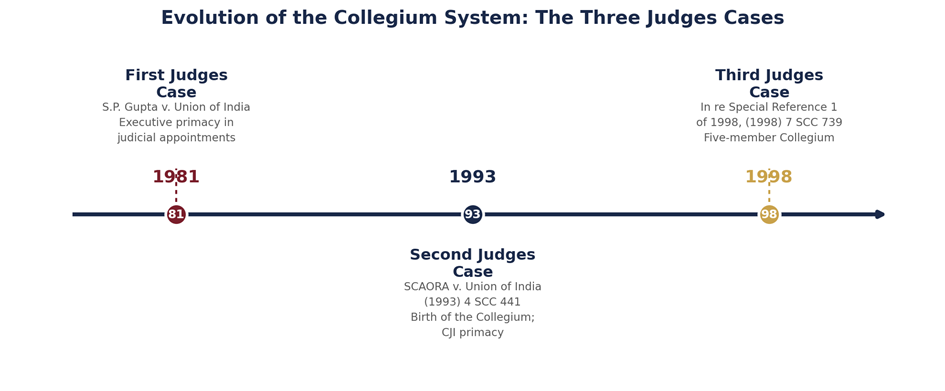
First Judges Case — S.P. Gupta v. Union of India (1981)
Also known as the “Judges’ Transfer Case,” this seven-judge bench ruling held that “consultation” under Articles 124 and 217 did not mean “concurrence,” and that the President (in effect, the Executive, acting through the Council of Ministers) was not bound by the advice of the constitutional functionaries consulted, including the CJI. This gave primacy to the Executive in matters of judicial appointment and transfer, and preserved the government’s dominant role for over a decade.
Second Judges Case — Supreme Court Advocates-on-Record Association v. Union of India (1993) 4 SCC 441
A nine-judge bench reversed the position taken in 1981. It held that “consultation” effectively meant “concurrence,” and that the CJI’s recommendation on judicial appointments would have primacy, subject to the CJI forming his opinion collectively — in consultation with his two senior-most colleagues on the Supreme Court, rather than as an individual. This judgment is the actual birth of the “Collegium” as an institution, even though the term itself gained currency only later. The rationale was rooted in the doctrine of judicial independence as a facet of the basic structure of the Constitution: the Court reasoned that unchecked executive discretion in appointments posed a risk to the separation of powers and to the judiciary’s independence from the political executive.
Third Judges Case — In re Special Reference 1 of 1998, (1998) 7 SCC 739
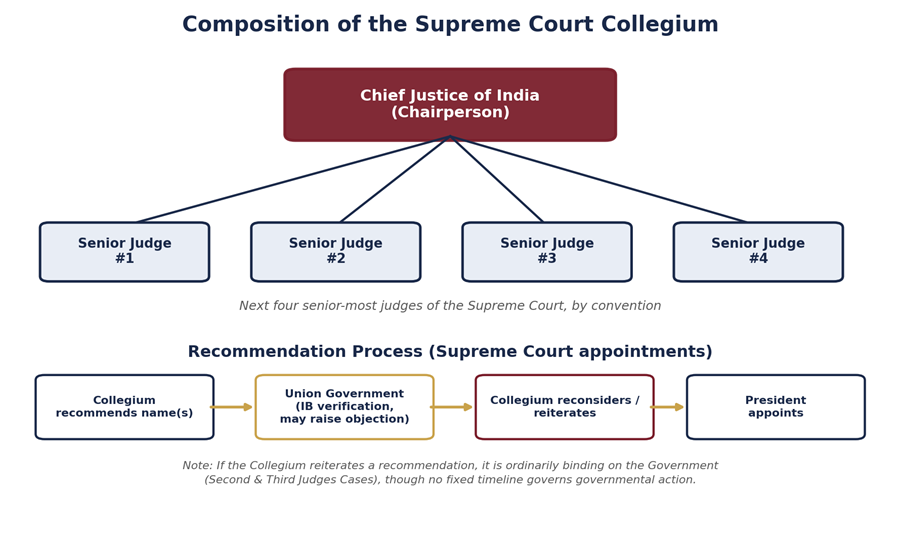
President K.R. Narayanan, exercising the advisory jurisdiction power under Article 143, referred nine questions to the Supreme Court seeking clarification on the “consultation” process laid down in 1993. A nine-judge bench responded with an advisory opinion (not a “case” in the conventional adversarial sense) that expanded the Collegium from the CJI-plus-two format to its present composition: the CJI and the four senior-most judges of the Supreme Court for appointments to the Supreme Court itself. For High Court appointments, the Collegium comprises the CJI and two senior-most Supreme Court judges, along with inputs from the senior judges of the High Court concerned and the state government. This 1998 opinion gave the Collegium system its current institutional shape.
How the Collegium Works Today
Supreme Court appointments: The CJI and the four senior-most judges of the Supreme Court recommend names to the Union Government, which conducts an Intelligence Bureau (IB) verification and can raise objections or seek reconsideration, but if the Collegium reiterates its recommendation, it is ordinarily binding on the government (a principle reaffirmed in the Third Judges Case).
High Court appointments: The Chief Justice of the High Court, in consultation with two senior colleagues, initiates proposals, which pass through the state government, the Supreme Court Collegium, and finally the Union Government before being sent to the President.
Memorandum of Procedure (MoP): A set of guidelines, evolved after the Second and Third Judges Cases, that lays down the procedural steps for appointments and transfers. Attempts to finalise a revised MoP incorporating greater transparency and eligibility criteria have remained inconclusive for years, which is itself a recurring criticism.
The NJAC Interlude (2014–2015)
In an attempt to replace the Collegium with a broader-based body, Parliament passed the Constitution (Ninety-Ninth Amendment) Act, 2014 and the National Judicial Appointments Commission (NJAC) Act, 2014. The NJAC was to comprise the CJI, two senior Supreme Court judges, the Union Law Minister, and two eminent persons selected by a committee including the Prime Minister and the Leader of the Opposition. In Supreme Court Advocates-on-Record Association v. Union of India (2015), a five-judge Constitution Bench struck down both the Constitutional Amendment and the NJAC Act as unconstitutional, holding them violative of the basic structure doctrine on the ground that they compromised judicial independence by giving the political executive a substantive role in appointments. This restored the Collegium system, which continues to operate to this day.
Advantages and Disadvantages
Advantages of the Collegium System
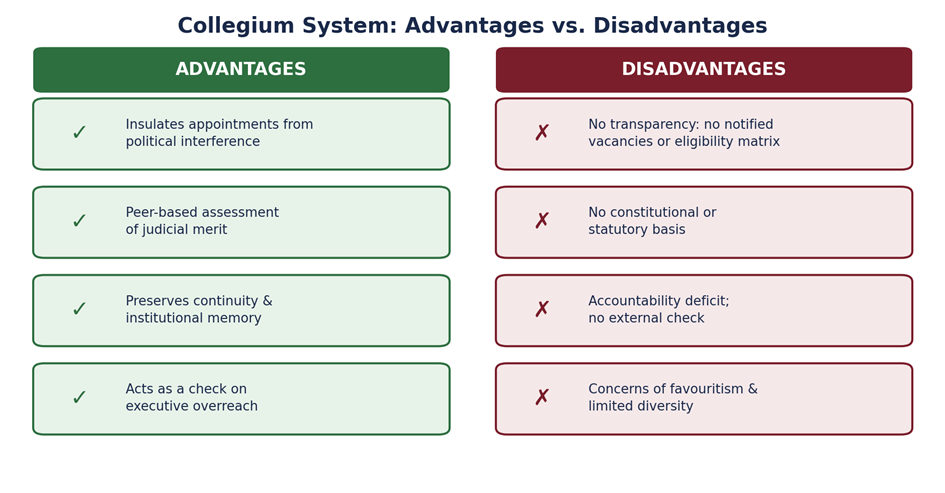
Insulation from political interference: By keeping the Executive’s role largely consultative rather than determinative, the system seeks to prevent the ruling government of the day from packing courts with ideologically convenient appointees, thereby protecting judicial independence — a core element of the basic structure.
Peer-based assessment of merit: Sitting judges are arguably best placed to assess the legal acumen, integrity, and judicial temperament of candidates from the bar or subordinate judiciary, drawing on first-hand knowledge of their conduct in court.
Continuity and institutional memory: Because the same institution nurtures and elevates judges, the system aims to preserve consistency in judicial standards and institutional culture across generations of judges.
A check against executive overreach: The doctrine emerged in an era (post-Emergency) marked by memories of “committed judiciary” rhetoric and mass transfers of judges seen as inconvenient to the government. The Collegium was in part a judicial response to that history.
Disadvantages and Criticisms
Absence of transparency: There is no public notification of vacancies, no published eligibility matrix, and no disclosed methodology for evaluating candidates. Recommendations and rejections are rarely accompanied by reasons, making the process opaque to litigants, the bar, and the public alike.
No constitutional or statutory basis: The Collegium is entirely a judicial creation. Critics argue that a body wielding such significant power over a coordinate constitutional institution ought to derive its authority and procedure from a clearly codified constitutional or statutory source rather than evolving interpretation.
Accountability deficit: Unlike appointments to most other high constitutional offices, there is no external check on the Collegium’s decisions. The “judges appointing judges” structure has been described as unique among major constitutional democracies, most of which involve the executive, legislature, or independent commissions in some form.
Allegations of favouritism and lack of diversity: Concerns have periodically been raised — including by former judges — about “uncle-judge syndrome,” dominance of a few families and law schools, and inadequate representation of women, marginalised communities, and lawyers from smaller Bar associations or subordinate judiciary.
Delays and government-Collegium friction: The absence of fixed timelines for the government to act on Collegium recommendations has led to prolonged vacancies in the Supreme Court and High Courts, and to a pattern of the government sitting on reiterated names — a practice that strains the “binding” nature the Third Judges Case sought to establish, since the Constitution does not prescribe any timeframe for governmental action.
No firm, published seniority or eligibility criteria: While seniority is a significant factor for Supreme Court elevation, it is not the sole or a rigidly codified criterion, leading to perceptions of inconsistency in how candidates are shortlisted.
The pending MoP: Repeated rounds of negotiation between the Collegium and the government over a revised Memorandum of Procedure — meant to introduce eligibility criteria, a permanent secretariat, and grounds for rejection — have not concluded, leaving the process to run on informal convention.
Way Forward: Reform Without Compromising Independence
Most serious reform proposals do not seek a return to executive primacy (which the 2015 NJAC judgment rejected as a threat to basic structure) but rather ask for internal reform of the Collegium itself:
Finalising and publishing the Memorandum of Procedure, including clear eligibility criteria and reasons for supersession or rejection.
A permanent secretariat to process recommendations, handle documentation, and maintain records, reducing ad hoc delays.
Timelines for governmental action on Collegium recommendations, to prevent indefinite deferral once a name is reiterated.
Publication of resolutions and reasons, a practice the Supreme Court itself began intermittently after 2017 by placing some Collegium resolutions on its website, though this has been inconsistent and often omits reasoning.
Diversity audits, to ensure fairer representation of women, Scheduled Castes/Scheduled Tribes/Other Backward Classes, minorities, and the district judiciary in higher judicial appointments.
Conclusion
The Collegium system represents a distinctive Indian constitutional innovation — an attempt to safeguard judicial independence by removing appointments almost entirely from executive control. Its origins in the Three Judges Cases reflect a judiciary responding to a specific historical anxiety about executive interference. Yet the very features that insulate it from political control — self-selection, absence of codified criteria, and lack of a formal accountability mechanism — have also made it, in the words of many constitutional commentators, one of the least transparent methods of judicial appointment among major democracies. For UPSC aspirants, the Collegium is best understood not as a settled institution but as a site of continuing tension between two constitutional values that are both legitimate but frequently in conflict: judicial independence and institutional accountability. The way forward likely lies not in abandoning judicial primacy (which the courts have tied to the basic structure) but in making the exercise of that primacy more transparent, criteria-based, and answerable to constitutional expectations of fairness.
Quick Reference Table
Case
Year
Citation
Key Holding
First Judges Case (S.P. Gupta v. Union of India)
1981
AIR 1982 SC 149
Executive has primacy; “consultation” ≠ “concurrence”
Second Judges Case (SCAORA v. Union of India)
1993
(1993) 4 SCC 441
“Consultation” = “concurrence”; birth of the Collegium (CJI + 2 senior judges)
Third Judges Case (In re Special Reference 1 of 1998)
1998
(1998) 7 SCC 739
Expanded Collegium to CJI + 4 senior-most judges (5-member body)
NJAC Case (SCAORA v. Union of India)
2015
(2016) 5 SCC 1
Struck down the 99th Amendment and NJAC Act; restored the Collegium
★ Why this topic matters for UPSC One of the most tested laws in GS-II (governance/social justice) and GS-III (labour reforms, economy).Prelims frequently tests definitions (industry, workman, industrial dispute), thresholds and landmark cases.Mains asks about the transition from the four labour codes and the trade-off between worker protection and ease of doing business.
1. Quick Facts on the Industrial Disputes Act, 1947
Attribute
Detail
Enacted
11 March 1947; came into force 1 April 1947
Extent
Whole of India
Type of law
Central legislation (Concurrent List – Entry 22, List III)
Successor law
Industrial Relations Code, 2020 (in force from 21 November 2025)
Nodal ministry
Ministry of Labour and Employment
Core purpose
Investigation and settlement of industrial disputes
2. What the Industrial Disputes Act, 1947 Was Designed To Do
The Act was enacted in the backdrop of post-War industrial unrest to provide a permanent, statutory machinery for peaceful resolution of conflicts between capital and labour. Its objectives are:
Investigation & settlement – Provide a structured mechanism (works committees, conciliation, adjudication) for prevention and settlement of industrial disputes.
Industrial peace – Prevent illegal strikes and lockouts, and regulate legal ones through notice and cooling-off requirements.
Worker protection – Provide compensation to workers for lay-off, retrenchment and closure, so that the burden of business fluctuations is not borne by labour alone.
Codify worker rights – Statutorily recognise concepts like continuous service, unfair labour practices and victimisation to protect workmen from arbitrary employer action.
Economic development – Ensure a stable industrial climate necessary for post-Independence economic planning and growth.
3. The Five-Tier Dispute Resolution Machinery
The Act sets up a graded, five-tier machinery moving from voluntary/bipartite mechanisms to compulsory adjudication:
1
Works Committee (Section 3) Mandatory in establishments with 100+ workmen (in the preceding 12 months); equal representation of employer & workmen; aims to promote amity and resolve minor day-to-day frictions before they escalate.
2
Conciliation Officer (Section 4) Appointed by appropriate government for a specified area/industry; mediates and promotes settlement; duty is mandatory in disputes relating to public utility services.
3
Board of Conciliation (Section 5) An ad hoc body constituted for a specific dispute; used where a dispute is of a complex or wider nature than a single conciliation officer can handle.
4
Court of Inquiry (Section 6) Constituted to inquire into any matter connected with or relevant to an industrial dispute; not an adjudicatory body – only submits a fact-finding report within 6 months.
5
Labour Court / Industrial Tribunal / National Tribunal (Sections 7, 7A, 7B) The adjudicatory wing. Labour Courts decide matters in the Second Schedule (e.g. legality of an order, discharge/dismissal); Industrial Tribunals decide Second & Third Schedule matters (e.g. wages, bonus, retrenchment); National Tribunals are constituted by the Centre for disputes of national importance affecting more than one State.
★ Exam Alert Only the Labour Court/Tribunal/National Tribunal tier is adjudicatory (binding award); Works Committee, Conciliation Officer, Board of Conciliation and Court of Inquiry are all non-adjudicatory/facilitative.A Court of Inquiry submits a report, not an award or verdict.
4. Definition of “Industrial Dispute” Under Section 2(k)
Section 2(k) defines an industrial dispute as “any dispute or difference between employers and employers, or between employers and workmen, or between workmen and workmen, which is connected with the employment or non-employment or the terms of employment or with the conditions of labour, of any person.”
Three categories of parties recognised – Employer–Employer, Employer–Workmen, and Workmen–Workmen.
Scope – The dispute must relate to employment/non-employment, terms of employment, or conditions of labour – courts have read in a requirement that the workman raising the dispute (or on whose behalf it is raised) must have a direct or substantial interest in it (community of interest test, laid down in Workmen of Dimakuchi Tea Estate v. Management, 1958).
Individual vs. collective – An individual dispute is ordinarily not an ‘industrial dispute’ unless it is sponsored/espoused by a union or a substantial number of workmen – though Section 2A creates a statutory exception, deeming disputes relating to an individual workman’s discharge, dismissal, retrenchment or termination to be an industrial dispute even without union support.
5. Strikes and Lockouts: The Right and Its Limits
Aspect
Strike [Section 2(q)]
Lockout [Section 2(l)]
Initiated by
Workmen
Employer
Meaning
Cessation of work by a body of persons acting in combination, or concerted/common refusal to continue work
Closing of a place of employment, or suspension of work, or refusal by employer to continue to employ workmen
Objective
Press worker demands
Counter-pressure tactic / defensive measure by management
Public utility services (Section 22) – At least 6 weeks’ notice before striking/locking out; strike must not commence within 14 days of giving notice, before the date of strike specified in the notice, or during the pendency of conciliation proceedings and 7 days after their conclusion.
General prohibition (Section 23) – Strikes/lockouts are prohibited during the pendency of conciliation proceedings before a Board, arbitration proceedings, or adjudication proceedings before a Labour Court/Tribunal/National Tribunal (and for 2 months after conclusion of proceedings before the latter), and during the operation of a settlement/award in respect of matters covered by it.
Illegal strikes/lockouts – A strike/lockout that contravenes Section 22 or 23 is illegal (Section 24). Section 25 prohibits financial aid to illegal strikes/lockouts; Sections 26–31 prescribe penalties.
Section 10(3) power – On referring a dispute for adjudication, the appropriate government may by order prohibit the continuance of any strike/lockout in connection with the dispute.
6. Lay-off: Section 2(kkk) and Sections 25A to 25E
Lay-off means the failure, refusal or inability of an employer to give employment to a workman whose name is on the muster roll, on account of shortage of coal, power or raw materials, accumulation of stocks, breakdown of machinery, natural calamity, or any other connected reason [Section 2(kkk)].
Applicability – Chapter VA (Sections 25A–25E) applies to non-seasonal industrial establishments employing 50 or more workmen (but excludes establishments covered by Chapter VB, i.e., 100 or more workmen, where prior government permission is additionally required under Section 25M).
Compensation (Section 25C) – A laid-off workman (other than a badli/casual workman) is entitled to compensation equal to 50% of the total of basic wages and dearness allowance for the period of lay-off, subject to a ceiling of 45 days in a year in most cases.
Eligibility – A workman must have completed at least one year of continuous service to claim lay-off compensation (Section 25B defines ‘continuous service’, including deemed continuous service based on days actually worked).
Establishments with 100+ workmen – Chapter VB (Sections 25K–25S) mandates prior permission of the appropriate government before laying off workmen in establishments employing 100 or more workmen (raised to 300 under many State amendments and under the Industrial Relations Code, 2020).
7. Retrenchment: Section 25F and the “Last Come, First Go” Rule
Retrenchment [Section 2(oo)] means the termination of a workman’s service by the employer for any reason whatsoever, other than as a punishment by way of disciplinary action. It excludes voluntary retirement, retirement on reaching the age of superannuation, non-renewal of a contract on its expiry, and termination on grounds of continued ill-health.
Conditions precedent to retrenchment – Section 25F
One month’s written notice (or wages in lieu of notice) stating the reasons for retrenchment.
Retrenchment compensation at 15 days’ average pay for every completed year of continuous service (or any part thereof in excess of six months).
Notice served on the appropriate government (or prescribed authority) in the prescribed manner.
Section 25G – “Last come, first go”
In the absence of any agreement between employer and workman, the employer must ordinarily retrench the workman who was the last person employed in that particular category, unless the employer records reasons for retrenching any other workman. This is a procedural safeguard against arbitrary/discriminatory retrenchment.
Section 25H – Re-employment – Section 25H requires the employer to give retrenched workmen an opportunity of re-employment in preference to other persons, if the employer proposes to take on more workmen.
Chapter VB overlay – Establishments employing 100 (or, under later amendments/the 2020 Code, 300) or more workmen require prior permission of the appropriate government before retrenching, under Chapter VB (Section 25N).
8. Closure: Section 25-O and Government Permission
Closure refers to the permanent closing down of a place of employment or part thereof.
Section 25FFA – For establishments not covered by Chapter VB, the employer must serve 60 days’ notice before closure and pay compensation as if the workmen had been retrenched.
Section 25-O – Establishments employing 100 or more workmen must apply for prior permission of the appropriate government at least 90 days before the intended date of closure; if permission is neither granted nor refused within 60 days, it is deemed to have been granted.
Excel Wear case – Excel Wear v. Union of India (1978) struck down the original absolute prohibition on closure (introduced by the 1976 amendment) as violative of the fundamental right to close a business under Article 19(1)(g); Parliament responded in 1982 by substituting it with the current permission-based regime under Section 25-O.
Consequence of illegal closure – If closure takes place without permission (or after refusal), it is deemed illegal and workmen are entitled to full wages; Section 25P allows the government to direct that an undertaking not be closed if closure is not justified.
9. Landmark Judgments Under the Industrial Disputes Act, 1947
Case
Key Holding
D.N. Banerji v. P.R. Mukherjee (1953)
A municipality carrying on activities analogous to trade/business (e.g. running a conservancy department) can be an ‘industry’ – laid the foundation for an expansive reading of Section 2(j).
State of Bombay v. Hospital Mazdoor Sabha (1960)
Held a hospital run by the government to be an ‘industry’; emphasised organised employer-employee cooperation over profit motive.
Workmen of Dimakuchi Tea Estate v. Management (1958)
For a dispute to be an ‘industrial dispute’ under Section 2(k), the person on whose behalf it is raised must have a direct/substantial interest in the employer-employee relationship (‘community of interest’ test).
Bangalore Water Supply & Sewerage Board v. A. Rajappa (1978)
Seven-judge Bench laid down the expansive ‘Triple Test’ for ‘industry’ (see dedicated section below).
Excel Wear v. Union of India (1978)
Struck down the blanket ban on closure as unconstitutional; led to the permission-based Section 25-O regime.
Workmen of Firestone Tyre & Rubber Co. v. Management (1973)
Clarified principles for computing retrenchment compensation and continuity of service.
State of U.P. v. Jai Bir Singh (2026) – 9-Judge Bench
Reconsidered but substantially retained the Rajappa Triple Test; clarified its prospective, non-retroactive application (see final section).
10. Unfair Labour Practices and the Fifth Schedule
Section 2(ra) defines ‘unfair labour practice’ as any practice specified in the Fifth Schedule. Section 25T prohibits the commission of unfair labour practices by employers, workmen and trade unions; Section 25U prescribes penalties (imprisonment up to 6 months, or fine up to ₹1,000, or both).
Fifth Schedule, Part I – by employers and trade unions of employers
Interfering with, restraining or coercing workmen in the exercise of their right to organise, form or join a trade union.
Establishing employer-sponsored trade unions.
Discouraging trade union membership through discriminatory treatment.
Discharging or dismissing workmen by falsely implicating them in a criminal case, or by abusing the employer’s position for victimisation.
Abolishing work of a permanent nature and giving it to contractors merely to deprive workmen of the status/privileges of regular workmen.
Recruiting workmen during a strike which is not illegal, or transferring a workman mala fide.
Fifth Schedule, Part II – by workmen and trade unions of workmen
Advising or instigating an illegal strike.
Coercive picketing that obstructs public passage or intimidates non-striking workmen.
Stay-in, sit-down, pen-down or lightning (wild-cat) strikes contrary to the terms of employment.
Gherao of members of the management or their families.
11. Transition to the Industrial Relations Code, 2020
The Industrial Relations Code, 2020 subsumes and repeals three central labour laws – the Trade Unions Act, 1926; the Industrial Employment (Standing Orders) Act, 1946; and the Industrial Disputes Act, 1947. It came into force, along with the other three labour codes, on 21 November 2025.
Higher thresholds – The threshold for requiring prior government permission before lay-off, retrenchment or closure is raised from 100 to 300 workmen (with State governments empowered to notify a different threshold).
Fixed-term employment – ‘Fixed-term employment’ is formally recognised, with fixed-term employees entitled to the same statutory benefits as permanent workmen on a pro-rata basis.
Grievance Redressal Committee – Every industrial establishment with 20 or more workers must set up a Grievance Redressal Committee with equal representation of employers and workers.
Strike notice for all industries – Notice requirements for strikes/lockouts are extended to all industrial establishments (not just public utility services); a 14-day (up to 60-day, as applicable) notice is mandatory, and strikes/lockouts are barred during and for 60 days after proceedings before a Tribunal/National Industrial Tribunal.
Re-skilling fund – Employers retrenching workmen must contribute 15 days’ wages to a worker’s re-skilling fund.
Redefinition of ‘industry’ – ‘Industry’ is defined afresh under Section 2(p) of the Code, with specific carve-outs (e.g., institutions for charitable, social or philanthropic services run mainly on a voluntary/donation basis) – to be interpreted independently of the old Section 2(j) jurisprudence (see final section).
12. UPSC Angles on the Industrial Disputes Act, 1947
Prelims – Definitions and thresholds (workman, industry, industrial dispute, lay-off vs. retrenchment vs. closure, 50/100/300-worker cut-offs).
Prelims – Match-the-following on landmark cases and the doctrine they established.
Prelims – Composition and hierarchy of the five-tier dispute resolution machinery.
Mains – Discuss the rationale for consolidating 29 central labour laws into four labour codes, and the debate between labour welfare and ease of doing business (GS-II/III).
Mains – Analyse the judicial evolution of the definition of ‘industry’ from D.N. Banerji to the 2026 nine-judge Bench ruling, and its implications for public-sector/government employees (GS-II).
Mains – Evaluate whether raising the threshold for retrenchment/closure permission to 300 workers dilutes worker protection or improves industrial competitiveness (GS-III, Essay).
13. Frequently Asked Questions
Q1. Is every government department an ‘industry’ under the Act?
No. Sovereign functions of the State (defence, legislation, administration of justice, etc.) are excluded. However, if a government department carries on an activity that is otherwise organised like a trade or business (e.g. running workshops, hospitals, water boards), it may qualify – subject to the Triple Test and its refinements (see Section 14 below).
Q2. What is the difference between lay-off, retrenchment and closure?
Lay-off is a temporary inability to provide work while the employment relationship continues; retrenchment is a permanent termination of specific workmen’s services while the establishment continues to function; closure is the permanent shutting down of the establishment itself.
Q3. Can a single, aggrieved workman raise an ‘industrial dispute’ without union support?
Ordinarily disputes must be sponsored by a union or a substantial body of workmen. However, Section 2A creates a deeming fiction: disputes relating to the discharge, dismissal, retrenchment, or termination of an individual workman are deemed to be industrial disputes even without such espousal.
Q4. Are strikes an absolute right of workmen in India?
No. The right to strike is a legal, statutorily regulated right rather than a fundamental right; it is subject to notice requirements (Section 22) and general prohibitions during pendency of proceedings (Section 23), non-compliance with which renders a strike illegal.
Q5. What replaced the Industrial Disputes Act, 1947?
The Industrial Relations Code, 2020, which came into force on 21 November 2025 along with the Code on Wages, the Code on Social Security, and the Occupational Safety, Health and Working Conditions Code.
14. The Supreme Court’s 2026 Reference on Bangalore Water Supply v. Rajappa
★ Latest Development (August 2026) A nine-Judge Constitution Bench of the Supreme Court delivered its verdict on 20 August 2026 in State of U.P. v. Jai Bir Singh (2026 INSC 897), reconsidering the correctness of the 1978 Bangalore Water Supply ruling.
14.1 Background – how the reference reached a nine-judge Bench
On 21 February 1978, a seven-judge Bench in Bangalore Water Supply & Sewerage Board v. A. Rajappa gave an expansive, functional meaning to ‘industry’ under Section 2(j) of the Industrial Disputes Act, 1947, holding that BWSSB – a statutory body performing an essential civic function – was nonetheless an ‘industry’. Justice V.R. Krishna Iyer’s opinion formulated the celebrated ‘Triple Test’.
Systematic activity organised by cooperation between employer and employee (the direct and substantial element, not merely any cooperation).
For the production and/or distribution of goods and services calculated to satisfy human wants and wishes (not spiritual or religious, but inclusive of material services or things).
Irrespective of profit motive, capital investment, or whether the enterprise is charitable, philanthropic or run by the State in discharge of its welfare functions.
Doubts about the correctness and workability of this broad test – particularly its impact on hospitals, educational institutions, charitable bodies and sovereign government functions – persisted for decades. A three-judge Bench raised concerns in 2002; in State of U.P. v. Jai Bir Singh (2005), a five-judge Bench formally referred the correctness of Bangalore Water Supply to a larger Bench, citing lack of unanimity in the original verdict and its problematic consequences for public welfare institutions and State functions. In 2017, a seven-judge Bench further referred the matter to a nine-judge Constitution Bench for authoritative reconsideration.
14.2 The questions before the nine-Judge Bench
Whether the Triple Test laid down in Bangalore Water Supply correctly states the law on ‘industry’ under Section 2(j).
Whether the Industrial Disputes (Amendment) Act, 1982 (which sought to narrow the definition but was never notified/brought into force) and the Industrial Relations Code, 2020 have any bearing on the 1947 definition.
Whether social welfare schemes and activities of government departments/instrumentalities can be construed as ‘industrial activities’.
What precisely falls within the ‘sovereign functions’ exception carved out from the definition of industry.
14.3 The verdict (20 August 2026) – State of U.P. v. Jai Bir Singh, 2026 INSC 897
A nine-Judge Bench headed by Chief Justice of India Surya Kant – with Justices B.V. Nagarathna, P.S. Narasimha, Dipankar Datta, Ujjal Bhuyan, Satish Chandra Sharma, Joymalya Bagchi, Alok Aradhe and Vipul M. Pancholi – delivered a set of separate opinions with significant internal disagreement, but converged on the operative outcome.
Triple Test substantially retained – The core framework of the Triple Test has “stood the test of time” and does not require outright rejection or overruling; the precedent has been followed in roughly 84 subsequent decisions over nearly five decades.
Refinement floated, not imposed – The CJI’s opinion (for himself and three other judges) proposed a possible recalibration of the Triple Test to give greater weight to the commercial character of an activity – but explicitly framed this only as a hypothesis for future cases, not a binding reformulation disturbing settled law.
Divergent reasoning, same result – Justice Nagarathna held the reference itself was unnecessary, finding the original 1978 majority ratio to be good law requiring no reconsideration. Justices Datta and Bhuyan (jointly) held that the 2005 reference order did not meet the threshold for disturbing settled precedent. Justice Bagchi affirmed the Triple Test as correctly decided on the merits, including its treatment of sovereign functions, charitable institutions, clubs and liberal professions.
Prospective effect only – Crucially, the Bench unanimously held that whatever view individual judges took on the correctness of Bangalore Water Supply, all disputes pending under the (now repealed) Industrial Disputes Act, 1947 will continue to be decided by applying the original 1978 Triple Test as it stood. “Judgments, settlements and determinations that are no longer subject to challenge shall remain undisturbed.”
No bearing on the Industrial Relations Code – The Bench erected a firewall between the old and new regimes: the definition of ‘industry’ under Section 2(p) of the Industrial Relations Code, 2020 must be interpreted entirely on its own text and scheme, uncoloured by either the original Bangalore Water Supply ratio or any reformulation debated in this judgment.
Sovereign function narrowly read – Justice Bagchi’s opinion separately affirmed – as an application of the retained Triple Test – that ‘sovereign functions’ must be confined to the narrow, non-justiciable core of Statehood (defence, legislative, judicial, primary administrative functions) rather than extended to welfare schemes; that charitable/religious/educational bodies remain ‘industry’ wherever an organised employer-employee relationship exists; and that large, systematically run clubs and professional establishments (as distinct from solitary practitioners) also qualify.
14.4 Significance for UPSC
A rare instance of a nine-Judge Constitution Bench being convened specifically to reconsider a labour-law precedent – tests understanding of the judicial hierarchy for reconsidering earlier decisions (3-Judge → 5-Judge → 7-Judge → 9-Judge references).
Reinforces the doctrine of stare decisis: a precedent followed consistently for decades acquires a settled character that courts are reluctant to unsettle, even where individual judges have reservations about its original reasoning.
Demonstrates how repeal of the parent statute (ID Act, 1947, repealed by the Industrial Relations Code, 2020) can render a pending constitutional reference largely prospective/transitional rather than of continuing operative significance for future disputes.
Highlights the equality-based rationale (Article 14) for not withdrawing labour protection from government employees performing non-sovereign, welfare-linked functions – relevant for GS-II discussions on social justice and labour rights of State employees.
The judgment leaves the interpretation of ‘industry’ under Section 2(p) of the Industrial Relations Code, 2020 completely open for future litigation – a live area to watch for further developments.
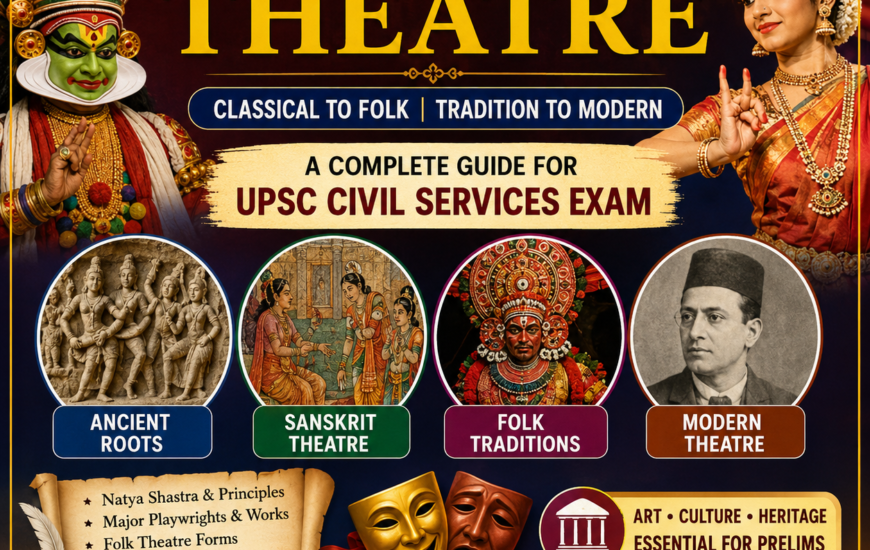
Indian theatre is a composite performing art integrating narrative, acting, music, dance, recitation, costumes, stagecraft and audience interaction.
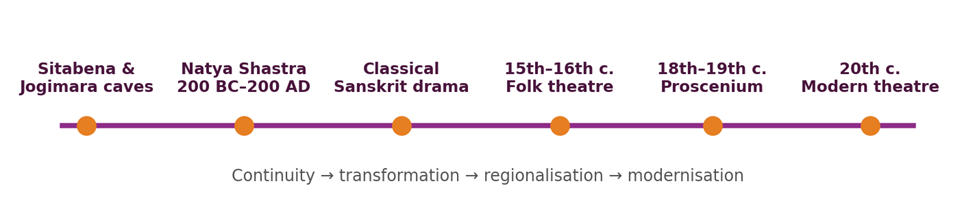
The chapter moves through Classical Sanskrit Theatre → Folk Theatre → Modern Indian Theatre.
For Prelims, the highest-yield area is form ↔ region ↔ distinctive feature matching.
For Mains, use theatre to show continuity between classical traditions, devotional/folk traditions, social communication and modern institutional theatre.
PRELIMS CORE Sitabena & Jogimara caves → ancient amphitheatre tradition; Natya Shastra → first formal treatise on dramaturgy; Koodiyattam → oldest continuing theatre tradition in the source chapter; folk theatre → regional, rural and socially embedded.
The ruins at Sitabena and Jogimara caves are presented in the source as representing the world’s oldest amphitheatres, highlighting the antiquity of theatrical culture in India.
According to the Natya Shastra tradition, Brahma created Natya Veda for the pastime of the gods by combining elements of the four Vedas.
The Natya Shastra is placed by the source between 200 BC and 200 AD and is described as the first formal treatise on dramaturgy.
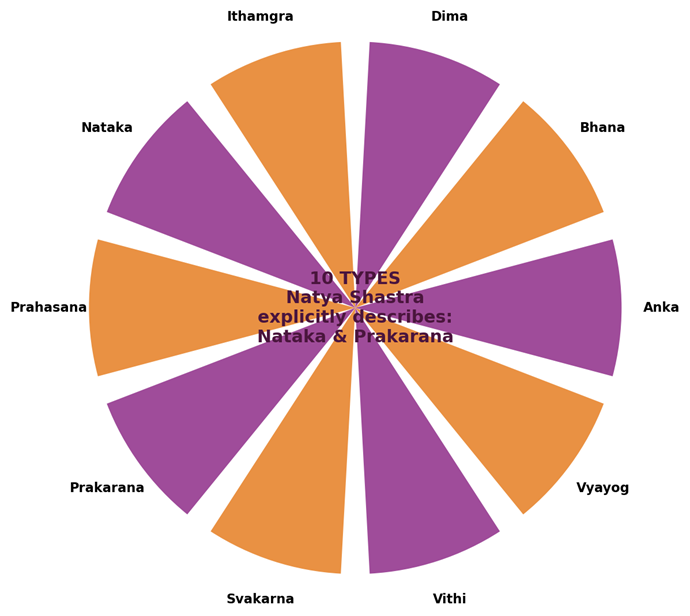
It discusses ten types of plays, ranging from one-act to ten-act forms, and covers the major dimensions of classical Sanskrit theatre.
Indian theatre began as a narrative art combining music, dance and acting; recitation, dance and music were integral rather than separate add-ons
ETYMOLOGY ‘Nataka’ is derived from the root ‘nata’, meaning a dancer. Other terms used for drama include Rupaka, Drishyakavya and Preksakavya.
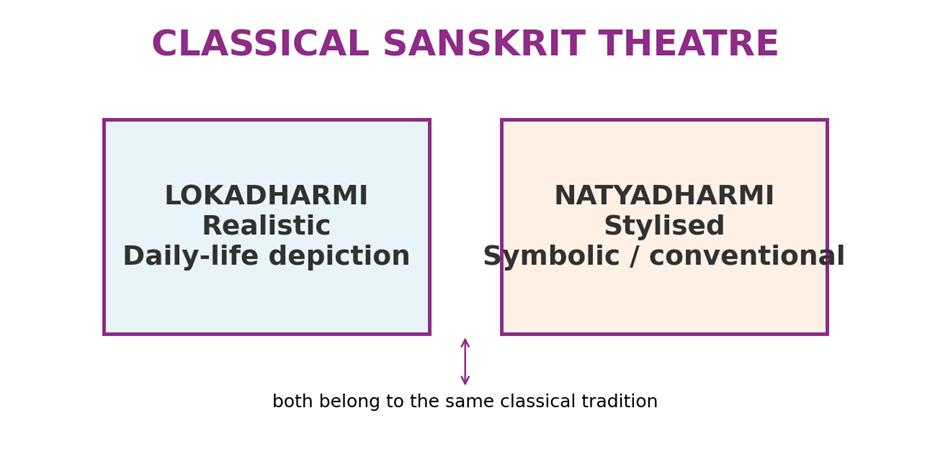
Lokadharmi vs Natyadharmi
Feature
Lokadharmi
Natyadharmi
Nature
Realistic
Conventional / stylised
Representation
Daily life
Symbolic and overtly theatrical
Memory cue
‘Loka’ = life as people experience it
‘Natya’ = codified theatrical expression
3. Classical Sanskrit Theatre: Major Playwrights
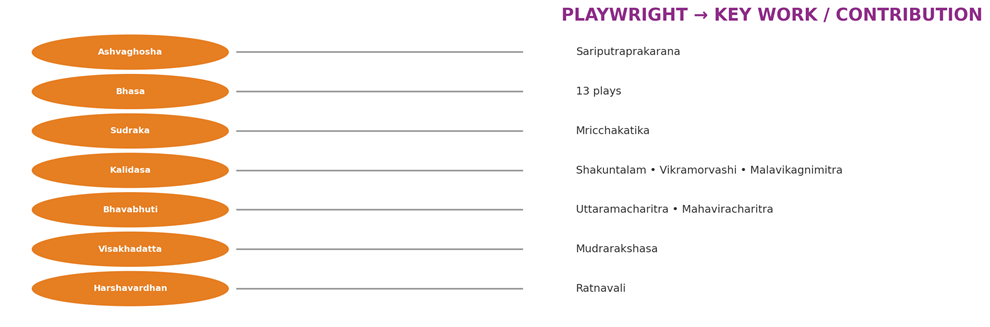
High-yield playwright–work pairs
Playwright
Important work / point
Ashvaghosha
Sariputraprakarana — first example of classical Sanskrit drama in the source; nine-act play.
Bhasa
Thirteen plays; placed by the source in the 4th–5th century B.C.
Sudraka
Mricchakatika — introduces conflict; features an antagonist alongside hero and heroine.
Kalidasa
Malavikagnimitra, Vikramorvashi, Shakuntalam; conflict between desire and duty.
Bhavabhuti
Uttaramacharitra; Mahaviracharitra.
Visakhadatta
Mudrarakshasa.
Harshavardhan
Ratnavali.
4. Types & Conventions of Sanskrit Plays
Ten types
Important note
Anka • Bhana • Dima • Ithamgra • Nataka
Natya Shastra describes Nataka.
Prahasana • Prakarana • Svakarna • Vithi • Vyayog
Natya Shastra describes Prakarana.
Rigid conventions
Generally four to seven acts.
Happy endings were the norm; tragedy was rare. The hero wins or does not die.
The protagonist was male and achieved the object of his desire.
Plots had a defined opening, progression, development, pause and conclusion.
5. Stagecraft & Performance Sequence
Ritualised progression
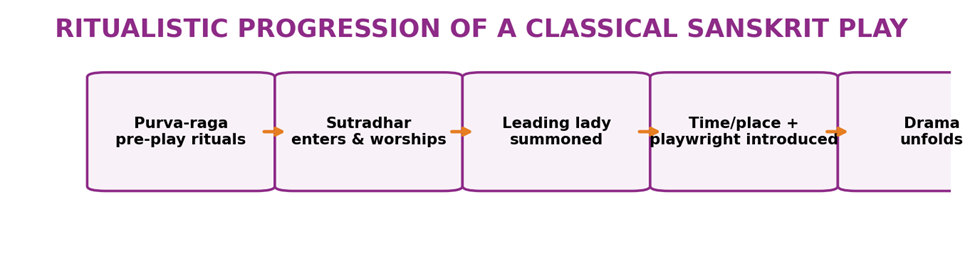
Pre-play rituals (purva-raga) were largely performed behind the curtain.
Sutradhar = stage manager and director; enters with assistants, dressed in white, worships the deity and seeks blessings.
The leading lady is summoned; the Sutradhar announces time and place and introduces the playwright.
According to Bharata in the source, the theatre could accommodate around 400 persons.
Stages were two-storeyed: upper floor for the celestial sphere; lower floor for the terrestrial sphere.
Curtains heightened dramatic impact; masks were not used.
6. Characters in Sanskrit Plays
Character
Key points
Examples / categories
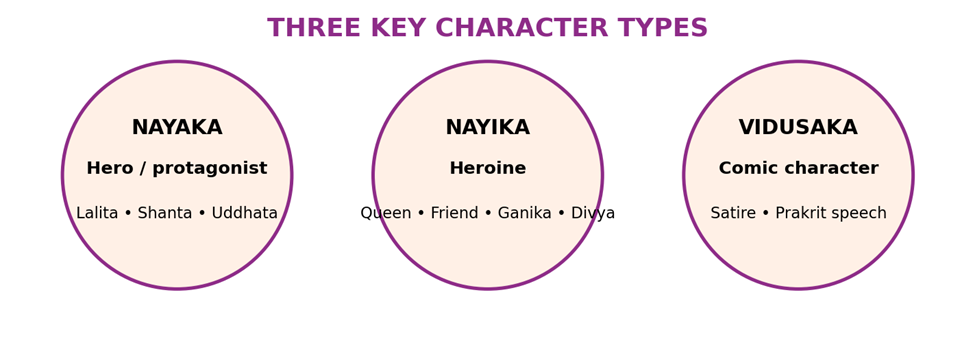
Nayaka
Hero / protagonist; male
Lalita, Shanta, Uddhata; may be Pratinayaka such as Ravana/Duryodhana.
Nayika
Heroine; female
Queen, friend, courtesan (ganika), divine lady (Divya).
Vidusaka
Comic character; often hero’s friend; good-hearted; satire
Traditionally speaks Prakrit while other principal characters speak Sanskrit.
Mains value-add The Vidusaka shows that Sanskrit theatre was not merely elite ritual: humour and satire could question prevailing social norms while also supporting audience engagement.
7. Decline of Sanskrit Theatre
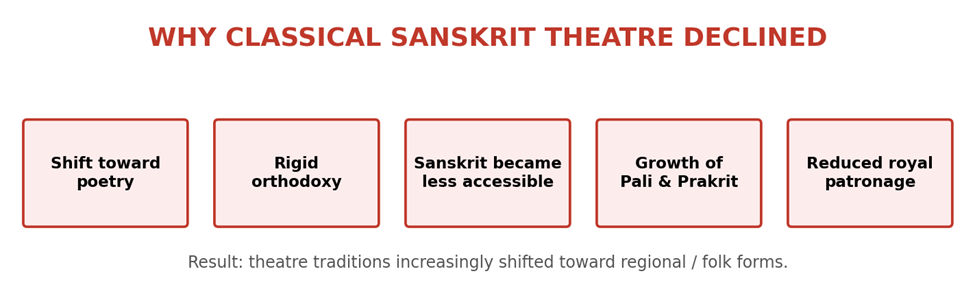
Sanskrit dramatists increasingly moved toward poetry; lyrical writing gained popularity over dramatic writing.
Rigid orthodoxy restricted creative space, encouraging movement toward other forms.
Embellished Sanskrit lost popularity among the masses and became increasingly confined to religious contexts and Brahmin circles.
Pali and Prakrit gained space as alternative languages.
With Muslim rulers, Sanskrit theatre receded while dance and music received patronage.
Continuity, not disappearance The decline of Sanskrit theatre did not mean the disappearance of theatre itself. Folk and regional theatre preserved performance traditions and adapted them to local beliefs, languages and audiences.
8. Koodiyattam / Koothiyattam
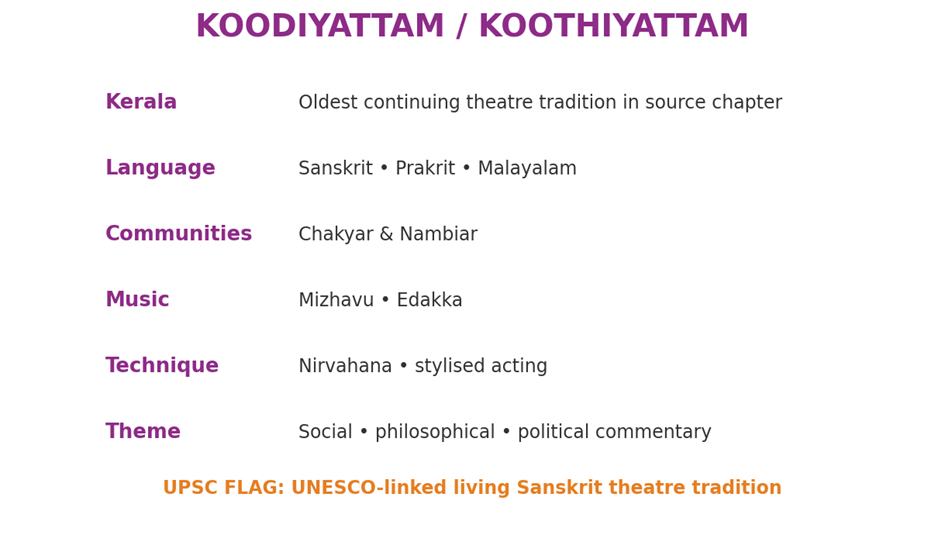
Kerala; presented in the source as India’s oldest continuing form of theatre, surviving since the 10th century A.D.
Follows Natya Shastra rules and was traditionally associated with Chakyar and Nambiar communities.
Uses Sanskrit, Prakrit and Malayalam; Mizhavu and Edakka provide background music.
All characters begin with Nirvahana, recollecting past events; the narrative then unfolds leisurely.
Includes commentary on social, philosophical and political behaviour; Margi Madhu Chakyar is noted as a leading exponent.
9. Folk Theatre: Nature & Evolution
Folk theatre reflects local lifestyle, social norms, beliefs and customs.
Compared with urban-oriented Sanskrit theatre, folk theatre has rural roots and a rustic flavour.
Many surviving forms emerged around the 15th–16th centuries with devotional themes.
Love ballads, local heroes and secular themes were later incorporated.
After Independence, folk theatre increasingly served as a vehicle for disseminating social wisdom rather than merely providing entertainment.
10. Ritual Theatre
Form
Region
Distinctive features
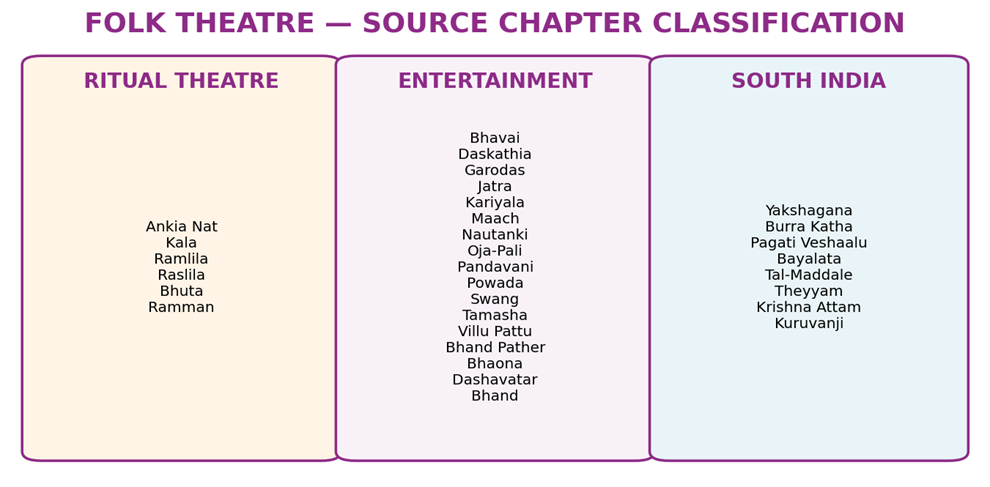
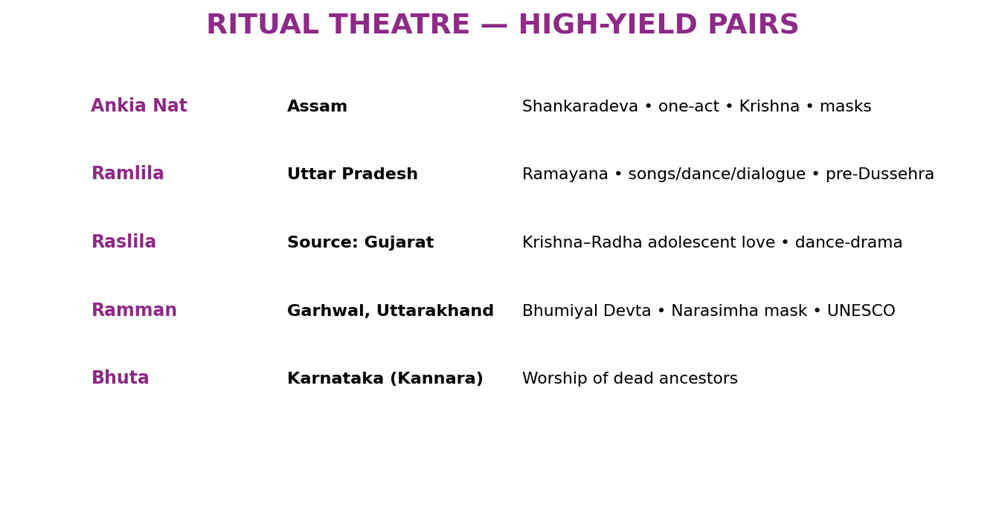
Ankia Nat
Assam
Traditional one-act; Shankaradeva + Mahadeva; opera style; Krishna; Sutradhar + Gayan-Bayan; khol/cymbals; masks.
Farmers’ theatre; ten Vishnu incarnations; Purva-ranga + Uttara-ranga.
Naqal / Bhand
Punjab & adjoining areas
Mimicry; Behroopiya/Naqalchi; comedy/wit/humour for social-political messages; two artists.
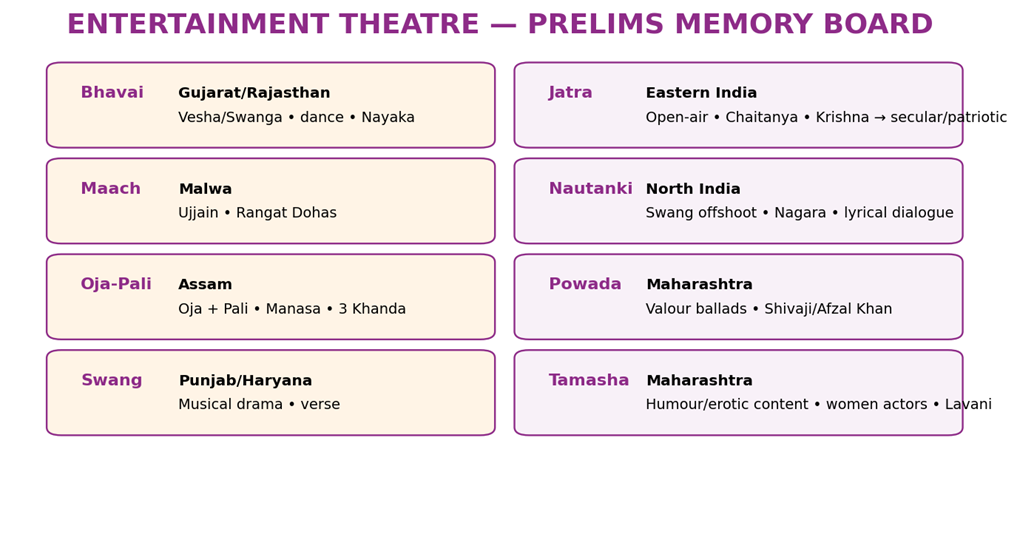
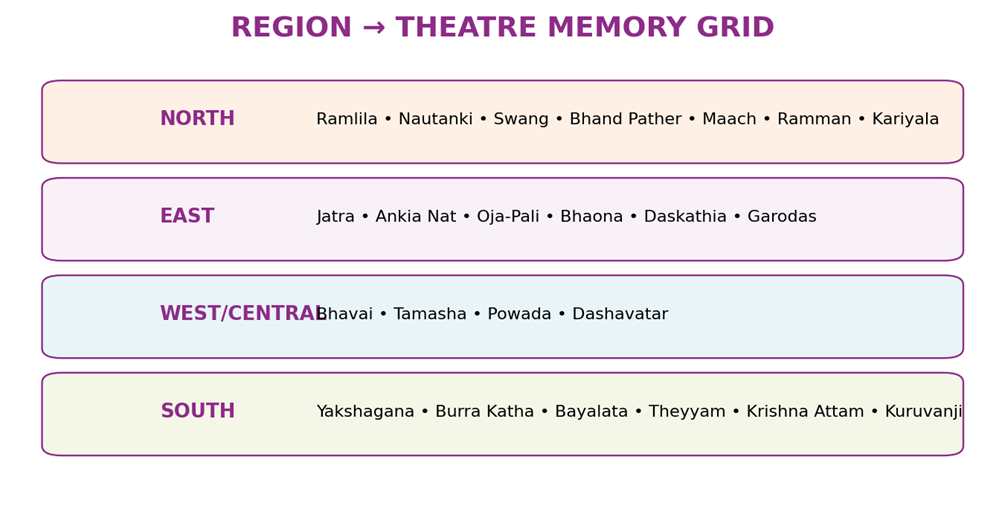
Memory chain Maharashtra = Tamasha + Powada + Dashavatar (Konkan link). Punjab/Haryana = Swang; Punjab region also has Naqal/Bhand. Assam = Oja-Pali + Bhaona + Ankia Nat.
13. Theatre of South India
When Sanskrit classical theatre declined in North India around the 8th century A.D., the source notes that it gained popularity in southern parts of India.
A key distinction in the source: South Indian theatrical traditions emphasise dance, whereas Northern traditions emphasise music.
Form
Region / origin
High-yield detail
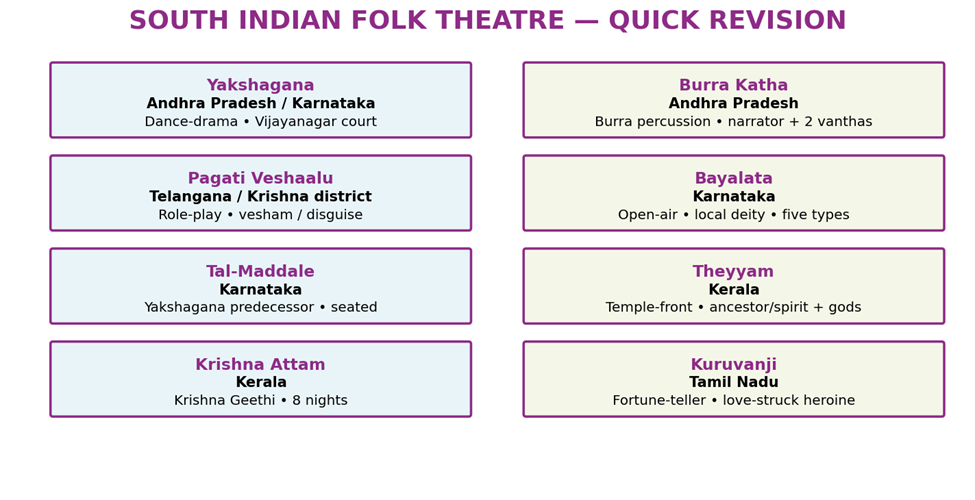
Yakshagana
Andhra Pradesh & Karnataka
Source links origin to Vijayanagar royal courts and Jakkula Varu; evolved to dance-drama. Plays: Garudachalam, Krishna-Hiramani, Sugriva Vijayam.
Burra Katha
Andhra Pradesh
Named after Burra percussion; narrator + two vanthas/co-artists.
Pagati Veshaalu
Telangana & Krishna district
Role-playing; central character = vesham/disguise.
Bayalata
Karnataka
Open-air; local deity; Dasarat, Sannata, Doddata, Parijata, Yakshagana.
Tal-Maddale
Karnataka
Predecessor of Yakshagana; seated; no costume, dance or acting; Bhagavata + Arthadharis.
Theyyam
Kerala
Open theatre before temples; ancestors and gods; Vaishnavism, Shaktism, Shaivism; elaborate headgear/costumes.
Source notes IPTA continues in Chhattisgarh, Punjab and West Bengal.
Institutional development
Kalakshetra Manipur — Heisnam Kanhailal, 1969, to keep traditional theatre alive.
Chorus Repertory Theatre — Ratan Thiyam, 1976.
Sangeet Natak Akademi — 1952; promotion of performing arts including theatre.
National School of Drama — under Ibrahim Alkazi; contributed to producing major theatre personalities.
NINASAM — K.V. Subbanna; Ramon Magsaysay Award winner.
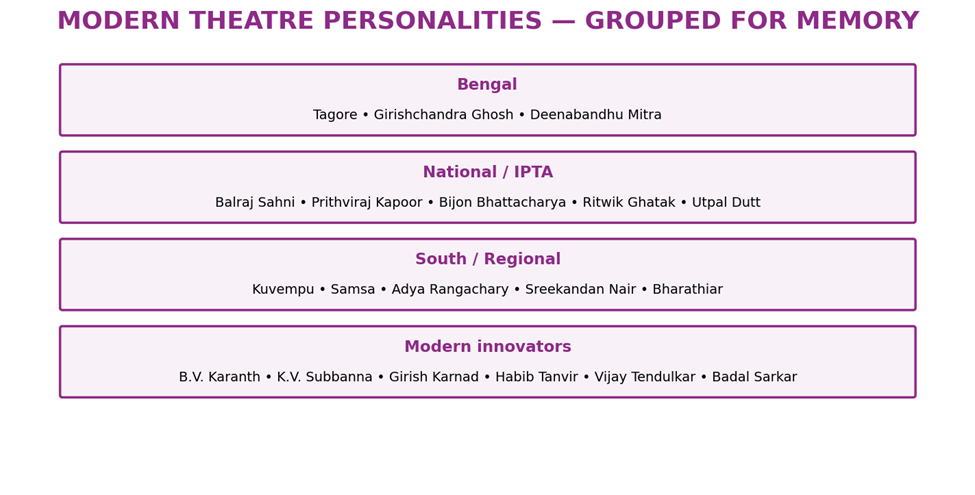
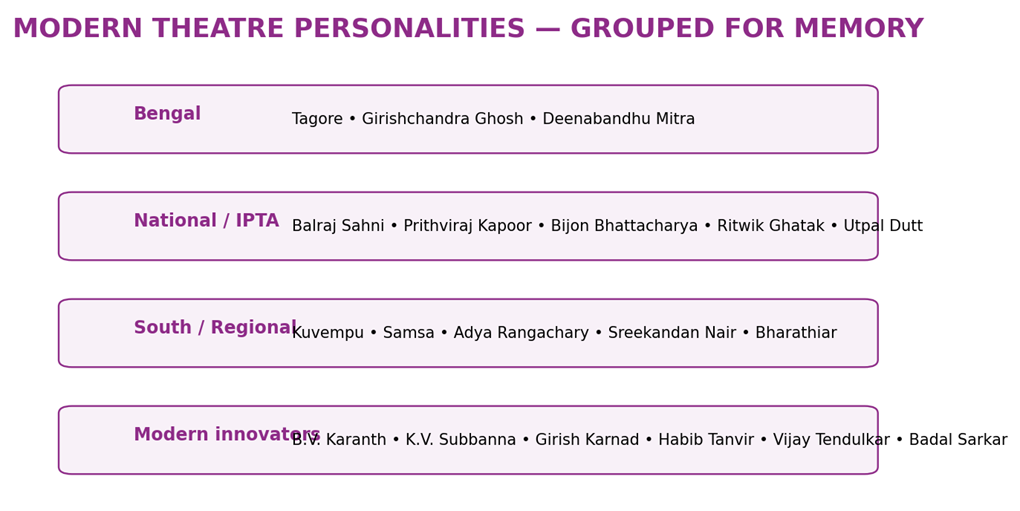
18. Modern Theatre Personalities — UPSC Ready
Name
Association in source
Why remember
Samsa (Sami Venkatadri Iyer)
Karnataka
Kannada dramatist/playwright
Adya Rangachary
Karnataka
Kannada dramatist/playwright
Kuvempu
Karnataka
Actor-playwright
Subrahmanya Bharathiar
Tamil Nadu
Theatre personality
Veeresalingam Pantulu
Andhra Pradesh
Regional personality
Sreekandan Nair
Kerala
Theatre personality
Bharatendu Harishchandra
Hindi theatre
Modern theatre personality
Jaishankar Prasad
Hindi theatre
Modern theatre personality
B.V. Karanth
Andhra/Karnataka/MP
Regional theatre contribution
Girish Karnad
Modern Indian theatre
Major playwright/personality
Habib Tanvir
Modern Indian theatre
Major theatre innovator
Vijay Tendulkar
Modern Indian theatre
Major playwright
Badal Sarkar
Modern Indian theatre
Major theatre personality
Vijaya Mehta
Modern Indian theatre
Major theatre personality
Dharmavir Bharati
Modern Indian theatre
Major theatre personality
Mohan Rakesh
Modern Indian theatre
Major theatre personality
Chandrashekhar Kambar
Modern Indian theatre
Major theatre personality
P. Lankesh
Modern Indian theatre
Major theatre personality
Indira Parthasarathy
Modern Indian theatre
Major theatre personality
19. Prelims Rapid Revision — Match the Following
Theatre form
Region / association
Distinctive clue
Ankia Nat
Assam
Shankaradeva; one-act; Krishna; masks
Ramman
Garhwal, Uttarakhand
Bhumiyal Devta; Narasimha mask; UNESCO
Bhavai
Gujarat/Rajasthan
Vesha/Swanga; Nayaka; Bhungala
Jatra
Eastern India
Chaitanya; open-air; later secular/patriotic
Maach
Malwa
Rangat Dohas
Nautanki
North India
Swang offshoot; Nagara; Kanpur/Lucknow
Oja-Pali
Assam
Oja + Pali; Manasa
Powada
Maharashtra
Valour ballads; Shahirs/Gondhalis
Swang
Punjab/Haryana
Musical drama; verse
Tamasha
Maharashtra
Lavani; women performers
Bhand Pather
J&K
Social satire + myth; music/dance/drama
Bhaona
Assam/Majuli
Ankia Naat; Vaishnavite
Dashavatar
Konkan/North Goa
Ten Vishnu incarnations; Purva/Uttara-ranga
Yakshagana
Andhra Pradesh/Karnataka in source
Dance-drama; Vijayanagar court
Burra Katha
Andhra Pradesh
Burra percussion; narrator + two vanthas
Bayalata
Karnataka
Open-air; five types
Tal-Maddale
Karnataka
Predecessor of Yakshagana; seated
Theyyam
Kerala
Temple-front open theatre; elaborate headgear
Krishna Attam
Kerala
Eight nights; Krishna Geethi
Kuruvanji
Tamil Nadu
Fortune-teller; love-struck heroine
20. Mains Answer Framework + Last-Minute Sheet
How to structure a 10/15-marker
Introduction: define Indian theatre as a composite performing tradition linking narrative, music, dance and acting.
Historical core: mention early amphitheatre evidence and the Natya Shastra.
Classical section: explain Lokadharmi/Natyadharmi, playwrights, conventions, Sutradhar and characters.
Transition: explain decline of Sanskrit theatre and persistence through regional/folk traditions.
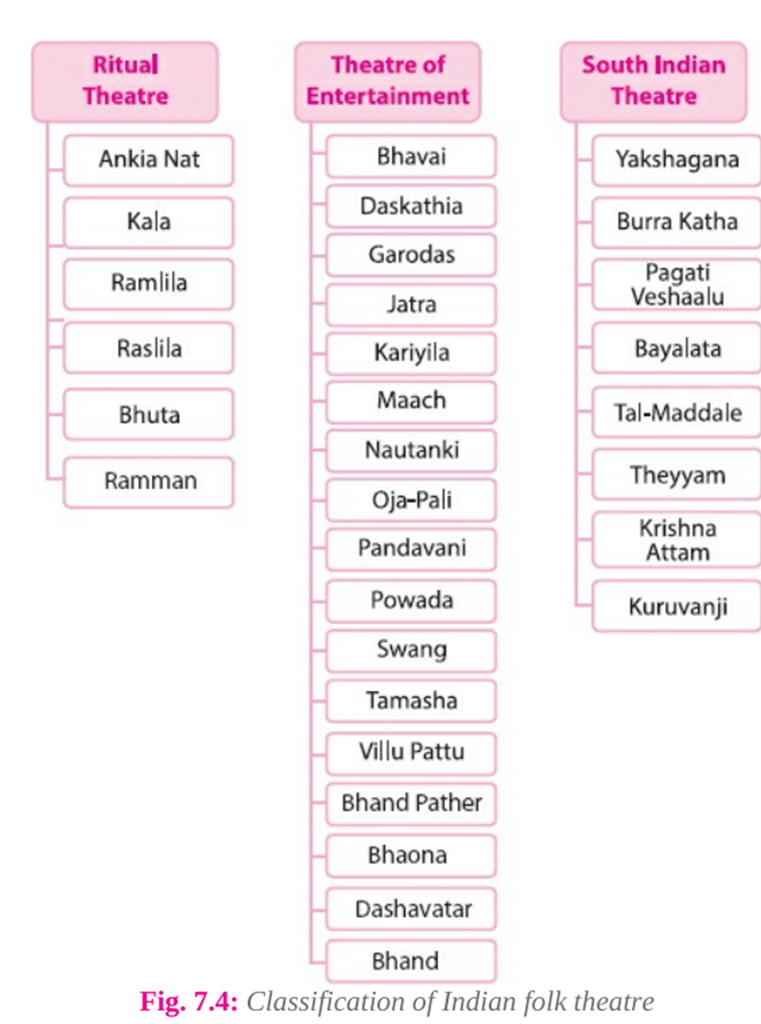
Folk section: classify into ritual, entertainment and South Indian traditions; give 4–6 region-form examples.
Modern section: colonial proscenium, Parsi theatre, social themes, IPTA and institutions such as Sangeet Natak Akademi/NSD.
Conclusion: theatre demonstrates cultural continuity, regional diversity and the ability of performance to transmit religious, social and political ideas.
Final UPSC takeaway CLASSICAL THEORY → REGIONAL ADAPTATION → DEVOTIONAL & SECULAR FOLK FORMS → COLONIAL PROSCENIUM → SOCIAL/POLITICAL THEATRE → MODERN INSTITUTIONS.
★ Why this topic matters for UPSC Classical vs folk dance identification, state-wise mapping, founders/revivalists and UNESCO tags are frequently asked in Prelims.Mains (GS-I, Art & Culture) may ask about the socio-religious significance and revival of classical dance forms.Essay/Interview: link dance to India’s composite culture and ‘Unity in Diversity’.
1. Background & Origin
As per legend in Bharata Muni’s Natya Shastra, Lord Brahma combined elements of the four Vedas to create a fifth Veda – the Natya Veda. It is an amalgamation of dance, drama and music, drawing Pathya (words) from the Rig Veda, Abhinaya (gestures) from the Yajur Veda, Geet (music) from the Sama Veda, and Rasa (emotion) from the Atharva Veda.
Mythological roots: Shiva’s Tandava symbolises the cosmic cycle of creation, preservation and destruction; Parvati’s response represents the feminine (Lasya) counterpart.
Archaeological evidence: Bhimbetka rock-shelter engravings and the Bronze Dancing Girl of the Harappan civilisation show dance as a means of social entertainment since prehistoric times.
Natya Shastra: Compiled between 200 BCE and 2nd century CE by Bharata Muni; it is the first formal, comprehensive treatise on Indian classical dance – covering technique, postures, emotions, ornaments, stage and audience. Dance is described as the ‘complete art’, encompassing music, sculpture, poetry and drama.
2. Aspects of Indian Classical Dance
2.1 Two Basic Aspects (Natya Shastra)
Lasya – Denotes grace, bhava, rasa and abhinaya; symbolic of the feminine (soft) element of dance.
Tandava – Symbolic of the masculine element; emphasis on rhythm and vigorous movement (associated with Shiva).
2.2 Three Basic Elements (Abhinaya Darpan by Nandikeshwara)
Nritta – Basic, rhythmic dance steps devoid of expression or mood (pure dance).
Natya – Dramatic representation; the story conveyed through the recital.
Nritya – The sentiment/emotion evoked through dance, including mime and mudras.
Nandikeshwara also describes the Nayaka–Nayika Bhav, where the deity is the hero (Nayaka) and the devotee-performer is the heroine (Nayika).
These moods are expressed through mudras – combinations of hand gestures and body postures. There are 108 fundamental mudras in Indian classical dance.
3. Classical Dance Forms of India
The Sangeet Natak Akademi (SNA) currently recognises eight classical dance forms. All are governed by the principles of the Natya Shastra and rely on the ‘Guru-Shishya Parampara’ (teacher-disciple tradition) for transmission of knowledge.
★ Exam Alert SNA recognises 8 classical dances. The Ministry of Culture recognises 9 classical dances – the extra one being Chhau (a folk-martial form covered later in this note).
3.1 Bharatanatyam – Tamil Nadu
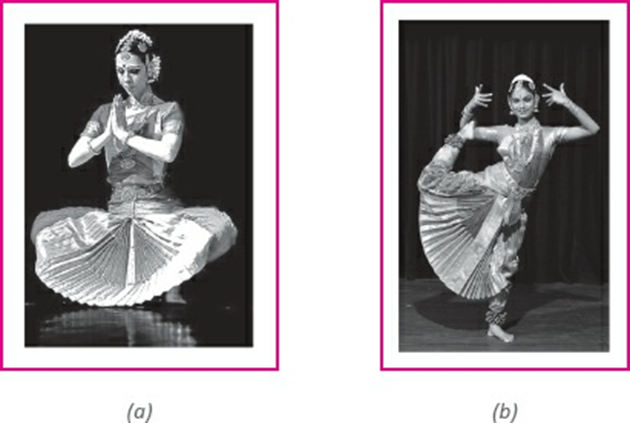
The oldest classical dance form; name derived from Bharata Muni and ‘natyam’ (Tamil for dance) – also linked to Bhava-Raga-Taal. It evolved from ‘Sadir’, the solo temple dance of Devadasis, and was earlier called Dashiattam.
Revival: Nearly went extinct with the decline of the Devadasi system; revived by freedom fighter E. Krishna Iyer. Rukmini Devi Arundale gave it global recognition.
Jatiswaram – Pure Nritta – poses and movement without expression.
Shabdam – Dramatic element with words/abhinaya, in praise of God.
Varnam – Nritya component; combines dance & emotion; most important part of the recital.
Padam – Mastery of abhinaya of the spiritual message; light music, emotional dance.
Jawali – Short, fast-tempo love lyrics.
Thillana – Concluding pure-dance item with exuberant, intricate rhythm.
The ‘Tanjore Quartet’ – Chinnaiah, Ponniah, Vadivelu and Shivanandam – codified the above elements in the 19th century; hence also called Tanjore Natyam.
Called the ‘fire dance’ – movements resemble a dancing flame. Key mudra: Kataka Mukha Hasta (symbolises ‘Om’). Knees mostly bent, weight equal on both feet. Both Tandava and Lasya are emphasised.
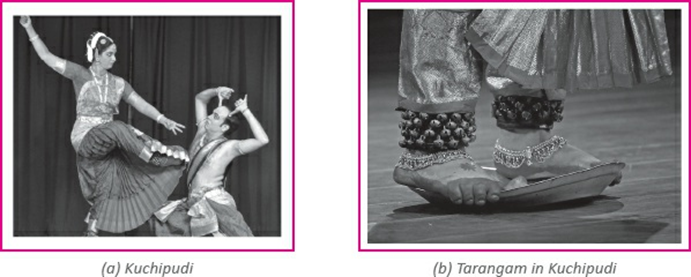
Named after Kuchelapuram village; originally performed by travelling actor troupes (Kusselavas). Formalised in the 17th century by Siddhendra Yogi (author of Bhama Kalapam). Became a Brahmin-male temple art with the spread of Vaishnavism; revived in the 20th century by Balasaraswati, Ragini Devi and Lakshminarayan Shastry (who introduced solo & female participation).
Difficult footwork; usually a team performance with a secular theme (predominance of Shringaara rasa) though based on Bhagavata Purana.
Each character introduces itself via a ‘daaru’ – a short dance-song composition.
Sollakath/Patakshara (Nritta) and Kavutvams (Nritya, with acrobatics) are key components.
Symbolises the element of Earth. Both Lasya and Tandava are important; performer may also sing.
Popular solo items – Manduk Shabdam (frog story); Tarangam (dancing on the rim of a brass plate while balancing a pot/diyas); Jala Chitra Nrityam (drawing pictures on the floor with the toes).
Accompanied by Carnatic music (Violin, Mridangam); recital language – Telugu. Famous exponents: Radha & Raja Reddy, Yamini Krishnamurthy, Indrani Rehman.
3.3 Kathakali – Kerala
Evolved from the temple dance-drama traditions Ramanattam and Krishnattam; related to Koodiyattam (Sanskrit drama). Name from ‘Katha’ (story) + ‘Kali’ (drama/play). Declined with the fall of feudalism; revived in the 1930s by poet V. N. Menon under Mukunda Raja’s patronage.
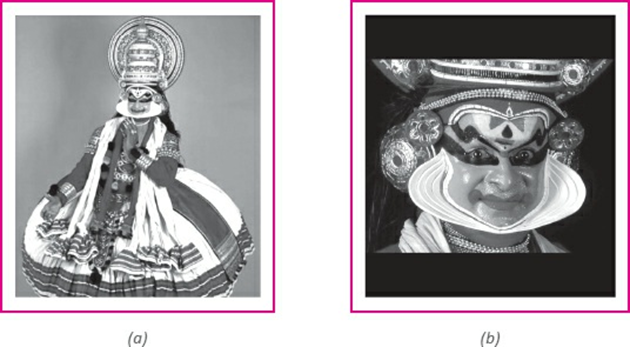
All-male troupe performance with minimal props but very elaborate facial make-up and headgear.
Colour code: Green – nobility/divinity/virtue; Red patches near nose – royalty; Black – evil/wickedness; Yellow – saints/women; fully Red face – evil; White beard – higher consciousness/divinity.
Language: Manipravalam (mix of Malayalam & Sanskrit). Depicts the eternal conflict of good vs evil from epics/puranas – also called the ‘Ballad of the East’.
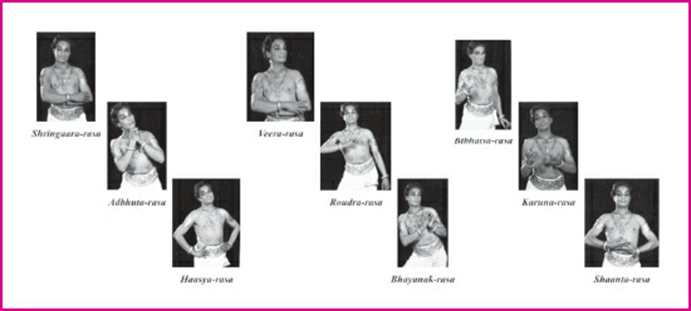
Nine facial expressions (Navarasas) convey emotion through eyes and eyebrows; extensive hand gestures. Accompanying instruments: Chenda, Maddalam. Performed in open-air theatres, lit by a brass lamp. Symbolises the element of Sky/Ether.
Famous exponents: Guru Kunchu Kurup, Gopi Nath, Kottakal Sivaraman, Rita Ganguly.
3.4 Mohiniattam – Kerala
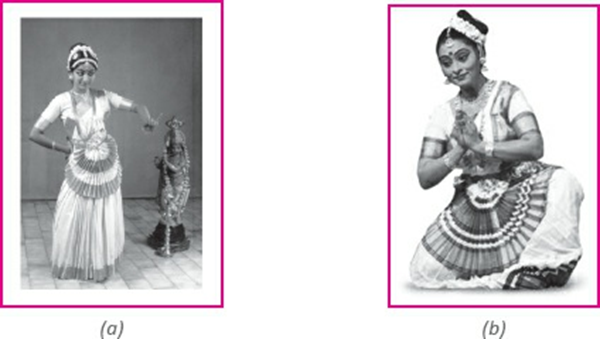
‘Dance of the Enchantress’ – a solo dance for women, developed further by Vadivelu (19th century) and patronised by Travancore ruler Swathi Thirunal. Revived by V. N. Menon and Kalyani Amma.
Combines the grace of Bharatanatyam with the vigour of Kathakali; gentle footwork, no thumping. Narrates the feminine (Mohini) form of Vishnu.
Lasya-dominant; costume is white/off-white with gold brocade; no elaborate face make-up; Ghungroo worn on ankles. Symbolises the element of Air.
Famous exponents: Sunanda Nair, Kalamandalam Kshemavathy, Madhuri Amma, Jayaprabha Menon.
3.5 Odissi – Odisha
Traced to the Udayagiri-Khandagiri caves; name from ‘Odra Nritya’ (Natya Shastra). Practised by ‘Maharis’ and patronised by Jain king Kharavela; later by ‘Gotipuas’ (boys dressed as girls) after Vaishnavism made the Mahari system defunct. Gained international acclaim via Charles Fabri and Indrani Rehman.
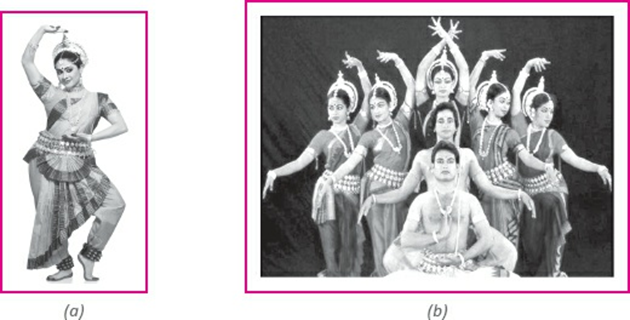
Tribhanga (three-bend body posture) is distinctive; ‘Chowk’ posture (hands spread out) depicts masculinity. Lower body largely static; torso and hand gestures carry expression – called ‘mobile sculpture’.
Sequence: Mangalacharan (invocation, flower offered to earth); Batu Nritya (Tribhanga & Chowk); Pallavi (facial expression); Tharijham (pure dance).
Conclusion: Moksha (joyous, signifying liberation) or Trikhanda Majura (leave-taking from gods, audience, stage).
Accompanied by Hindustani classical music; instruments – Manjira, Pakhawaj, Sitar, Flute. Lyrics from Jayadeva’s Gita Govinda. Symbolises the element of Water.
Famous exponents: Guru Pankaj Charan Das, Kelu Charan Mohapatra, Sonal Mansingh, Sharon Lowen (USA), Myrla Barvie (Argentina).
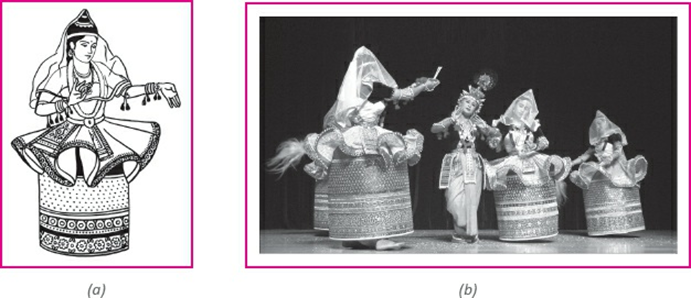
3.6 Manipuri – Manipur
Mythological origin in the celestial dance of Shiva-Parvati with local Gandharvas; traced to the Lai Haraoba festival. Gained prominence with 15th-century Vaishnavism (Krishna as central theme). Revived by Raja Bhagyachandra (18th c.); brought to wider fame by Rabindranath Tagore at Santiniketan.
Emphasis on devotion, not sensuality; faces covered with a thin veil – facial expression is less important than hand gestures and gentle footwork.
Naga Bandha mudra – body connected in a figure-of-‘8’ curve. Ras Leela (Radha-Krishna) is a recurring theme. Main instrument: Pung (drum). Also linked to Thang-Ta and Sankirtana.
Famous exponents: Jhaveri Sisters (Nayana, Suverna, Ranjana, Darshana), Guru Bipin Singha.
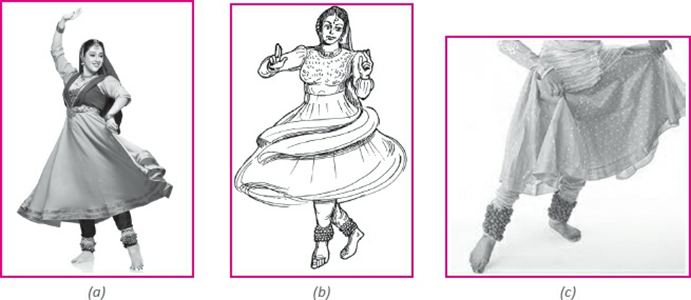
3.7 Kathak – Uttar Pradesh
Traced to the Ras Leela of Brajbhoomi; derives its name from ‘Kathika’ (storytellers). During the Mughal era it became a court dance, absorbing Persian costume and style. Classical form revived by Lady Leela Sokhey in the 20th century.
Lucknow gharana – Reached its peak under Wajid Ali Khan; stresses expression and grace.
Jaipur gharana – Initiated by Bhanuji; stresses speed, fluency and long rhythmic patterns.
Raigarh gharana – Developed under Raja Chakradhar Singh; emphasis on percussion.
Banaras gharana – Developed under Janakiprasad; more floorwork, symmetry.
Elements of a recital: Ananda (entry), Thaat, Todas/Tukdas (fast rhythm pieces), Jugalbandi (dancer-tabla competitive play), Padhant (reciting bols), Tarana, Kramalaya (fast concluding footwork), Gat Bhaav (dance without music, to depict mythological episodes).
Characterised by intricate footwork and pirouettes. Traditionally accompanied by dhrupad; Thumri, Ghazal and Tarana added during Mughal period.
Famous exponents: Birju Maharaj, Lacchu Maharaj, Sitara Devi, Damayanti Joshi.
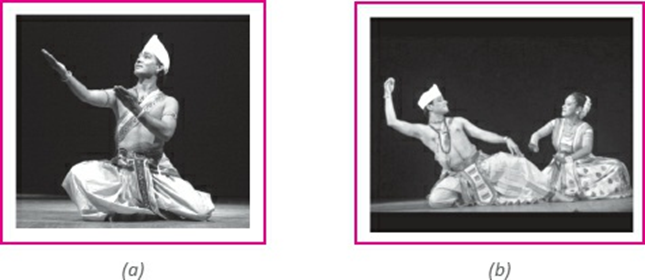
3.8 Sattriya – Assam
Introduced in its modern form by Vaishnava saint Shankaradeva in the 15th century; name from the monasteries (‘Sattras’) where it was practised; inspired by the Bhakti Movement.
Amalgamation of Assamese dance forms, mainly Ojapali and Devadasi traditions; devotional focus, narrating Vishnu’s mythology.
Performed traditionally in groups by male monks (‘Bhokots’) as daily ritual. Instruments: Khol, Cymbals (Manjira), flute; songs are Shankaradeva’s ‘Borgeets’.
Costumes: Dhoti and Paguri (turban) for men; Assamese jewellery, Ghuri and Chador in Pat silk for women. Two modern streams: Gayan-Bhayanar Nach and Kharmanar Nach.
Ankia Naat – a musical-drama form of Sattriya (also called ‘Bhaona’), written in the Assamese-Maithili mix language Brajavali, narrating Krishna stories.
Folk dances arise from local legends, myths and traditions. Unlike classical dance, they are spontaneous and performed by the masses without formal, codified training – yet each carries deep regional and religious significance.
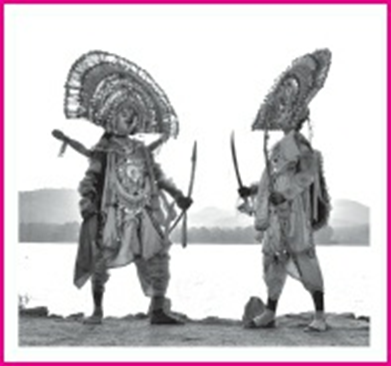
4.1 Chhau – A Special Case (Jharkhand, Odisha, West Bengal)
Name derived from ‘Chhaya’ (shadow). A masked, martial dance narrating mythological stories; also includes nature-themes like Sarpa Nritya (serpent) and Mayur Nritya (peacock).
Three styles: Saraikella Chhau (Jharkhand), Mayurbhanj Chhau (Odisha – no masks worn), Purulia Chhau (West Bengal).
Inscribed by UNESCO in the Representative List of Intangible Cultural Heritage of Humanity in 2010. Note: Ministry of Culture counts Chhau as India’s 9th classical dance form.
4.3 Quick Revision – State-wise Folk Dances
State / Region
Folk Dance(s)
Tamil Nadu
Kummi (women, circular, no instruments – only clapping); Kolattam / Pinnal Kolattam; Mayilattam (peacock dance)
Kerala
Kaikottikali (performed at Onam); Padayani (temple, masked – kolams); Kolkali-Parichakali (mock fight with sticks/shields, shared with Lakshadweep); Chakyar Koothu (solo, Malayalam narration); Mayilattam, Kummi
Andhra Pradesh
Burrakatha / Jangam Katha (solo narration of puranas); Butta Bommalu (masked, West Godavari)
Karnataka
Bhootha Aradhane (devil worship dance); Pata Kunitha (bamboo poles with ribbons, Mysore); Puja Kunitha (variant, Bengaluru-Mandya)
★ High-Yield Facts for Prelims Panchabhoota (5 elements) linked to classical dance: Fire–Bharatanatyam, Earth–Kuchipudi, Air–Mohiniattam, Water–Odissi, Sky/Ether–Kathakali. UNESCO ICH tags: Chhau (2010) and Kalbelia (2010). SNA recognises 8 classical dances; Ministry of Culture recognises 9 (adds Chhau). Tanjore Quartet (Bharatanatyam): Chinnaiah, Ponniah, Vadivelu, Shivanandam. All-male performance traditions: Kathakali and Sattriya (by Bhokots). Martial folk/dance forms: Chhau, Paika, Thang-Ta, Kolkali-Parichakali, Pata Kunitha. Rabindranath Tagore popularised Manipuri dance at Santiniketan. Guru-Shishya Parampara is the common thread that binds all classical dance traditions.
5. Conclusion
Indian dance forms – classical and folk – together reflect the country’s civilizational continuity, from the Natya Shastra’s codified aesthetics to the living, evolving folk traditions of every region. For the UPSC exam, focus on: origin & mythology, region/state association, revivalists, distinguishing features (costume, mudras, music), and UNESCO recognitions, since questions are frequently framed around matching and factual recall.
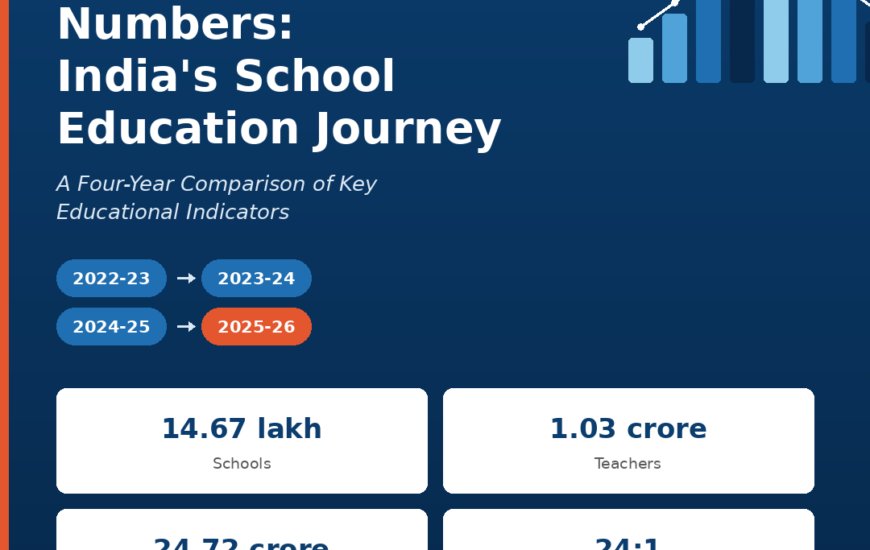
The latest UDISE+ 2025-26 report shows India’s school education system continuing to strengthen across nearly every indicator tracked since 2022-23. The headline figures for the current year are:
14.67 lakh Total Schools
1.03 crore Total Teachers
24.72 crore Total Enrolment
24:1 Overall PTR
This report traces each indicator across all four years, with a chart, a data table, and a short analysis for every parameter.
1. Teacher Availability
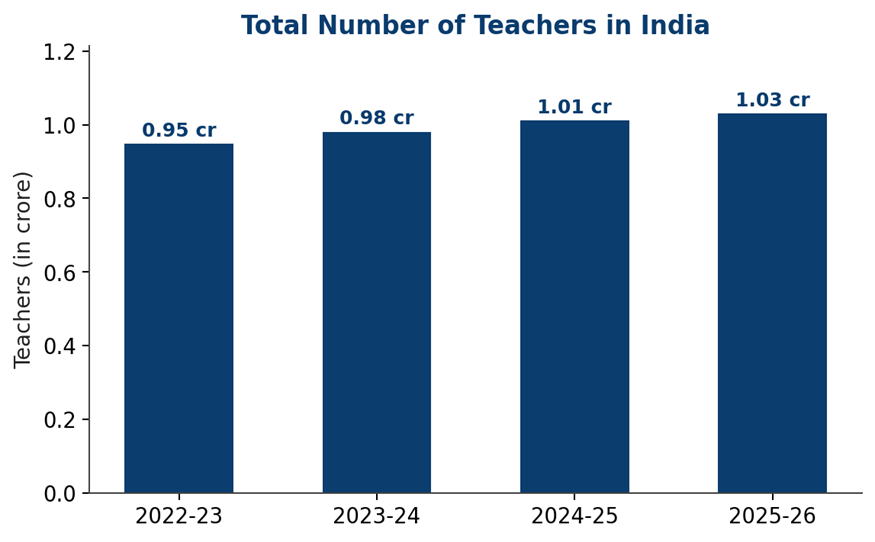
The total number of teachers in India crossed the 1-crore mark for the first time in 2024-25 and has continued to rise into 2025-26, reaching approximately 1.03 crore.
Indicator
2022-23
2023-24
2024-25
2025-26
Total Teachers
94,83,294
98,07,600
1,01,22,420
~1,03,00,000 (1.03 cr)
Analysis: Teacher numbers have grown by roughly 8.6% over the four-year window (94.83 lakh → 103 lakh), a steady, uninterrupted increase each year. This directly supports the improving Pupil-Teacher Ratios seen below, and reflects sustained recruitment effort aimed at closing regional staffing gaps.
2. Pupil-Teacher Ratio (PTR)
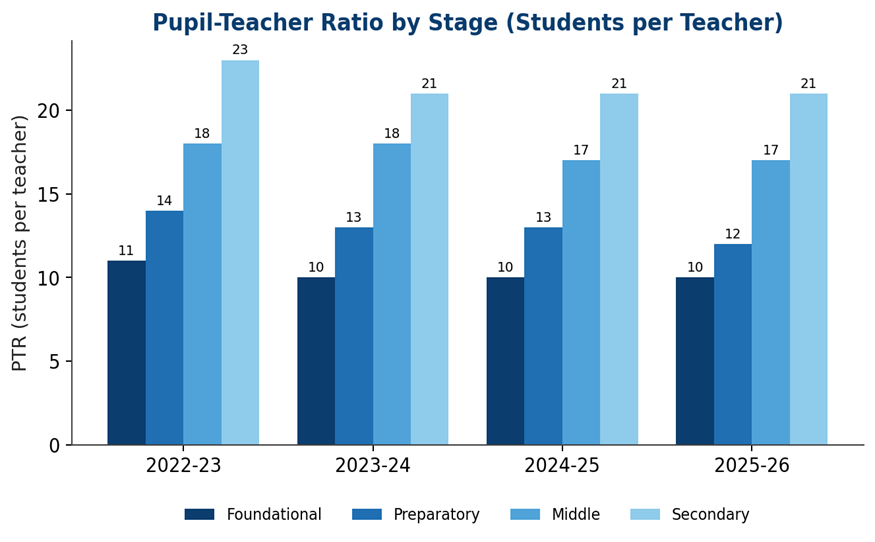
PTR measures how many students, on average, are taught per teacher at each stage. A lower ratio generally allows more individual attention. All stages remain comfortably within the NEP 2020 benchmark of 30:1.
Stage
2022-23
2023-24
2024-25
2025-26
Foundational
11
10
10
10
Preparatory
14
13
13
12
Middle
18
18
17
17
Secondary
23
21
21
21
Analysis: PTR has improved or held steady at every stage over four years. The Secondary stage saw the largest gain (23→21), and Preparatory improved most recently (13→12 in 2025-26). Foundational and Middle stages have essentially stabilised at favourable ratios, suggesting the earlier gains from 2022-23 to 2023-24 are now being maintained rather than repeated.
3. Dropout Rate
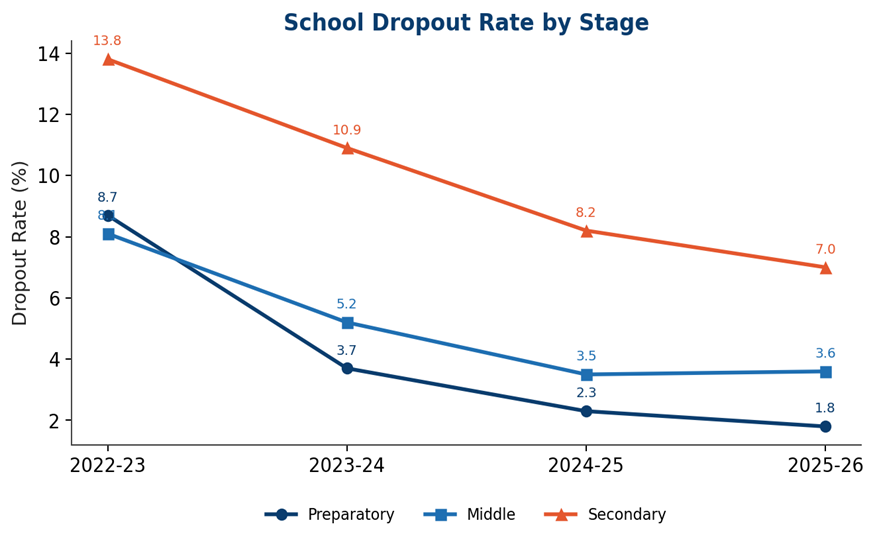
Dropout rate is the percentage of enrolled students who leave school before completing a stage. Lower is better.
Stage (%)
2022-23
2023-24
2024-25
2025-26
Preparatory
8.7
3.7
2.3
1.8
Middle
8.1
5.2
3.5
3.6
Secondary
13.8
10.9
8.2
7.0
Analysis: Dropout has fallen sharply and consistently at the Preparatory (8.7%→1.8%) and Secondary (13.8%→7.0%) stages — both cut by more than half. The Middle stage improved strongly through 2024-25 (down to 3.5%) but ticked up marginally to 3.6% in 2025-26 — the only reversal in the entire dataset, and worth monitoring in next year’s report even though it remains far below the 2022-23 baseline.
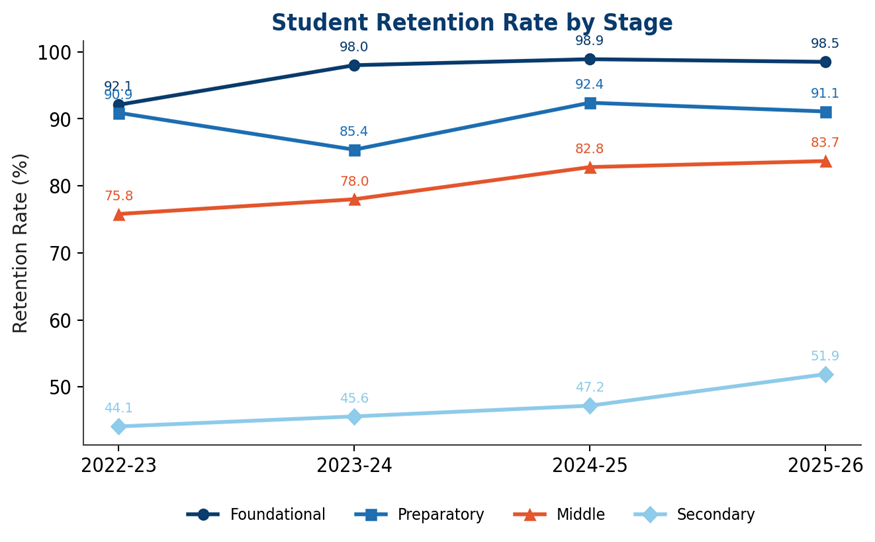
4. Student Retention Rate
Retention rate is the percentage of students who continue enrolment through to the end of a stage. Higher is better.
Stage (%)
2022-23
2023-24
2024-25
2025-26
Foundational
92.1
98.0
98.9
98.5
Preparatory
90.9
85.4
92.4
91.1
Middle
75.8
78.0
82.8
83.7
Secondary
44.1
45.6
47.2
51.9
Analysis: Secondary-stage retention shows the most encouraging and consistent trend, rising from 44.1% to 51.9% — a gain of nearly 8 percentage points — crossing the halfway mark for the first time. Middle-stage retention has also climbed steadily each year (75.8%→83.7%). Foundational and Preparatory retention improved sharply through 2024-25 but eased slightly in 2025-26, mirroring the same pattern seen in dropout rates for those stages.
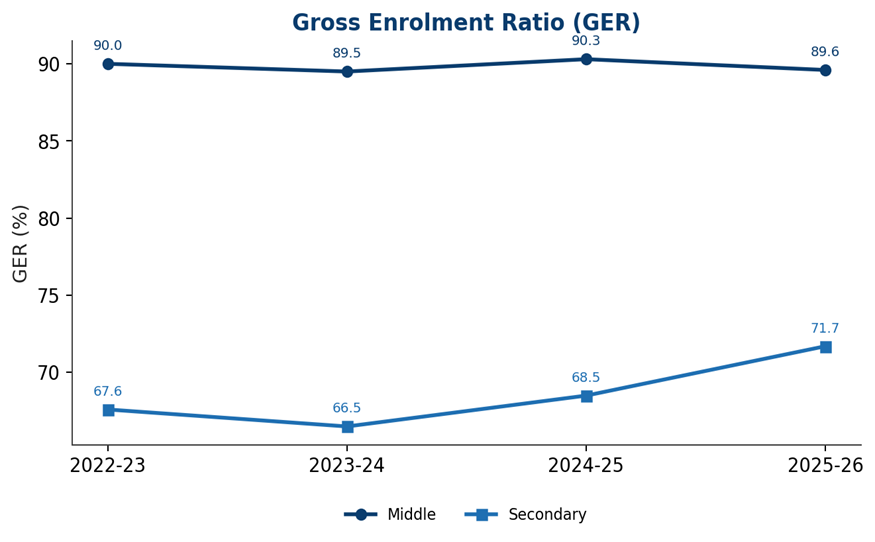
5. Gross Enrolment Ratio (GER)
GER expresses total enrolment at a stage as a percentage of the population in the corresponding official age group; it can exceed or fall short of 100% depending on over-age/under-age enrolment.
Stage (%)
2022-23
2023-24
2024-25
2025-26
Middle
90.0
89.5
90.3
89.6
Secondary
67.6
66.5
68.5
71.7
Analysis: Secondary-stage GER shows the clearest upward trend in the whole report, rising from 66.5% in 2023-24 to 71.7% in 2025-26 — a jump of over 3 points in the latest year alone, indicating meaningfully expanding access to senior schooling. Middle-stage GER has fluctuated in a narrow band around 89-90% across all four years, suggesting participation at that stage is already close to saturation and is not the current growth driver.
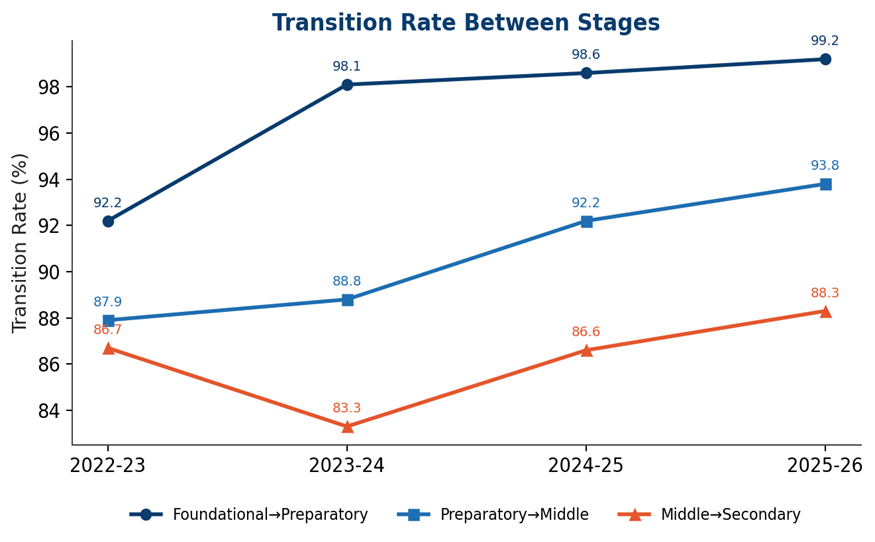
6. Transition Rate
Transition rate is the percentage of students completing one stage who go on to enrol in the next.
Transition (%)
2022-23
2023-24
2024-25
2025-26
Foundational → Preparatory
92.2
98.1
98.6
99.2
Preparatory → Middle
87.9
88.8
92.2
93.8
Middle → Secondary
86.7
83.3
86.6
88.3
Analysis: Every transition point has improved in every year without exception, making this the most uniformly positive indicator in the dataset. Foundational-to-Preparatory transition is now almost universal (99.2%). Preparatory-to-Middle has improved the most in percentage-point terms (87.9%→93.8%). Middle-to-Secondary dipped in 2023-24 before resuming its climb, and remains the weakest of the three links — consistent with Secondary being the stage with the lowest GER and retention.
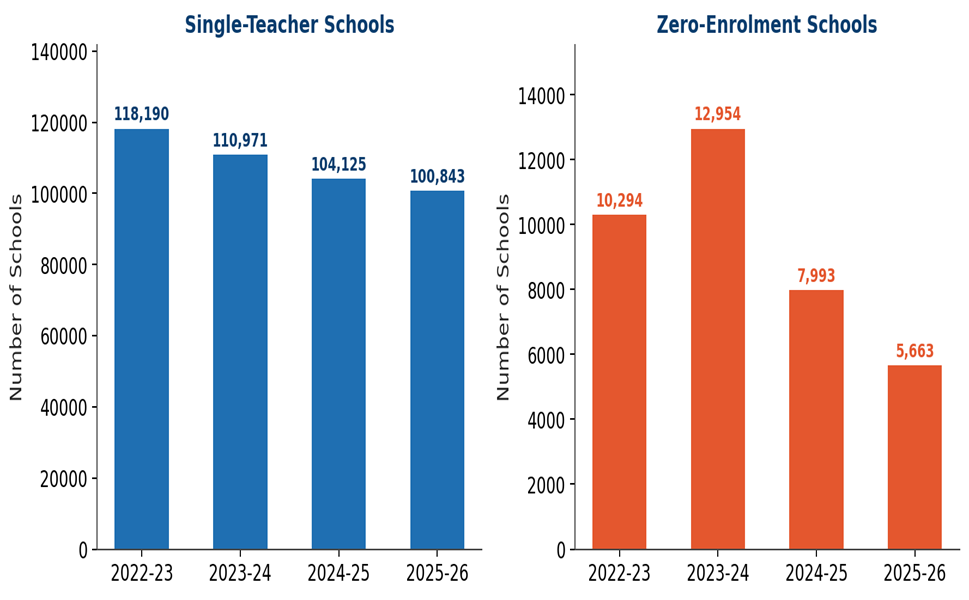
7. Single-Teacher and Zero-Enrolment Schools
These two counts flag structural weak points: schools too small to be viably staffed (single-teacher) and schools with no students on roll (zero-enrolment), both targets for rationalisation.
Indicator (numbers)
2022-23
2023-24
2024-25
2025-26
Single-Teacher Schools
1,18,190
1,10,971
1,04,125
1,00,843
Zero-Enrolment Schools
10,294
12,954
7,993
5,663
Analysis: Single-teacher schools have declined every year, down 15% cumulatively from 1.18 lakh to just under 1.01 lakh. Zero-enrolment schools tell a more uneven story — they actually rose in 2023-24 (to 12,954) before falling sharply in both 2024-25 and 2025-26, ending 45% below the 2022-23 level. The steep, consistent recent decline (a 38% drop in 2024-25 and a further 29% drop in 2025-26) suggests active rationalisation and merger of non-functional schools is now underway.
8. Digital Infrastructure
Share of schools with computer and internet access — a proxy for readiness for technology-enabled and digital learning.
Facility (%)
2022-23
2023-24
2024-25
2025-26
Computer Access
47.7
57.2
64.7
69.9
Internet Access
49.7
53.9
63.5
67.4
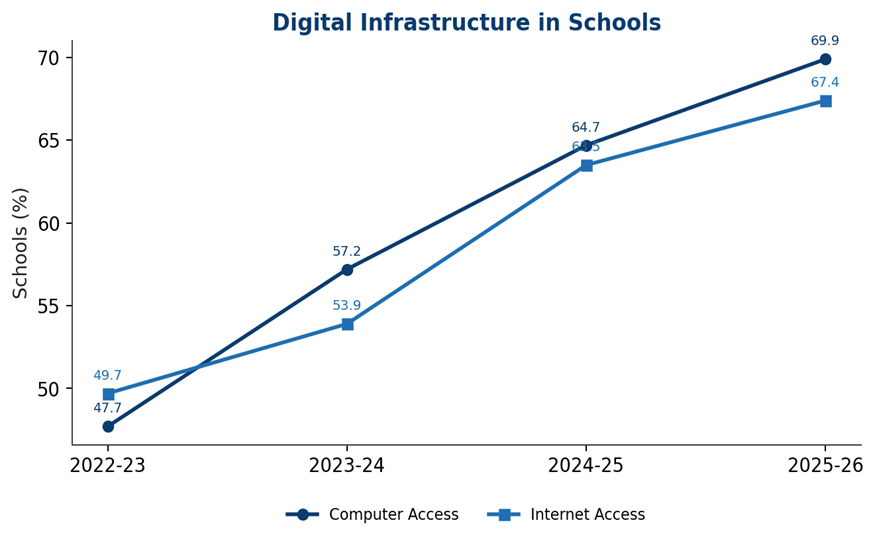
Analysis: Digital infrastructure shows the fastest sustained growth of any category in this report. Computer access has risen 22 percentage points (47.7%→69.9%) and internet access 18 points (49.7%→67.4%) in just four years, with the pace of improvement actually accelerating in 2024-25 and 2025-26 rather than slowing down. Roughly seven in ten schools now have both facilities, though nearly a third of schools still lack them, leaving room for further investment.
9. Basic Infrastructure
Coverage of essential facilities: electricity, drinking water, toilets and handwashing stations.
Coverage of additional amenities: playgrounds, libraries and rainwater harvesting.
Facility (%)
2022-23
2023-24
2024-25
2025-26
Electricity
91.7
91.8
93.6
95.0
Drinking Water
98.4
98.3
99.3
99.5
Girls’ Toilets
97.0
97.2
97.3
98.5
Boys’ Toilets
95.6
95.7
96.2
97.2
Handwash
94.1
94.7
95.9
96.9
Playground
82.0
82.4
83.0
81.9
Library
88.3
89.0
89.5
90.5
Rainwater Harvesting
28.0
28.4
29.4
29.9
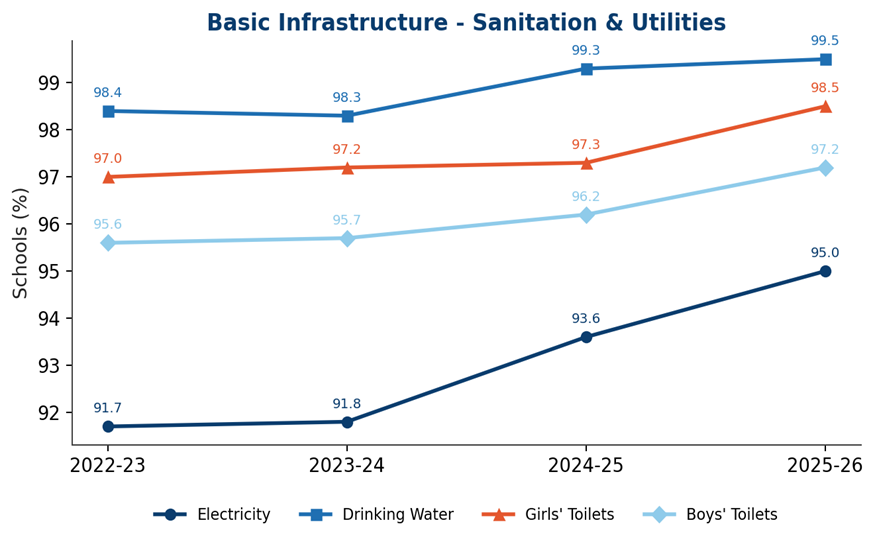
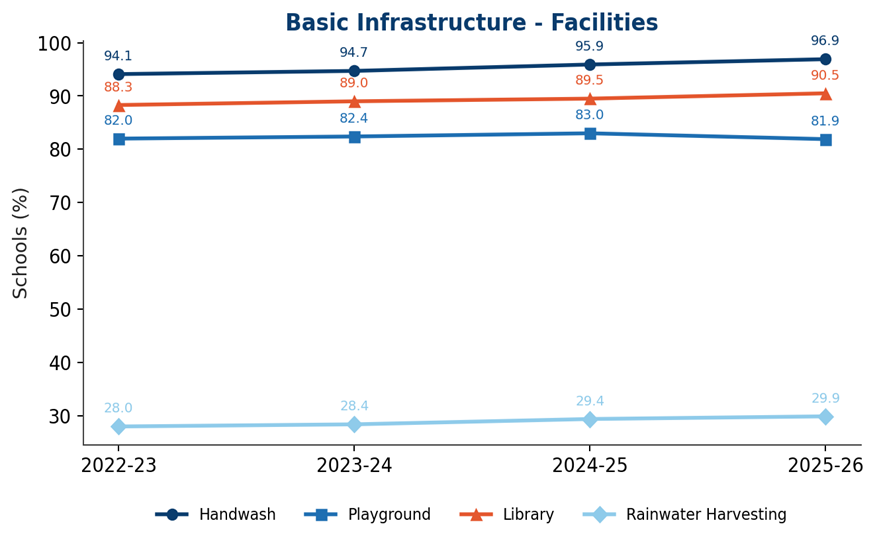
Analysis: Core amenities — drinking water, toilets, electricity, handwash — are now nearly universal (95-99.5%) and have improved steadily each year. Library coverage has grown modestly but consistently (88.3%→90.5%). Two indicators stand out as laggards: rainwater harvesting remains stuck below 30% throughout the entire period, showing almost no meaningful progress, and playground availability actually declined slightly in 2025-26 (83.0%→81.9%) after three years of gains — likely reflecting land constraints in newly added or urban schools rather than an active loss of existing playgrounds.
10. Accessibility — Ramps with Handrails
Share of schools equipped with ramps and handrails, a key marker of accessibility for students with disabilities.
Indicator (%)
2022-23
2023-24
2024-25
2025-26
Ramps with Handrails
51.0
52.3
54.9
58.2
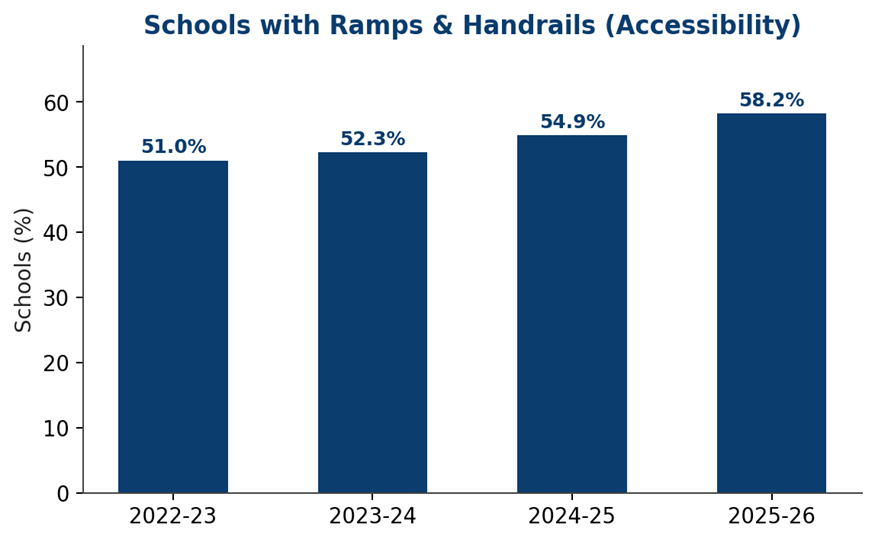
Analysis: Accessibility infrastructure has improved every year, gaining over 7 percentage points in four years (51.0%→58.2%), with the pace picking up in the latest year (+3.3 points in 2025-26 alone, the largest single-year jump). Even so, more than 4 in 10 schools still lack ramps and handrails, making this one of the least-covered basic facilities alongside rainwater harvesting.
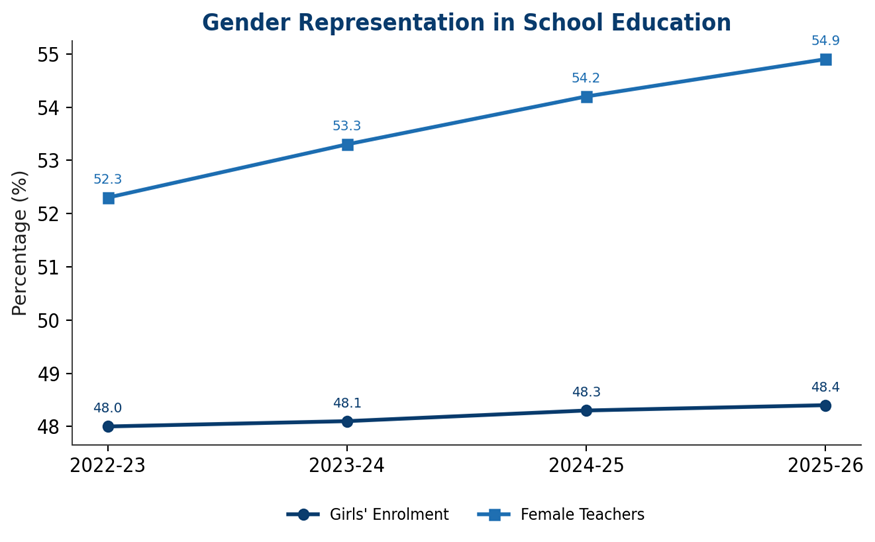
11. Gender Representation
Share of girls in total student enrolment and share of women in the teaching workforce.
Indicator (%)
2022-23
2023-24
2024-25
2025-26
Girls’ Enrolment
48.0
48.1
48.3
48.4
Female Teachers
52.3
53.3
54.2
54.9
Analysis: Girls’ enrolment has been essentially stable near gender parity (48.0%→48.4%) throughout the period — there was little imbalance to correct, and the figure has inched upward slightly each year. Female representation in the teaching workforce has grown more noticeably, from 52.3% to 54.9%, meaning women now make up a growing majority of teachers — a trend that has held in every single year without exception.
Overall Conclusion
Across all eleven parameters tracked from 2022-23 to 2025-26, the UDISE+ data shows a school education system that has improved almost monotonically — most indicators moved in the favourable direction in every single year, with very few exceptions:
Consistently strong, uninterrupted improvement: Teacher numbers, Foundational-to-Secondary transition rates, single-teacher school reduction, digital infrastructure, basic amenities, ramps/handrails, and female teacher share.
Strong overall improvement with one minor wobble: Dropout and retention at the Preparatory/Foundational stages (excellent through 2024-25, slight easing in 2025-26); zero-enrolment schools (a temporary rise in 2023-24 before a sharp, sustained fall).
Areas of stagnation or concern: Rainwater harvesting coverage has barely moved in four years (28.0%→29.9%); playground availability slipped slightly in the latest year; Middle-stage dropout rose marginally in 2025-26 after three years of decline.
Standout performer: Secondary-stage indicators (GER, retention, dropout) show the strongest sustained gains of any stage — the system appears to be successfully addressing what was historically its weakest link.
Taken together, the four-year trend affirms steady progress toward the NEP 2020 goals of universal access, equity and improved retention, while flagging rainwater harvesting, playground space and Middle-stage dropout as the specific areas needing renewed attention going into 2026-27.
Source: Ministry of Education / Press Information Bureau — UDISE+ 2024-25 report (28 Aug 2025) and UDISE+ 2025-26 “Beyond the Numbers” report (17 Aug 2026).
How to use this article Designed for GS-I preparation: build conceptual clarity first, then revise the comparison tables, state-wise folk traditions, instruments, institutions and communities for Prelims; use the analytical themes and cultural linkages for Mains.
1. Introduction and Historical Evolution
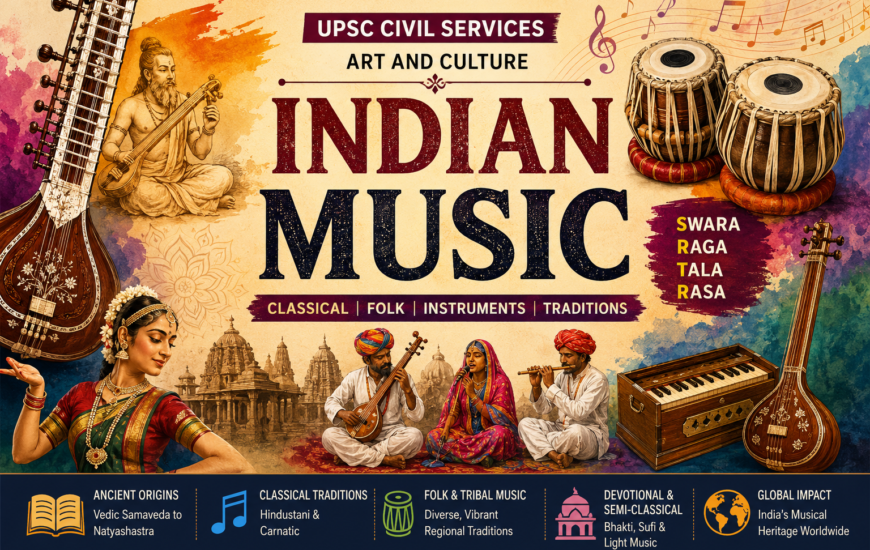
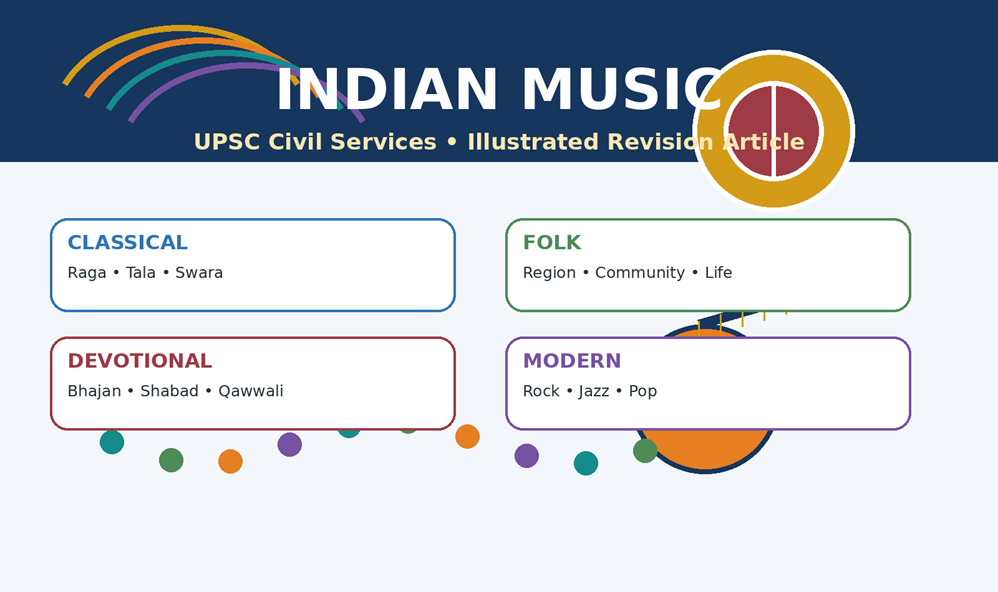
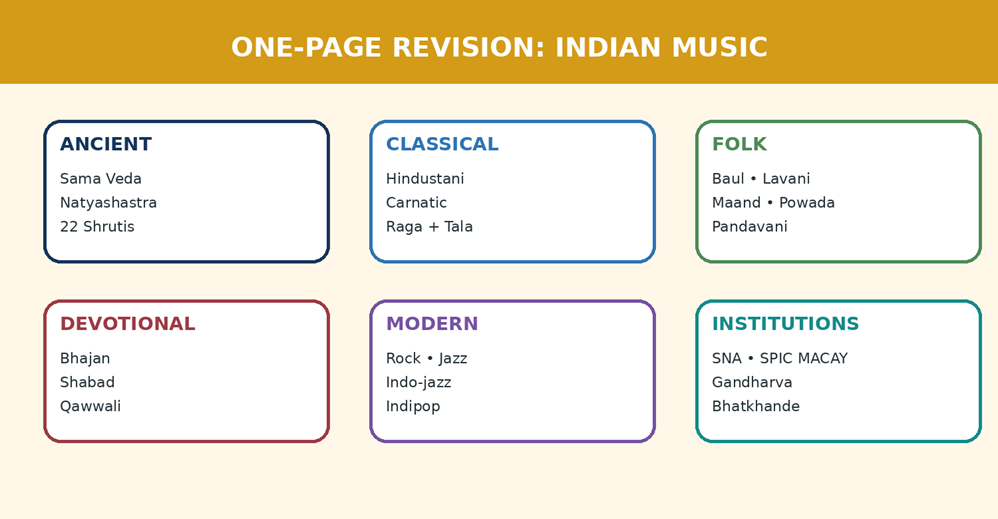
Indian music is presented in the chapter as a major expression of India’s cultural continuity and diversity. Its evolution can be traced from archaeological evidence and Vedic traditions to sophisticated systems of raga, tala and swara, and later to classical, folk, devotional, semi-classical and modern forms.
Early evidence and Vedic foundations
Tradition associates Narada Muni with the introduction of music to earth and with the concept of Naada Brahma — the cosmic sound that pervades the universe.
Archaeological evidence from the Indus Valley Civilization includes a seven-holed flute and the Ravanahatha.
The Vedic period provides the earliest literary traces of Indian music. The Sama Veda is especially important: the seven notes of the raga Kharaharapriya are noted in descending order.
Gandharva Veda, the science of music, is described as an Upaveda of the Sama Veda.
The Aitareya Aranyaka mentions parts of the Veena; the Jaimini Brahmana refers collectively to dance and music; and the Kausitaki Brahmana brings dance, vocal and instrumental music together as an art.
The chapter notes theories connecting Om with the origin of ragas and notes.
Panini (c. 500 BCE) made an early proper reference to the art of making music, while Bharata’s Natyashastra (compiled c. 200 BCE–200 CE) provides the first major systematic treatment of musical theory.
Ancient and medieval musicology
Later Vedic ritual music included Sangama, in which verses were chanted according to musical patterns.
The epics were associated with narrative music called Jatigan.
Bharata’s Natyashastra elaborated the octave and the 22 shrutis (microtonal divisions).
Dathilam also endorsed the existence of 22 shrutis per octave. Sarangadeva later supported this view.
Sarangadeva’s 13th-century Sangeet Ratnakara identified about 264 ragas, including North Indian and Dravidian repertoires, and contributed to the study and classification of microtones.
Matanga’s Brihaddeshi (9th century) focused particularly on the definition of raga.
Nanda’s Sangeeta Makaranda (11th century) enumerated 93 ragas and classified them into feminine and masculine forms.
Ramamatya’s Swaramela-Kalanidhi (16th century) dealt primarily with ragas.
Venkatamakhin’s Chaturdandi-prakasika (17th century) is another important work of musicology.
Guru–shishya and Gurukul tradition
The chapter emphasises the Gurukul/Ashram system as an important mechanism for transmitting musical knowledge. Students lived with the teacher, traditionally for a long period (described as 12 years), learning through direct experience and service. Kings and wealthy patrons supported such hermitages. Princes and commoners were treated alike in the idealised system.
UPSC linkage The evolution of Indian music illustrates continuity with change: Vedic ritual and textual traditions remained foundational, while patronage, religious movements and cultural interactions created new forms and styles.
Persian and Islamic influence
Persian and Islamic influences significantly changed the tenor of North Indian music. The devotional Dhruvapad tradition transformed into Dhrupad by the 15th century. By the 17th century, Khayal had emerged as a major Hindustani form. The period also saw the growth of numerous folk traditions.
2. Anatomy of Indian Classical Music
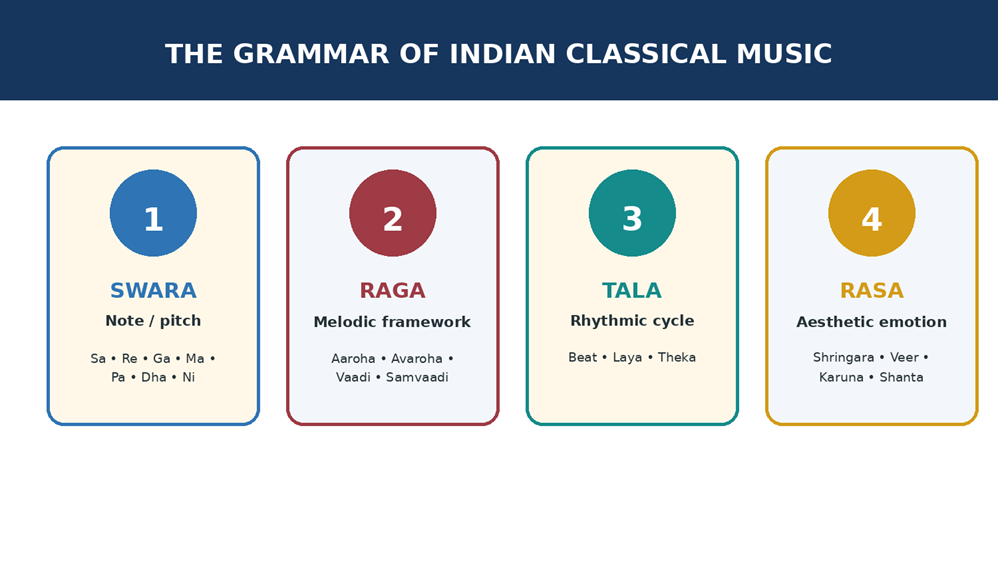
The chapter identifies three pillars of Indian classical music: Swara (pitch/note), Raga (melodic framework) and Tala (rhythmic cycle).
Swara and Shruti
Swara originally had associations with Vedic recitation. In music it denotes a note or scale degree. The seven basic swaras form the Saptak/Sargam:
Sanskrit name
Abbreviation
Functional description
Sadaja
Sa
Tonic
Rishabha
Re/Re
Supertonic
Gandhara
Ga
Mediant
Madhyama
Ma
Sub-dominant
Panchama
Pa
Dominant
Dhaivata
Dha
Sub-mediant
Nishada
Ni
Subtonic
A Shruti is a smaller gradation of pitch or microtone. The chapter describes 22 shrutis in the octave; of these, 12 are treated as audible in its discussion — seven Suddha swaras and five Vikrita swaras.
Raga
The word raga is derived from Sanskrit ‘Ranj’, meaning to delight, please or satisfy. A raga is not merely a scale or mode; it is a precise and aesthetic melodic framework with a characteristic ascending and descending movement and a distinctive emotional personality.
Audav/Odava: pentatonic — 5 notes.
Shadava: hexatonic — 6 notes.
Sampurna: heptatonic — 7 notes.
Shuddha Raag: adding notes absent from the original does not substantially alter its nature/form.
Chhayalag Raag: adding notes not present in the original changes its nature/form.
Sankeerna Raag: combination of two or more ragas.
Vaadi: principal or most important note of the raga.
Samvaadi: second most important note, related as a fourth or fifth to the principal note.
Anuvaadi: other notes used in the composition besides vaadi and samvaadi.
Laya may be Vilambit (slow), Madhya (medium) or Drut (fast).
Six major Hindustani ragas :
Raga
Time
Season
Mood/association
Bhairav
Dawn
Any
Peace
Hindol
Morning
Spring
Sweetness of a young couple
Deepak
Night
Summer
Compassion
Megh
Late night
Rainy
Courage
Shree
Evening
Winter
Gladness
Malkaush
Midnight
Winter
Vir/bravery
Tala and Laya
Tala is the rhythmic grouping/cycle of beats. The chapter notes cycles ranging from 3 to 108 beats. Tala has its own divisions and is conceptually independent of the accompanying music; the uniform tempo of a tala is laya.
Important Hindustani talas mentioned: Dadra, Kaharba, Rupak, Ektal, Jhaptal, Teental and Ada Chautal.
Teental is especially important and uses 16 beats.
Carnatic tala has a more rigid structure and is built from Laghu, Dhrutam and Anu Dhrutam.
The chapter gives 35 basic Carnatic talas, each capable of five subdivisions (‘ghaatis’), giving 175 combinations.
Rasa
Raga is intended not merely to produce sound but to evoke an emotional/aesthetic response called Rasa. The chapter describes the nine Naurasas:
Rasa
Mood
Shringara
Love
Haasya
Humour/laughter
Karuna
Pathos
Roudra
Anger
Bhayanak
Horror/fear
Veer
Bravery
Adbhuta
Wonder
Bibhatsa
Disgust
Shant
Peace/calm
Bhakti (devotion) gained wider acceptance after the 15th century and some musicologists consider it closely related to Shanta. Bharata also associated particular swaras with moods: Madhyam with humour, Pancham with erotic feeling, Shadja with heroism and Rishabh with wrath.
Thaat and Samay
Thaat is a system for classifying ragas into groups. In Hindustani music, V. N. Bhatkhande’s 10-Thaat system is central. A thaat contains seven notes selected from the 12-note system, arranged in ascending order, and is not itself sung or endowed with a rasa; the ragas derived from it are sung.
The 10 Hindustani Thaats
Bilawal
Khamaj
Kafi
Asavari
Bhairavi
Bhairav
Kalyan
Marwa
Poorvi
Todi
Samay is the time theory of raga performance. The 24-hour day is divided into Poorva Bhaag (12 AM–12 PM) and Uttar Bhaag (12 PM–12 AM). The chapter associates the Poorvang saptak with Sa–Ma and the Uttarang with Pa–Sa.
Other important raga components
Alap: gradual, slow exposition of a raga, highlighting vaadi, samvaadi and other characteristic features; generally without words and often in aakar (‘aa’ sound).
Sthayee/Mukhda: first/main part of a Hindustani composition.
Antara: second part of the composition.
Taan: fast, technically demanding patterns of notes demonstrating dexterity and rhythmic variation.
Murki: a short, very fast taan-like cluster of about 3–4 notes.
Alankara: patterned melodic ornamentation/sequences such as Sa-Re-Ga, Ga-Ma-Pa, etc.
Thaat vs Raga — Prelims table
Feature
Thaat
Raga
Nature
Scale/framework
Aesthetic melodic form
Notes
7 notes
At least 5 notes
Movement
Aaroha only
Aaroha + Avaroha
Sung?
No
Yes
Melodic/rasa quality
No inherent emotional quality
Must be melodious and evokes mood
Vaadi/Samvaadi
Absent
Present
Function
Classifies ragas
Performs/expresses melody
3. Classification of Indian Music
The chapter classifies Indian music broadly into classical music, semi-classical styles, folk music and modern music, while also highlighting fusion between classical and folk traditions and later interactions with global genres.
4. Hindustani Classical Music
Hindustani music is associated primarily with northern India. Though its historical roots and Carnatic music trace back to Bharata’s Natyashastra, the two branches diverged around the 14th century. Hindustani music places greater emphasis on musical structure and improvisational possibilities and uses the Shuddha Swara Saptaka/‘octave of natural notes’ in the chapter’s description.
Ten main singing styles listed in the chapter are Dhrupad, Dhamar, Hori, Khayal, Tappa, Chaturang, Ragasagar, Tarana, Sargam and Thumri.
Dhrupad
One of the oldest and grandest Hindustani classical forms; associated with the Natyashastra and older forms such as Prabhanda and Dhruvapada.
The term combines ‘dhruva’ (fixed/unmoving) and ‘pada’ (verse/word).
Consolidated as a classical form by the 13th century; reached a zenith under Akbar, who patronised Baba Gopal Das, Swami Haridas and Tansen. Dhrupad was also associated with the court of Raja Man Singh Tomar of Gwalior.
Declined in the 18th century.
Performance begins with a wordless alap, gradually increasing in tempo; the composed Dhrupad section follows with Pakhawaj.
Temple origins and use of Sanskrit syllables are emphasised.
Compositions commonly have 4–5 stanzas and are often performed by two male vocalists with Tanpura and Pakhawaj.
Four Dhrupad gharana/vani traditions
Tradition
Key features / associations
Dagari/Dagar Gharana
Dagar Vani; strong emphasis on alap; Dagar family traditionally performs in pairs; Muslim performers singing Hindu devotional texts; Gundecha Brothers cited.
Darbhanga Gharana
Khandar and Gauhar Vani; emphasis on alap and composed songs; layakari; Mallik family; Ram Chatur Mallik, Prem Kumar Mallik, Siyaram Tewari.
Bettiah Gharana
Nauhar and Khandar Vani; family-specific techniques; Mishra family; Indra Kishore Mishra; Haveli style associated with Bettiah and Darbhanga.
Talwandi Gharana
Khandar Vani; based in Pakistan, creating continuity challenges within Indian music.
Gharana system
A gharana is a social and artistic organisation linking musicians through lineage/apprenticeship and adherence to a distinctive musical style. The term derives from ‘ghar’ (house/family). A gharana can represent the place where a musical ideology originated and shapes teaching, performance, musical thinking and appreciation.
Important Hindustani vocal gharanas listed include Agra, Gwalior, Indore, Jaipur, Kirana and Patiala.
Khayal
‘Khayal’ is derived from Persian and means idea/imagination.
The chapter attributes its origin to Amir Khusrau and notes major patronage from Sultan Mohammad Sharqi in the 15th century.
It allows substantial improvisation and uses short compositions (about 2–8 lines) called Bandish.
A typical performance includes Bada Khyal (slow) and Chhota Khyal (fast).
Taan is prominent; therefore alap occupies less space than in Dhrupad.
Themes are frequently romantic, devotional or eulogistic; Krishna-related compositions are important.
Major Khayal gharanas
Gharana
Distinctive features
Gwalior
One of the oldest and elaborate Khayal traditions; equal emphasis on melody and rhythm; complex singing with preference for comparatively simple ragas; Nathu Khan and Vishnu Palushkar cited.
Kirana
Named after Kirana in Uttar Pradesh; popularity associated with Abdul Karim Khan and Abdul Wahid Khan; precise tuning, expressive notes, slow-tempo ragas, melody and clarity of text; Bhimsen Joshi and Gangubai Hangal.
Agra
Associated with Khuda Baksh/Haji Sujan Khan in differing accounts; revived and lyrically developed by Faiyaz Khan; blend of Khayal and Dhrupad; emphasis on Bandish.
Patiala
Started by Bade Fateh Ali Khan and Ali Baksh Khan; patronised by Maharaja of Patiala; noted for ghazal, thumri and khayal, rhythm, alankara and intricate taans; Bade Ghulam Ali Khan associated.
Bhendibazaar
Founded by Chhajju Khan, Nazir Khan and Khadim Hussain Khan; long-breath singing; repertoire includes some Carnatic ragas.
Tarana
Tarana gives rhythm a central role. A short melody is repeated and varied, with a contrasting higher melody introduced before returning to the main theme. Fast rhythmic syllables and complex rhythmic manipulation demand specialised training. The chapter cites Pandit Rattan Mohan Sharma of the Mewati Gharana as a leading Tarana singer and notes the title ‘Tarana ke Baadshah’ awarded to him in 2011.
5. Semi-Classical Styles of Hindustani Music
Semi-classical music retains the swara foundation but relaxes the strictness of classical raga/tala treatment. The chapter notes lighter raga versions, lighter talas, Madhya/Drut laya and greater emphasis on bhava and lyrics than on alap-jod-tan-jhala.
Thumri
Based on mixed ragas; generally romantic or devotional.
Strongly influenced by Bhakti traditions; Krishna-love themes are common.
Lyrics may use Hindi, Awadhi or Braj Bhasha.
Often sung in a female voice; characterised by sensuality and freedom to improvise.
Purbi Thumri: slower; Punjabi Thumri: faster and livelier.
Banaras and Lucknow are major centres; Begum Akhtar is highlighted.
The term thumri can also cover lighter forms such as Dadra, Hori, Kajari, Saavan, Jhoola and Chaiti.
Tappa
Fast, subtle and knotty melodic-rhythmic construction; quick turns of phrases.
Originated in folk songs of camel riders of north-west India.
Entered the semi-classical tradition through the Mughal court of Muhammad Shah.
The Baithaki style developed under zamindari patronage in late 19th/early 20th-century salons and entertainment halls.
The chapter notes that the form is declining and lists Mian Sodi, Pandit Laxman Rao of Gwalior and Shanno Khurana among its few exponents.
Ghazal
A poetic form of rhyming couplets with a refrain and common metre; conventionally not more than 12 ashaar/couplets in the chapter’s description.
Origin associated with Iran in the 10th century; spread into South Asia from the 12th century through Sufi mystics and Islamic Sultanate courts; reached a high point during the Mughal period.
Traditionally deals with love, especially love, loss and separation; South Asian ghazal carries Islamic mystical influence and permits the beloved to be interpreted as human or divine.
Traditional classical rendering was relatively difficult for wider audiences; later simplification of language and phrasing broadened its reach.
Associated names include Rumi, Hafiz, Muhammad Iqbal, Mirza Ghalib and Kazi Nazrul Islam.
6. Carnatic Music
Carnatic music is the southern branch of Indian classical music. The chapter describes it as kriti-based, with greater emphasis on saahitya (lyric quality), while using the traditional octave and fixed tala structures.
Kriti and components of a Carnatic composition
Kriti: a highly evolved composition set to a raga and fixed tala/rhythmic cycle.
Pallavi: first/initial thematic line(s), often repeated; central to Ragam Thanam Pallavi, which provides major scope for improvisation.
Anu Pallavi: usually two lines following the Pallavi; may recur near the end but need not follow every Charanam.
Varnam: usually performed at the beginning of a recital; introduces the raga; divided into Purvanga and Uttaranga.
Ragamalika: usually concluding section; permits extensive improvisation but returns to the original theme.
Swara-Kalpana: improvised swara passages, often with the drummer in medium/fast pace.
Thanam: melodic improvisation in free rhythm with mridangam.
Ragam: corresponding pieces of melodic improvisation without mridangam.
Important nuance Although the chapter’s comparison table describes Carnatic music as having less improvisational freedom than Hindustani music, Carnatic performance itself contains substantial structured improvisation — especially in Ragam Thanam Pallavi and Swara-Kalpana.
7. Hindustani vs Carnatic — High-Yield Comparison
Dimension
Hindustani
Carnatic
Core region
North India
South India
Historical interaction
Greater Arab, Persian and Afghan influence
Described in the chapter as more indigenous
Improvisation
Greater scope for variation
More prescribed/structured overall, but with important improvisatory sections
Sub-styles
Multiple styles and gharanas
More unified prescribed tradition in the chapter’s comparison
Instrumental emphasis
Instruments highly important along with vocals
Greater emphasis on vocal/lyric quality
Raga figure in chapter
6 major ragas
72 ragas (as stated in the comparison table)
Time theory
Adheres to raga time
Does not adhere to the same time system
Major instruments
Tabla, Sarangi, Sitar, Santoor
Veena, Mridangam, Mandolin
Common instruments
Flute, Violin
Flute, Violin
8. Folk Music of India — State/Region-wise Revision
Folk music reflects India’s geographical and social diversity. Unlike classical music, which follows codified principles and a guru-shishya tradition, folk music is the music of the people and has no rigid universal rules. It is often rhythmic, theme-based and linked with dance, work, rituals, life-cycle events, local heroes, religion and nature.
Tradition
Region
UPSC-ready features
Baul
West Bengal
Mystical/religious folk tradition; Bhakti and Sufi influences; Baul Gaan; Lalon Phakir and others.
Courtly roots; neither full classical raga nor unrestricted folk; Rajput glory; ‘Kesariya Balam’.
Dandiya Raas
Gujarat/Western India
Holi/Krishna-Radha associations; major Navratri tradition; men and women dance with sticks.
Powada
Maharashtra
Heroic ballads, especially Shivaji and past deeds.
Khongjom Parva
Manipur
Musical narration of the 1891 Khongjom battle.
Bhavageete
Karnataka & Maharashtra
Emotional songs; nature, love, philosophy; close to ghazal in musical character.
Mando
Goa
Indian-Western blend; guitar, violin and ghumot.
Kolannalu/Kolattam
Andhra Pradesh, Karnataka, Tamil Nadu
Rhythmic dance form similar to Dandiya; music accompanies dance.
Other major folk traditions
Tradition
Region
Theme / feature
Sohar
Bihar
Childbirth
Tikir
Assam
Teaching of Islam
Ja-jin-ja
Arunachal Pradesh
Marriage
Nyioga
Arunachal Pradesh
End of marriage ceremony
Heliamleu
Nagaland
Dancing songs
Neuleu
Nagaland
Legends and myths
Hereileu
Nagaland
War songs
Hekaileu
Nagaland
Songs about oneself
Dollu Kunitha
Karnataka
Men of Kuruba community; named after Dollu percussion instrument
Naatupura Paatu
Tamil Nadu
Village and city folk music
Veeragase
Karnataka
Hindu mythology; also Dussehra procession
Pala & Daskathia
Odisha
Religious ballads
Manganiars
North-West India
Songs of Alexander, local kings and battles
Dhadi
Punjab
Ballads of bravery
Basant Geet
Garhwal/Uttarakhand
Basant Panchami
Villu Pattu
Tamil Nadu
Religious; victory of good over evil
Sukar ke Biah
Bihar
Love between Shukra and Brihaspati
Saikuti Zai
Mizoram
Praise of brave men/hunters
Lai Haroba Festival songs
Manipur
Religious; Umang-Lai/forest deity
Chhakri
Kashmir
Fairy tales and love stories
Bhuta songs
Kerala
Songs against evil/ghosts
Khubakeshei
Manipur
Accompanied entirely by clapping
Fusion of Classical and Folk: Sugam Sangeet and Related Forms
classical and folk traditions often intermingle, particularly through devotional music. Devotional themes provide a bridge because both royalty and common people have historically patronised deities.
Sugam Sangeet
Sugam Sangeet is presented as devotional music bringing classical and folk traditions together, with roots in earlier devotional forms such as Prabandha Sangeet and Dhruvapada.
Bhajan
Popular devotional singing, especially in North India; closely linked to the Bhakti movement.
Simple melodies, generally set in one or more ragas.
Themes include the lives of gods and goddesses and episodes from the Ramayana and Mahabharata.
Common instruments: chimta, dholak, dhaphli and manjira.
Medieval exponents include Mirabai, Tulsidas, Surdas and Kabir; modern singers mentioned include Anup Jalota and Anuradha Paudwal.
Shabad
Devotional music associated with Sikhism and sung in gurdwaras in praise of the Gurus.
Guru Nanak and his disciple Mardana are associated in the chapter with its development and popularity.
Three types are identified: raga-based Shabad, traditional shabds in the Adi Granth, and lighter forms.
Singh Bandhus and Bhai Santa Singh are cited among known exponents.
Qawwali
Devotional Sufi/Islamic music praising Allah, the Prophet Muhammad or Sufi saints.
Generally composed in a single raga; lyrics may be in Urdu, Punjabi or Hindi, with Braj Bhasha and Awadhi also used.
Performed at Sufi shrines; commonly uses tabla, dholak and harmonium.
Tempo and intensity build progressively to induce a transcendental state.
Amir Khusrau is sometimes credited with its origin, but the chapter explicitly notes that this attribution is disputed.
Major names mentioned: Sabri Brothers, Nusrat Fateh Ali Khan and Aziz Warisi.
Other Sugam Sangeet forms :
Form
Region
Key feature
Abhanga
Maharashtra
Praise of Vithoba; associated with Tukaram, Namdev and others.
Bhatiali
Bengal
Nature and daily life; traditionally sung by boatmen.
Tevaram
Tamil Nadu
Shaivite devotional tradition; Oduyars.
Kirtan
Bengal
Singing and dancing; inspiration from Gita Govinda.
Rabindra Sangeet
Music created/composed in the tradition of Rabindranath Tagore.
Blends classical elements with Bengali folk strains.
The chapter notes more than 2,000 songs being performed.
Themes include worship, nature, love, celebration of life and patriotism/national commitment.
Gana Sangeet
Group/choral fusion music, often carrying patriotic messages or social criticism. It may address exploitation of women and children and other social concerns. The chapter gives Vande Mataram as a popular example of patriotic Gana Sangeet.
Haveli Sangeet
Originated mainly in Rajasthan and Gujarat as temple music and later moved beyond temple premises. It is associated with the Pushtimarg Sampradaya.
10. Modern Indian Music
Indian Rock
Combines Indian musical elements with mainstream rock and is often India-centric in subject while retaining global rock conventions.
Indian musicians began fusing rock with traditional Indian music from the mid-1960s; film music often overshadowed the independent rock scene.
The chapter cites Usha Uthup among early rock singers from India.
Cultural influence was two-way: Indian classical music influenced Western rock, with George Harrison’s Ravi Shankar-inspired raga rock and the Beatles’ engagement with Indian spiritual/cultural traditions cited as milestones.
Jazz and Indo-Jazz
Jazz in India is traced to Bombay in the 1920s, when African-American jazz musicians performed for private audiences in elite hotels.
Goan musicians helped carry the form into wider Indian musical and film circles.
The chapter calls 1930–1950 the ‘Golden Age’ of jazz in India.
Musicians such as Leon Abbey, Crickett Smith, Creighton Thompson, Ken Mac, Roy Butler and Teddy Weatherford are mentioned.
Indian classical music and jazz both value improvisation; collaborations from the 1940s helped create Indo-jazz, combining jazz, classical and Indian influences.
Ravi Shankar and John Coltrane are cited among pioneers/important figures in the interaction; Indian classical influence also extended to free jazz.
Indi-pop
Combines Indian musical elements with pop; also called Indipop/Hindipop.
The British-Indian fusion band Monsoon used the term ‘Indipop’ for an album in 1981.
The genre expanded in the early 1990s through Alisha Chinai, Biddu and MTV India.
Bollywood became a major source of Indian pop; remix culture attempted to renew old film songs with new beats but attracted criticism and the earlier Indi-pop phase declined.
The chapter mentions Mohit Chauhan, Mika Singh, Raghav Sachar and Papon among contemporary pop musicians.
11. Musical Instruments — Four Traditional Categories :
Traditional instruments are grouped into four broad categories based on how sound is produced
Category
Scientific/modern equivalent
Principle
Examples / UPSC facts
Avanaddha / Awanad Vadya
Membranophones
Sound from stretched membrane/skin struck or beaten.
Tabla, drum, dhol, congo, mridangam; Bhumi Dundubhi described as an ancient example. Tabla accompanies Hindustani vocals; mridangam accompanies Carnatic music.
Sushira Vadya
Aerophones
Wind instruments; air column produces sound.
Bansuri, shehnai, pungi, etc. Shehnai is double-reeded with flaring tube; Bismillah Khan is associated with its zenith. Flute is traced to Vedic usage and was called Nadi/Tunava.
Ghana Vadya
Idiophones
Solid instruments; no tuning required in the conventional sense.
Manjira, Jaltarang, Kanch-tarang, Jhanj, Khartal. Manjira is a small brass cymbal and has Harappan archaeological associations; used to maintain rhythm/time.
Tata Vadya
Chordophones
Strings produce sound, modified by hand/bow/plectrum.
Sarangi, Esraj, violin; Sitar, Veena, Tamboora; Gotuvadyam and Swaramandal. Veena is associated with Saraswati.
Tata Vadya sub-types
Bowed: bow drawn across strings — Sarangi, Esraj, Violin.
Plectral/plucked: strings plucked by fingers or plectrum — Sitar, Veena, Tamboora.
Struck: strings struck with small hammer/sticks — Gotuvadyam, Swaramandal.
The Bhangash family is associated with pioneering the Sarod in the 20th century.
Sitar gharanas mentioned: Jaipur, Varanasi and Etawah (Imaad Khani).
12. Folk Musical Instruments — Prelims Map :
Type
Instrument
Region/community/use
Chordophone
Tumbi
Punjab; Bhangra
Chordophone
Ektara / Tun Tuna
One-stringed; wandering monks
Chordophone
Dotara
Two-stringed; Bauls
Chordophone
Chikara
Rajasthan, Uttar Pradesh, Madhya Pradesh
Chordophone
Dilruba / Esraj
Punjab; also accompanies Rabindra Sangeet in eastern India
Chordophone
Onavillu
Kerala; bamboo
Chordophone
Sarinda
Santhals in eastern India; also Rajasthan and Assam; Sarangi-like
Aerophone
Pungi / Been
Snake charmers; dried bottle gourd + bamboo
Aerophone
Algoza
Double flute; North-West India, especially Punjab
Aerophone
Tangmuri
Khasi hill people, Meghalaya
Aerophone
Titti
Goat-skin bagpipe-like instrument; South India, especially Kerala and Andhra Pradesh
Aerophone
Mashak
Garhwal/Uttarakhand; also noted in Rajasthan/Uttar Pradesh in the chapter
Aerophone
Gogona
Bamboo; Bihu, Assam
Membranophone
Ghumot
Goa; Ganesh festival
Membranophone
Idakka
Kerala; damru-like
Membranophone
Udukai
Tamil Nadu; hourglass-shaped
Membranophone
Sambal
Konkan, Maharashtra; played with sticks
Membranophone
Tamak
Santhal tribe; two-headed drum
Membranophone
Diggi
Ghariya village, Uttar Pradesh; folk drum
Idiophone
Chimpta
Punjab; evolved from fire tongs
Idiophone
Gharha
Earthen pots; Punjab folk music
Idiophone
Andelu
Burra-Katha; pair of hollow metal rings
13. Modern Developments and Institutions
Gandharva Mahavidyalaya
V. D. Palushkar established the institution in 1901 to teach and transmit Indian classical music and dance. It began in Lahore and shifted to Mumbai in 1915. The chapter describes its focus on Hindustani and Carnatic classical music and notes its devotional orientation and the associated Prayag Samiti in Allahabad.
Sangeet Natak Akademi
Established in 1952 as India’s first national academy for the arts under the Government of India.
Focuses on music, dance and drama and serves as a national platform for performing arts and intangible cultural heritage.
Works with States and Union Territories to preserve and promote cultural traditions.
Administers institutions including the National School of Drama, established in 1959 for focused work in dramatics.
Marris College of Music → Bhatkhande Music Institute
Vishnu Narayan Bhatkhande founded the institution in 1926 in Lucknow to integrate music theory with practical training in singing and instrumental performance. It was later renamed the Bhatkhande Music Institute.
SPIC MACAY
Founded by Kiran Seth in 1977.
Full form: Society for Promotion of Indian Classical Music and Culture Amongst Youth.
Started as a voluntary youth movement to reconnect younger generations with Indian classical and cultural traditions.
Promotes classical music, dance and culture through events, many of them free-entry, and has grown into a network with more than 200 chapters/branches worldwide according to the chapter.
14. Communities Related to Music
Community/group
Region
Music/cultural association
Langha (Muslim tribal community)
Gujarat & Rajasthan
Entertain Muslim Rajputs; praise them through songs.
Manganiar / Merasi
Rajasthan
Use Kamaicha; perform classical-folk music.
Karta Bhajas
West Bengal
Four classes; chanting mantras leading to spiritual perfection in their belief.
Bauls
West Bengal
Mystic countryside singers; described as one class of Kartabhaja.
Jogi
Rajasthan
Music-linked community listed in the chapter.
Bhopa
Rajasthan
Music-linked community listed in the chapter.
Barot, Charan, Gadhvi
Gujarat
Traditional bardic/music communities.
Muria tribes
Madhya Pradesh
Sing Relo songs.
Kamar community
Chhattisgarh
Marriage songs.
Baghela
Madhya Pradesh
Semi-historical songs devoted to Hardaul deity.
Pulayar hill tribes
Tamil Nadu
Perform melodies called talams.
Idu Mishmis
Arunachal Pradesh
Ritual and fertility dances.
Moken tribe
Andaman & Nicobar Islands
Ancestor worship and ritual tribal dance.
15. UPSC Prelims Quick Revision Sheet
Remember the 3 pillars SWARA = note/pitch | RAGA = melodic personality/framework | TALA = rhythmic cycle. RASA = emotional/aesthetic response.
Ancient texts and what to associate
Text/person
Association
Sama Veda
Vedic musical tradition; Gandharva Veda as Upaveda; seven notes referenced in the chapter.
Aitareya Aranyaka
Parts of Veena
Jaimini Brahmana
Dance + music
Kausitaki Brahmana
Dance + vocal + instrumental music
Panini
Early proper reference to art of making music
Bharata — Natyashastra
Major early systematic musical theory; octave and 22 shrutis
Dathilam
22 shrutis
Matanga — Brihaddeshi
Definition of raga
Nanda — Sangeeta Makaranda
93 ragas; masculine/feminine classification
Sarangadeva — Sangeet Ratnakara
About 264 ragas; microtones; North + Dravidian repertoires
Ramamatya — Swaramela-Kalanidhi
Raga-focused musicology
Venkatamakhin — Chaturdandi-prakasika
Important musicological work
V. N. Bhatkhande
10-Thaat system; major North Indian musicologist
Fast associations
Dhrupad → Alap + Pakhawaj + temple/Sanskrit association + Akbar/Tansen + four vani/gharana traditions.
Indian music demonstrates continuity through enduring concepts such as swara, raga, tala, rasa, textual traditions and guru-shishya transmission. At the same time, it continuously absorbed new influences: Persian and Islamic elements shaped North Indian music; Bhakti and Sufi movements popularised devotional forms; folk traditions supplied themes and melodies; and modern interactions produced rock, jazz, pop and fusion.
Theme 2: Cultural syncretism
Indian music is a strong example of syncretism. Dhrupad traditions include Muslim performers singing Hindu devotional texts; Baul music combines Bhakti and Sufi influences; Qawwali developed in the South Asian Sufi milieu; Mando combines Indian and Western traditions; Indo-jazz and raga-rock show cross-cultural exchange. Such examples support arguments about India’s composite cultural heritage.
Theme 3: Classical–folk continuum
The classical and folk categories should not be treated as isolated. Maand occupies an intermediate position; Sugam Sangeet, Bhajan, Shabad and Qawwali connect formal musical structures with popular devotional practice; Rabindra Sangeet combines classical and Bengali folk elements. This continuum helps explain how culture is transmitted between elite, religious and community settings.
Theme 4: Institutions and cultural preservation
Institutional support is important for preventing decline in traditional music. Gandharva Mahavidyalaya, Sangeet Natak Akademi, Bhatkhande Music Institute and SPIC MACAY represent different models — formal education, national cultural policy, musicological training and youth-oriented cultural outreach.
Theme 5: Threats and preservation
Some traditions in the chapter are explicitly described as declining or having very few active exponents, such as the Baithaki style of Tappa.
Transmission through hereditary communities and guru-shishya traditions can weaken when younger generations shift away from traditional occupations.
Commercial film/pop dominance can overshadow independent or traditional forms.
Preservation requires documentation, institutional support, performance opportunities, education, community participation and youth engagement.
A ready-made Mains conclusion
Conclusion Indian music is not a static inheritance but a living cultural system. Its strength lies in the coexistence of codified classical traditions, flexible folk practices, devotional syncretism and modern experimentation. Preserving this diversity requires transmitting both the musical grammar and the community contexts that give each tradition its meaning.
Indian painting has an unbroken tradition from prehistoric rock art through illustrated manuscripts, miniature schools, colonial hybrids, and modern/folk art. Broad arc: rock art → Indus painted pottery → Gupta-age murals (real “beginning” of the art) → miniature schools (Pala/Apabhramsa → Sultanate → Mughal/Rajput/Pahari/Deccan) → colonial Company & Bengal schools → modern & folk traditions.
Shadanga — The Six Limbs of Painting (mentioned by Vatsyayana in the Kamasutra, 3rd century CE):
Sanskrit Term
Meaning
Rupabheda
Variety of form
Sadrisyam
Portrayal of likeness of the subject
Bhava
Creation of luster and gleam with colours
Varnikabhanga
Mixing of colours to resemble the effects of modelling
Pramanam
Proportion of the object/subject
Lavanyayoganam
Immersion of emotions (“aesthetic bliss”)
Other terms from Brahmanical/Buddhist literature: Lepya Chitra (myths/lore represented on textiles), Lekhya Chitra (line drawings/sketches), Dhuli Chitra, Pata Chitra. Vishakhadutta’s play Mudrarakshasa names painting styles (patas): Cauka Pitaka (isolated framed drawings), Dighala Pitaka (long scrolls), Yama Pitaka (isolated paintings).
2. Pre-Historic Paintings
Executed on rocks (rock engravings = Petroglyphs). First discovered at Bhimbetka caves (MP) in 1957–58 by V.S. Wakankar; called the “Zoo Rock Shelter” for its animal depictions (elephant, rhino, cattle, snake, deer, bison, barasingha).
Three major phases:
Phase
Period
Features
Upper Paleolithic
40,000–10,000 BCE
Quartzite rock walls; mineral pigments (ochre/geru + lime + water); colours — red, white, yellow, green; large animals (bison, elephant, rhino, tiger); red for hunters, green for dancers
Mesolithic
10,000–4,000 BCE
Mainly red colour; smaller paintings; group hunting, grazing, riding scenes
Chalcolithic
—
More green/yellow; battle scenes; men riding horses/elephants with bows
Later-period sites show Ashokan/Gupta Brahmi inscriptions (proving continued habitation): Jogimara Caves (Ramgarh hills, Surguja, Chhattisgarh, ~1000 BCE — love story in Brahmi script; attached to the Sitabenga rock-cut theatre), Narsinghgarh (MP — deer-skin tanning scenes, harp, geometric spirals), and Chhattisgarh sites — Kanker district (Udkuda, Garagodi, Khairkheda, Gotitola, Kulgaon), Koriya district (Ghodsar, Kohabaur), Durg district (Chitwa Dongri — a Chinese figure on a donkey, dragons), Bastar (Limdariha), Sarguja (Oogdi, Sitalekhni).
Bhimbetka Rock Paintings (detailed):
South of Bhopal, Vindhyan ranges, MP; 500+ rock shelters; UNESCO World Heritage Site (2003).
Oldest paintings ~30,000 years old; continuous occupation from 100,000 BCE to 1000 CE (paintings layered on top of one another).
Spans Upper Paleolithic → Mesolithic → Chalcolithic → early historic → medieval (most belong to the Mesolithic age).
Themes: everyday life (stick-like human figures), hunting/war scenes (bows, arrows, spears, shields, swords), geometric designs, dancing, music, animal fights, honey collection, children playing, women cooking, community dance.
Colours: red ochre, purple, brown, white, yellow, green — from natural sources (e.g., Haematite → red).
3. Classification of Indian Paintings
A. Mural Paintings
Paintings on walls/solid structures; existed in India 10th century BCE – 10th century CE; found at Ajanta, Armamalai, Ravan Chhaya, Bagh, Sittanavasal, Kailasanatha Temple (Ellora), etc. — mostly natural caves/rock-cut chambers; themes: Hindu, Buddhist, Jain (occasionally secular, e.g. Jogimara’s theatre-room decoration).
Ajanta Cave Paintings
29 rock-cut caves (horseshoe-shaped), carved from volcanic rock beginning 4th c. CE; took 4–5 centuries to complete.
Caves 9 & 10 murals — Sunga period; rest — Gupta period; Caves 1 & 2 are the most recent.
Themes: Jataka tales, life of Buddha, decorative flora/fauna; unique — each female figure has a distinct hairstyle; emotions shown via hand gestures; medium = vegetable & mineral dyes; outlines in red ochre, contours in brown/black/deep red.
Key works: Padmapani mural; Bodhisattvas in tribhanga pose in Cave 1 — Vajrapani (Buddha’s power), Manjusri (wisdom), Padmapani/Avalokitesvara (compassion); The Dying Princess (Cave 16); Shibi Jataka (king offers his flesh to save a pigeon); Matri-Poshaka Jataka.
Jataka Stories (quick reference): tales of Buddha’s former births (human/animal) illustrating a virtue — The Ass in the Lion’s Skin, The Cock and the Cat, The Foolish Timid Rabbit, The Jackal and the Crow, The Lion and the Woodpecker, The Ox Who Envied the Pig, The Swan with Golden Feathers, King Shibi, The Turtle Who Couldn’t Stop Talking.
Ellora Cave Paintings — confined mostly to the Kailasa Temple, in two phases (during carving, and centuries later). Earlier phase: Vishnu-Lakshmi borne by Garuda. Later phase (Gujarati style): procession of Shaiva holy men. Covers all three religions. Key images: Lakshmi & Vishnu, Shiva with followers, graceful Apsaras.
Bagh Cave Paintings (MP) — extension of the Ajanta school; figures more tightly modeled, stronger outlines, more “earthly/human,” more secular. Cave 4 (“Rang Mahal”) has the best-preserved Buddhist/Jataka murals.
Armamalai Cave Paintings (Vellore, TN) — natural caves converted to a Jain temple (8th c.); depict the Ashtadikpalakas (guardian deities of 8 directions) and Jain themes.
Sittanavasal (Arivar Koil) Paintings (Pudukkottai, TN) — Jain rock-cut caves; resemble Bagh/Ajanta; painted on walls, ceiling, and pillars; central theme = Samavasarana (Jain preaching hall) with a lotus pond, ducks, swans, fish; attributed either to Pallava king Mahendravarman I or a 7th-c. Pandya renovation; medium = vegetable/mineral dyes on wet lime plaster; colours — yellow, green, orange, blue, black, white.
Ravan Chhaya Rock Shelter (Keonjhar, Odisha) — half-open-umbrella-shaped shelter, believed a royal hunting lodge; famous royal procession fresco (7th c.); also Chola-period remains (11th c.).
Lepakshi Paintings (Anantapur, AP) — Veerabhadra Temple walls, 16th c., Vijayanagara period; themes from Ramayana/Mahabharata/Vishnu avatars; notable for complete absence of primary colours (esp. blue); marks a decline in painting quality; black-outlined figures.
Jogimara Cave Paintings (Surguja, Chhattisgarh) — ~1000–300 BCE; Brahmi inscriptions telling a love story; dancing couples, elephants, fish; red outline with white/yellow/black; adjoins the Sitabenga rock-cut theatre.
Badami Cave Temple Murals (Karnataka) — 6th–7th c. CE; among the earliest surviving Hindu paintings; resemble Ajanta/Bagh tradition; big half-closed eyes, protruding lips; Chalukyan kings, Jain saints, Shiva-Parvati, Puranic scenes; Cave 3 — four-armed Brahma on his swan.
B. Miniature Paintings
★ QUICK FACT : Miniature comes from Latin minium (red lead paint) — not from “minimum”. A classic word-origin trap in Prelims.
“Miniature” ← Latin minium (red lead paint used in Renaissance illuminated manuscripts) — not related to “minimum” (size is incidental, not definitional).
Technical conventions: painting not larger than 25 sq. inch; subject painted at ≤ 1/6th actual size (e.g., a 9-inch head painted no larger than 1.5 inches); figures usually shown in side profile, with bulging eyes, pointed nose, slim waist; Rajasthani figures — brown skin; Mughal figures — fairer skin; Krishna/divine beings shown blue; women — long black hair; men — turbaned, traditional dress.
Early Miniature (8th–12th century)
Pala School of Art (750–1150 CE) — Buddhist manuscript illustrations on palm leaf/vellum (only banana/coconut-leaf material, per Buddhist non-violence norms); sinuous lines, subdued tones, solitary figures (rarely group scenes); simple compositions; patronised by Buddhist/Vajrayana rulers; painters — Dhimman and Vitapala.
Apabhramsa School of Art (11th–15th c.) — origin: Gujarat & Mewar (Rajasthan); dominant western-Indian school; themes — Jain (later appropriated by Vaishnava school, adding Gita Govinda & secular love); early phase on palm leaf, later on paper; colours — red, yellow, ochre (later: bright + gold); features — fish-shaped bulging eyes, pointed nose, double chin, stiff figures, enlarged hips/breasts on female figures, animals drawn “like toys”; masterpieces — Kalpasutra and Kalakacharya Katha (15th c.).
Transition Period Miniature (from 14th c.)
Arrival of Muslim rule → cultural synthesis (not replacement) — traditional styles survived in western Indian courts; in Vijayanagara, a Deccan-influenced style emerged. Features: flat colour application, black outlines, three-quarter profile faces, stylised (non-naturalistic) landscapes.
Delhi Sultanate Miniature — fusion of Persian + Indian elements; finest example: Nimatnama (a cookery book) under Nasir Shah of Mandu; also the Lodi Khuladar style (between Delhi–Jaunpur). These Sultanate precedents fed into three major schools: Mughal, Rajput, Deccan.
Mughal Era Miniature Painting :
Shift from religious subjects to glorifying the ruler — hunting scenes, historical events, court life; Persian naturalism + imperial opulence; introduced foreshortening (objects drawn to look smaller/closer than actual).
Ruler
Contribution
Babur
Too short a reign; patronised Persian artist Bihzad (Mughal family-tree illustrations)
Humayun
Great patron; in Persian exile (Shah Abbas’s court) recruited Abdus Samad & Mir Sayyid Ali, who later created the Tutinama (Tale of a Parrot) under Akbar
Akbar
Established Tasvir Khana (state atelier, salaried artists); “Indian influence” begins as native artists were absorbed; 3-D figures + foreshortening; encouraged calligraphy; shift from popular to court art; painters — Daswant, Basawan, Kesu; key manuscripts — Tutinama, Hamzanama, Anvar-i-Suhaili, Gulistan of Sadi
Jodhpur/Bikaner ruled by Rathods, Jaisalmer by Bhatis; Mughal-pattern early, Rajput-dominant after 18th c.; peak under Man Singh (1803–1843) — Shiva Purana, Natacharitra, Durgacharitra, Panchtantra series
Rajput vs Mughal Style — Key Differences :
Basis
Rajput Style
Mughal Style
Type
Mural/fresco origin → later miniature
Based on Persian miniature style
Themes
Devotional/religious
Emperor & household; pomp, battles, hunts
Peculiarity
Hindu symbols — lotus, peacock, swan
Focus on the person, or on trees/camels/falcons
Time period
Mainly 17th–18th century
16th–18th century
Pahari Styles of Painting — sub-Himalayan princely states (~22 states, Jammu to Almora) under loose Mughal overlordship; two groups: Jammu/Dogra School (Northern series) and Basholi & Kangra School (Southern series); many figures per canvas, full of movement; leading painters — Nainsukh and Manaku.
Basholi School (17th c., earliest phase): receding hairlines, big lotus-petal-shaped eyes; primary colours (red/yellow/green); Mughal cloth-painting technique + own style; first patron — Raja Kirpal Singh (Rasamanjari, Gita Govinda, Ramayana); leading painter — Devi Das (Radha-Krishna, royal portraits); colour-contrast borrowed from Malwa paintings.
Kangra School — emerged after Mughal decline, when displaced artists found patronage under Raja Govardhan Singh (1774); began at Guler, peaked under Raja Sansar Chand; sensuous, intelligent style; themes — Gita Govinda, Bhagwata Purana, Satsai of Biharilal, Nal-Damyanti; famous “Baramasa” (Twelve Months) series; parent school to Kullu, Chamba, Mandi ateliers.
Ragamala Paintings — illustrate the Ragamala (“Garland of Ragas”); flourished 16th–17th c. across schools (Pahari, Rajasthani, Deccan, Mughal Ragamala); each raga personified via a colour/mood depicting a nayaka-nayika (hero-heroine) story, linked season/time-of-day, and a presiding deity (e.g., Bhairava/Bhairavi–Shiva, Sri–Devi). Six principal ragas: Bhairava, Deepak, Sri, Malkaush, Megha, Hindola.
Miniatures in South India
Developed independently in the early medieval period; distinguished by heavy gold use and a focus on divine figures over patron-rulers.
Tanjore (Thanjavur) Paintings — Maratha patronage (18th c.); painted on glass/board (not cloth/vellum); brilliant colours + liberal gold leaf; gemstones/cut glass embellishment; mostly smiling Krishna imagery; zenith under Sarfoji Maharaj.
Mysore Paintings — Mysore royal (and later British-era) patronage; Hindu gods/goddesses; one dominant figure per composition; gesso paste (zinc oxide + Arabic gum) base for sheen, countered with muted colours.
C. Modern Paintings
Company Paintings — colonial hybrid (Rajput + Mughal + European elements); Indian-trained painters working for British patrons (e.g., Lord Impey, Marquess Wellesley); watercolour, linear perspective, shading; centres — Kolkata, Chennai, Delhi, Patna, Varanasi, Thanjavur; painters — Sewak Ram, Ishwari Prasad, Ghulam Ali Khan; prevalent till the 20th c.
Bazaar Paintings — Bengal/Bihar; Greco-Roman (not Indian) influence on European encounter; everyday bazaar scenes with European backdrop; courtesans dancing before officials; multi-limbed/animal-headed deities (e.g., Ganesha) avoided as “unnatural” by European taste.
Raja Ravi Varma — “originator” of modern Indian painting; Kerala; dubbed the “Raphael of the East“; fused South Indian style with Western technique/colour; works — Lady in the Moonlight, Mother India, Ravana Kidnapping Sita (from the Ramayana); biopic Rang Rasiya.
Bengal School of Art (flourished ~1940s–60s per the text; founding energy from early 20th c.) — reaction against Western academic style; Abanindranath Tagore — founder-figure, Arabian Nights series, Bharat Mata, Swadeshi values; Nandalal Bose — Santiniketan; iconic white-on-black Gandhi sketch; illuminated the original Constitution of India; Rabindranath Tagore — dominant black lines, small-format works, poetic/spiritual sensibility; also Asit Kumar Haldar, Manishi Dey, Mukul Dey, Hemen Majumdar, Sunayani Devi.
Cubist Style — Indian adaptation of European Cubism; objects broken/analysed/reassembled; leading figure — M.F. Husain (“Personification of Romance” series; recurring horse motif for fluid motion).
Progressive Artists’ Group (1947) — founded by Francis Newton Souza; members — S.H. Raza, H.A. Gade, Ara, M.F. Husain; first exhibition 1948, patronised by Mulk Raj Anand; nurtured later talents — Balraj Khanna, V.S. Gaitonde, Biren De, Akbar Padamsee, Tyeb Mehta.
4. Folk Paintings (State-wise Reference Table)
Tradition
Region
Key Features
Madhubani (Mithila)
Bihar (Madhubani, extending to Nepal Terai)
By village women; Hindu motifs (Krishna, Rama, Durga, Lakshmi, Shiva); symbolic figures (fish = luck/fertility); no shading → 2-D; double-line border, bold colour, ornate floral patterns; traditionally on mud/cow-dung-plastered walls with rice paste & vegetable colour, now paper/cloth/canvas; origin legend — King of Mithila ordered wall/floor painting to celebrate Sita-Rama’s wedding; revived via Jagdamba Devi (President’s award, 1970); other artists — Bua Devi, Bhati Dayal, Ganga Devi, Sita Devi; GI-tagged
Pattachitra
Odisha
Patta (canvas/cloth) + chitra (picture); classical + folk mix; natural colours (burnt coconut shell, Hingula, Ramaraja, lamp black); brush-drawn outlines (no pencil/charcoal), lacquer-glossed finish; themes — Jagannath/Vaishnava, Shakti/Shaiva cults; centre — Raghurajpur; palm-leaf version = Talapattachitra (layered leaves with peek-through “window” openings)
Patua Art
West Bengal
~1,000 years old; scroll (“pat”) painters (patuas) narrate Mangal Kavyas; earlier cloth/religious, now paper/poster-paint & social-political commentary; patuas mainly from Midnapur; “chitrakars” from 24 Parganas & Birbhum
Kalighat Painting
Kolkata (19th c.)
By rural migrants near the Kalighat temple; watercolour on mill paper, calf/squirrel-hair brushes; plaque-like shaded figures; shifted from religious to social-satirical themes (first Indian art to voice subaltern sentiment)
Paitkar Painting
Jharkhand (tribal)
Ancient scroll painting; linked to goddess Ma Mansa; theme — afterlife/what happens after death; endangered art form
Buddhist devotional scroll art on cotton canvas; natural/mineral dyes with symbolic colours (red = passion, gold = life/birth, white = serenity, black = anger, green = consciousness, yellow = compassion); silk-brocade framing; 3 types — Buddha’s life story, abstract doctrine (e.g. Wheel of Life), ritual/meditation offerings
Manjusha (Angika)
Bhagalpur, Bihar
Snake-motif (“snake painting”); painted on jute/paper boxes
Phad
Rajasthan
Scroll art (phad cloth, 15–30 ft long); deities Pabuji & Devnarayan; vegetable colours; large eyes, round faces; processional narrative scenes
Cheriyal Scroll
Telangana
Nakashi art; continuous comic-strip-style narrative by the Balladeer community; Hindu epics/Puranic stories; up to ~45 ft; GI-tagged (2007)
Pithora
Gujarat & Madhya Pradesh (tribal)
Ritual wall paintings for peace/prosperity on family occasions; horses a common motif
Saura
Odisha (Saura tribe)
Wall murals called italons/ikons; ritualistic; similar in spirit to Warli art
5. UPSC Exam Tips for This Topic
Prelims loves: matching pairs (painting tradition ↔ state ↔ GI status), cave-painting-site identification, “which colour is absent” facts (Lepakshi = no blue), and the Rajput-vs-Mughal / Ajanta-vs-Ellora style-comparison tables.
Mains (GS I) may ask you to trace the evolution of Indian painting from prehistoric to modern, or to compare miniature schools (Mughal/Rajput/Pahari/Deccan).
Build a mental timeline: Prehistoric rock art → Gupta-era murals (Ajanta/Ellora/Bagh) → Early miniatures (Pala/Apabhramsa) → Sultanate transition → Mughal → Rajput/Pahari/Deccan miniatures → Company/Bazaar/Bengal School → Modern (Cubist/Progressive Artists) → Folk traditions (still living).
Memorise ruler-wise Mughal painting evolution (Babur→Aurangzeb) — a recurring PYQ pattern, just like the dynasty-wise architecture questions.
Tag every folk-painting tradition to its state and note GI-tagged ones (Madhubani, Cheriyal) — a frequent one-liner MCQ format.
Don’t confuse mural (large-scale, wall/cave) with miniature (small-scale, manuscript/album) — a classic Prelims trap.
CORE IDEA Indian handicrafts are handmade decorative or functional goods reflecting regional skill. They are especially important to tribal and rural communities as livelihoods and as traditions to be preserved.
1. Indian Handicrafts — The Big Picture
Handicrafts are products crafted by hand, traditionally without machines. Different Indian regions have developed distinctive crafts combining utility, decoration, local materials, inherited techniques and artistic expression.
Livelihood: important income sources, especially for tribal and rural communities.
Cultural preservation: protects regional identities and inherited techniques.
UPSC lens: learn every craft as Region + Material + Technique + Signature feature.
PRELIMS MEMORY HOOK CRAFT = Region + Material + Technique + Signature feature. This is more efficient than memorising isolated names.
2. Glassware
The source traces glassmaking references to the Mahabharata; the earliest material evidence cited is glass beads from the Painted Grey Ware culture of the Ganges Valley, around 1000 BCE. Satapatha Brahmana uses kanch or kaca for glass.
Brahmapuri and Kolhapur (Maharashtra): glass industry around 2 BCE–2 CE; specialised lenticular beads.
Vyasayogacharita contains references interpreted in the material as evidence of early optical lenses/spectacles.
Other evidence: Maski; Ahar; Hastinapur; Ahichchatra; Eran; Ujjain.
Modern centres: Hyderabad—Churikajodas glass bangles; Firozabad—chandeliers/decorative pieces; Saharanpur—panchkora glass toys; Patna—Tikuli decorative glass beads, described as nearly lost to industrialisation but still worn by Santhal tribes.
Fig. 3.1 — Glass beads.
3. Handicrafts on Cloth
Major textile techniques include weaving, printing, tie-and-dye and resist-dyeing. Regional forms make Indian cloth handicrafts exceptionally diverse.
Ivory carving is traced to the Vedic period, where danta probably referred to the elephant tusk. Harappan evidence indicates ivory objects such as dice were exported to Turkmenistan, Afghanistan and parts of the Persian Gulf.
Sanchi inscription (2nd century BCE): guild of ivory workers from Vidisa; associated with Sanchi Stupa sculpture.
Taxila ivory comb: evidence of continued use in the early historic period.
Mughal uses: combs, dagger handles and ornaments.
Centres: Delhi, Jaipur and parts of West Bengal; objects included caskets, palanquins and Ambari Hathi.
Kerala—painting on ivory; Jodhpur—ivory bangles; Jaipur—ivory jali work.
EXAM CAUTION The chapter is historical in scope. Current legal/conservation status of ivory should be checked separately for contemporary questions.
6. Terracotta Crafts
Terracotta literally means ‘baked earth’. Semi-fired clay becomes hard and relatively waterproof, making it suitable for sculpture, architecture, pottery and bricks.
Bankura Horse and Panchmura Horse of West Bengal are highlighted specimens.
Bankura district terracotta temples are important examples.
Pala-period Buddhist viharas are major specimens of terracotta art.
Fig. 3.3 — Terracotta craft.
7. Silver Jewellery & Bidri
Filigree is a major silver-jewellery technique.
Odisha: painri and paijam silver anklets; knitted silver ornament called gunchi.
Bidri, Karnataka: silver inlay against a dark background, creating strong contrast.
Fig. 3.5 — Metal craft illustration.
8. Clay & Pottery Work
Pottery is called the ‘Lyric of handicrafts’ in the source. The earliest evidence cited is Mehrgarh, where clay pottery was highly developed around 6000 BCE.
Historical pottery
Period / place
Key point
Painted Grey Ware
Vedic period, 1500–600 BCE
Typically grey; associated with the Vedic period.
Red & Black Pottery
1500–300 BCE; West Bengal
Red-and-black tradition.
Northern Black Polished Ware
700–400 BCE and 400–100 BCE
Two phases; partly overlaps the Mauryan period.
Roulette Pottery
200–100 BCE; Arikamedu
Important southern evidence.
From the Gupta period (300–600 CE), embellishment, painting, stamping and moulding became prominent. Indo-Islamic traditions introduced glazed pottery.
Fig. 3.4 — Pottery.
Regional Pottery — Quick Revision
Pottery
Region
Signature
Khurja Pottery
Uttar Pradesh
Colourful and sturdy; household items.
Black Pottery
Azamgarh, UP
Special dark tint.
Glazed Tiles
Chunar & Chinhat
Special glazing techniques.
Blue Pottery
Jaipur
Made of Multani Mitti.
Kagzi Pottery
Alwar
Delicate, thin and slightly brittle.
Pokhran Pottery
Pokhran
Household items.
Dalgate Pottery
Jammu & Kashmir
Special glaze.
Karigari Pottery
Tamil Nadu
Special centres in South Arcot.
Surai
West Bengal
Common jugware.
Black Pottery
Ukhrul, Manipur
Special black tint in glaze.
Gopichandan
Saurashtra
Clay art objects.
9. Bronze Crafts
Metal casting has been used in Indian craftsmanship for more than 5,000 years. The bronze Dancing Girl of Mohenjo-daro is dated in the source to around 3500–3000 BCE.
Copper and tin are identified as the earliest non-ferrous metals; together they form bronze.
Matsya Purana gives early literary evidence on bronze casting methods; Rasa Ratnakar discusses metal purity and zinc distillation.
Uttar Pradesh: Etawah, Sitapur, Varanasi and Moradabad are major centres.
Products: flower pots, divine images and ritual objects such as tamrapatra, kanchantal and panchpatra.
Tamil Nadu produces statues reflecting Pallava, Chola, Pandya and Nayaka traditions.
10. Metal Crafts & Techniques
Technique / craft
Region / centre
Core idea
Marori
Rajasthan
Metal etched; gaps filled with resin.
Embossing / Repoussé
Various
Raised design in relief.
Engraving
Various
Scratching/cutting lines into metal.
Badla
Marwar, Rajasthan
Semi-circular/rounded zinc pots.
Baarik Kaam / Nakasshi
Moradabad
Delicate engraved metal work.
Tarkashi
Rajasthan
Fine copper/brass wires in chiselled grooves.
Koftagiri / Damascening
Jaipur & Alwar
Light metal inlaid on dark metal.
Fig. 3.6 — Marori work of Rajasthan.
Centre / region
Craft / feature
Kerala
Rare Jain imagery and icons are mentioned in the source table.
Karnataka
Gaja Tandava — Shiva in Tandava posture.
Odisha & West Bengal
Dokra casting; brass ornaments.
Jaipur & parts of UP
Pahaldar lamps — copper/brass lamps.
Warangal, Telangana
Pembarthi — sheet-metal brass work for chariots and temples.
Fig. 3.7 — Metal-work illustration.
11. Leather Products
Leather tanning is traced to about 3000 BCE. Early skins mentioned are tiger and deer; camel became especially important. Ancient rishis are described as using animal skins as mats.
Leather is difficult to preserve archaeologically because it is perishable.
Modern uses: footwear, bags and wallets.
Rajasthan: camel-leather bags; Jaipur and Jodhpur—Mojadis.
Kanpur: major leather/tanning centre; Maharashtra—Kolhapuri chappals.
Chennai and Kolkata: leather bags and footwear.
Punjabi juttis: applique decoration.
Bikaner: Manoti Art—decoration using camel skin.
Fig. 3.8 — Jutti.
12. Wooden Work
Wood supports furniture, architectural elements and decorative carving. The chapter emphasises regional wood types and climate-linked craftsmanship.
Kashmir: walnut and deodar; tradition flourished from the 13th century; wooden houses and houseboats; latticework—acche-dar, khatamband, azlipinjra.
Gujarat: latticework on windows and doors.
Himachal Pradesh: Brahmour and Chatrahi; temple woodcarving—naghbel, kutheriphool, jali, dori.
Region
Wood / material
Typical craft
Karnataka
Sandalwood
Carved wooden items.
Andhra Pradesh
Raktachandan / red sandalwood
Carved dolls and figurines.
Kerala
Teakwood
Tharavad houses; deep brown colour and intricate woodwork.
Nagaland / North-East
Kumisyng
Local wood; huge log drums.
Rajasthan
Rohilda
Sindoor boxes and turned bowls.
Ratnagiri, Maharashtra
Hale & Pangora
Lacquered imitation fruits.
13. Various Types of Toys
Toy making is both an art and a flourishing business. The earliest toy-cart evidence cited is Harappan.
India’s geography and long masonry tradition produced highly skilled stone carving. Materials include soft-brittle sandstone, red stone and hard granite.
Mauryan monuments demonstrate advanced carving and sculpture.
Major examples: Ajanta, Ellora, Khajuraho, Sanchi, Bharhut and Masrur’s monolithic rock-cut temple in Kangra.
Mughal period: greater use of marble and Pietra Dura — coloured-stone inlay on marble.
Taj Mahal and Itmad-ud-Daulah’s tomb are highlighted white-marble monuments.
Rajasthan: Makrana marble / Sang-e-Marmar.
Jhansi, Uttar Pradesh: dark-brown stone called Sang-e Rathak.
Fig. 3.10 — Stonework.
15. Embroidery Crafts
Embroidery creates raised textile designs using gold, silver, silk or cotton threads and needles. The chapter covers stitching, appliqué, metallic-thread work and mirror work.
Craft
Region
Distinctive feature
Pipli / Appliqué
Pipli, Odisha
Patchwork of colourful fabric; used for lamps and other decorative pieces.
Phulkari
Punjab, Haryana, Delhi
Darning creates colourful flower-like patterns.
Bagh
Punjab
Like Phulkari but covers the whole surface.
Gota
Rajasthan
Gold thread/zari; appliqué-like patterns.
Zari
Khandela & Jaipur
Gold/silver thread work.
Karchobi
Rajasthan
Raised zari-like metallic thread on cotton padding.
Chikankari
Lucknow
White-thread floral/patterned embroidery.
Kashida / Kashidakari
Kashmir
Fine embroidery, especially on cashmere shawls; floral motifs.
Banaras Brocade
Varanasi
Silver/gold zari on silk; floral motifs; 2–8 weeks in source.
Himroo
Aurangabad, Maharashtra
Historic royal dress/shawl material.
Maheshwari
Madhya Pradesh
Cotton-silk mix; golden zari; reversible borders.
Chamba Rumal
Himachal Pradesh
Pahari-painting influence; Krishna themes; marriage gifts.
Shisha
Kutch, Gujarat
Tiny mirrors fixed with herringbone and satin stitch.
Fig. 3.11 — Appliqué patterns.
Fig. 3.12 — Kashida embroidery.
Additional traditions: Kantha in West Bengal/Odisha uses layers of old cloth or saris stitched and embroidered; Manipur uses dark muga-silk embroidery on phanek borders for auspicious occasions; Kasuti of Karnataka uses geometric cross-stitch motifs and is traditionally hand-made.
KASUTI MEMORY HOOK Kasuti = Karnataka + counted threads + geometric motifs + no knots + both sides look alike.
Floor designs have universal appeal and are commonly created during religious or family auspicious occasions. They usually begin at a central dot and expand through repeated geometric patterns.
Common motifs: circles, squares, triangles, straight lines and curves.
Natural, non-staining and easily erasable materials are used because designs are temporary.
White is produced with dry chalk/lime (chuna), powdered marble, or rice powder mixed with lime.
Design
Region
Key features
Chowkpurna
Punjab & Uttar Pradesh
Squares, circles, triangles; chowk linked to Lakshmi’s chowki; auspicious occasions.
Aipan
Himachal Pradesh
Squares, circles and triangles.
Mandana
Rajasthan & Madhya Pradesh
Decoration; squares/hexagons/triangles/circles; ground cleaned with cow dung; sometimes crimson from reti/red earth.
Santhias
Gujarat
Entrance decoration for important occasions.
Rangoli
Maharashtra
Elegant shapes; lotus and swastik motifs.
Kolam
South India
Links dots; rice/stone powder on wet ground; red geru outline.
Hase / Muggulu / Golam
Karnataka / AP / Kerala
Regional names of Kolam.
Mandapa Kolam
South India
Large wet-rice-paste Kolam for marriages.
Graha Kolam
South India
Daily sanctification of household worship space.
Jhonti
Odisha
Stylised; conch, fish, serpent, flower motifs.
Aripana
West Bengal & Assam
Chalk outline; coloured powder/rice paste; alta red, turmeric yellow; flower before each design.
18. Kolam, Jhonti & Aripana — Special Notes
Kolam lines are drawn with powdered rice or white crushed-stone powder on wet ground and outlined with red geru.
Kolam is called Hase in Karnataka, Muggulu in Andhra Pradesh and Golam in Kerala.
Cosmological bodies such as the Sun and Moon may be drawn.
Mandapa Kolams are large marriage-hall designs made with wet rice paste; Graha Kolam sanctifies household worship space each morning.
Jhonti of Odisha and Aripana of West Bengal/Assam are highly stylised; common motifs include conch shells, fish, serpents and flowers.
Aripana uses chalk powder outlines and coloured powder/rice paste; alta/sindoor gives red and turmeric gives yellow. A flower is traditionally placed before each Aripana.
2015 PYQ The chapter reproduces a 2015 Prelims question asking what Kalamkari painting refers to. The correct association is the hand-painted cotton textile tradition of South India.
MAINS LENS Use handicrafts to discuss cultural diversity, continuity of traditional knowledge, regional specialisation, livelihoods of rural/tribal communities, material culture, and preservation. Strong answers connect a craft to region, technique and historical context.
Ancient • Classical • Temple • Indo-Islamic • Mughal • Colonial • Modern
HOW TO USE THIS ARTICLE Read once for chronology; revise the blue headings for Prelims; use the comparison tables and “Mains Lens” boxes to build GS-I answers. The article follows the scope of the specified course-material pages and preserves its terminology and examples.
Sanchi Stupa — a visual anchor for the Mauryan and Buddhist architectural tradition. Image source: VisitTNT.
1. The Big Picture
Indian architecture is a continuous story of urban planning, religious expression, engineering, political power and cultural synthesis. For UPSC, remember the sequence: Harappan urbanism → Mauryan monuments → Buddhist/Jain rock-cut traditions → Gupta temple foundations → regional temple schools → Indo-Islamic synthesis → Mughal monumental architecture → colonial hybrids → modern Indian architecture.
Visual memory map: the four major temple-style identities.
2. Harappan / Indus Valley Architecture
The Harappan civilisation is the starting point for the architectural story. Its defining achievement was planned urbanism rather than monumental royal or temple architecture.
Grid-pattern streets, generally intersecting at right angles; a raised citadel and a lower residential city.
Major civic structures included the Great Bath at Mohenjo-daro; Dholavira is notable for reservoirs and water-harvesting systems; Lothal is associated with a dockyard.
Important site associations: Harappa—granaries and sculptures; Mohenjo-daro—Great Bath, Dancing Girl and Pashupati seal; Dholavira—reservoirs and water management; Lothal—dockyard and bead industry; Rakhigarhi—large settlement; Kalibangan—fire altars; Banawali—toy plough and distinctive street planning.
UPSC MEMORY HOOK HARAPPAN = GRID + DRAINAGE + BRICK + WATER MANAGEMENT. The absence of clearly identified monumental temples/palaces is itself an important contrast with later civilisations.
3. Harappan Sculpture, Seals, Pottery & Bronze
Seals were commonly square and often made of steatite; the script remains undeciphered. Animal motifs include unicorn, bull, rhinoceros, tiger, elephant, buffalo and others.
Pashupati seal: seated figure with horned/three-horned headgear surrounded by animals.
Bronze casting used the lost-wax/Cire Perdue process. The Dancing Girl of Mohenjo-daro is the classic example and is shown in tribhanga.
Terracotta was used for mother-goddess figures, toys, animals and carts.
Pottery included plain and painted varieties, especially red-and-black designs with plant, bird, animal and geometric motifs.
Ornaments used gold, silver, gemstones, bone, baked clay and beads; Lothal and Chanhu-daro are important bead-production centres.
Mauryan architecture marks the emergence of large-scale imperial patronage. Achaemenid influence is especially visible in polished stone pillars and palace traditions.
Palaces at Pataliputra/Kumrahar; wood was an important material and the palace tradition shows Achaemenid influence.
Powerful symbolic Buddha; Hindu, Jain and Buddhist images
Amaravati
Krishna-Godavari
White marble
Dynamic narrative Buddhist reliefs; tribhanga
CHAITYA vs VIHARA Chaitya = prayer/worship hall. Vihara = monastic residence. Ajanta contains both forms; Karle is a major chaitya example.
6. Gupta Age: Ajanta, Ellora & Structural Temples
The Gupta age is treated in the material as a golden period of Indian architecture. Structural temple architecture became increasingly important, while Buddhist cave art and murals flourished.
Khajuraho — later northern temple architecture: rich sandstone carving and multiple shikharas. Image source: Mana Hotels.
Ajanta: rock-cut Buddhist complex in Maharashtra; the material describes 29 caves, comprising 25 viharas and 4 chaityas. Paintings depict Buddha’s life and Jataka stories; naturalistic figures and fresco technique are important.
Ellora: 34 caves comprising Buddhist, Brahmanical and Jain monuments. Cave 16 is the monolithic Kailash Temple, associated with Rashtrakuta ruler Krishna I.
Udayagiri caves in Madhya Pradesh: early Hindu rock-cut sculpture, especially the monumental Varaha.
Gupta temple development moves from flat-roofed shrines to raised platforms, shikhara-bearing temples and panchayatan arrangements.
7. Hindu Temple Architecture — Core Vocabulary
Term
Meaning / UPSC use
Garbhagriha
Sanctum; houses the principal deity
Mandapa
Pillared assembly/entrance hall
Shikhara
Superstructure over the sanctum, especially in northern traditions
Vimana
Main temple superstructure in Dravidian usage
Gopuram
Monumental gateway, especially prominent in South Indian temples
Pradakshina patha
Circumambulatory path around the sanctum
Vahana
Vehicle/mount of the principal deity
Amalaka
Disc-like crowning element characteristic of many Nagara temples
Kalasha
Finial at the top
8. Nagara Architecture
Nagara architecture developed prominently in North India. The central visual cue is the curvilinear shikhara rising above the sanctum.
Panchayatan plan; raised platform; mandapa; sanctum; generally no dominant monumental gopuram or large internal temple tank.
Shikhara types include Latina/Rekha-prasad, Phamsana and Valabhi.
Amalaka and kalasha crown the superstructure.
Rathas are vertical projections on temple walls and become surfaces for sculptural programmes.
Important regional expressions include Odisha/Kalinga, Khajuraho/Chandela and Solanki/Maru-Gurjara.
Shore Temple, Mahabalipuram — a major Pallava structural temple and a visual bridge to South Indian/Dravidian architecture. Image source: TicketsToTrip.
9. Dravidian Architecture
Dravidian architecture developed in South India, beginning prominently with Pallava experiments and reaching major expression under the Cholas and later Nayakas.
Pallava phases: Mahendra (rock-cut mandapas), Narasimha/Mamalla (rathas and sculptural mandapas), Rajsimha (structural temples) and Nandivarman.
Mahabalipuram: Pancha Rathas, rock-cut caves, Descent of the Ganges/Arjuna’s Penance relief and Shore Temple.
Chola temples: high enclosure walls, gopurams, stepped pyramidal vimanas, mandapas and temple tanks. Brihadeswara at Thanjavur is the classic example.
Nayaka architecture enlarged the scale of gopurams and introduced huge prakaram corridors and mandapas; Meenakshi Temple, Madurai is the iconic example.
10. Vesara, Hoysala & Vijayanagara
Vesara is a hybrid Deccan tradition combining Nagara and Dravidian elements. Chalukyas, Rashtrakutas and Hoysalas are especially important.
Chalukyan examples include Aihole and Badami; Doddabasappa and Ladkhan are important architectural references.
Rashtrakuta Kailash Temple at Ellora is monolithic.
Hoysala: star-shaped/stelate plans, raised jagati platforms, soft soapstone, extremely detailed sculpture; major examples at Halebid, Belur and Somanathapura.
Vijayanagara/Hampi: large temple enclosures, multiple gopurams, monolithic pillars, yali figures, kalyana mandapas and synthesis of earlier South Indian traditions with Indo-Islamic influence.
11. Regional Traditions, Sun Temples, Kashmir & Learning Centres
Odisha/Kalinga: Rekha Deul for the sanctum tower and Jagamohan for the assembly hall; Konark, Jagannath Puri and Lingaraja are key examples.
Solanki/Maru-Gurjara: decorative torans, sun temples and step-tanks; Modhera is the key example.
Pala-Sena Bengal: Buddhist monasteries, burnt brick/terracotta and the curved Bangla roof tradition; Somapura Mahavihara is important.
Kashmir: trefoil arches, enclosed courtyards, pyramidal roofs and Gandharan/Greek influences; Martand Sun Temple and Awantipora are major examples.
Mughal Kashmir gardens: Charbagh planning, water channels and terraces; Shalimar Bagh and Nishat Bagh are essential names.
Major centres of learning include Nalanda, Takshashila, Vikramshila, Odantapuri, Valabhi, Jagaddala, Kancheepuram, Manyakheta, Pushpagiri, Lalitagiri, Sharada Peeth and Nagarjunakonda.
12. Indo-Islamic Architecture
The interaction of Indian building traditions with Islamic and Persian forms produced a major architectural synthesis. The defining structural change is the movement from trabeate construction toward arcuate forms.
Trabeate
Arcuate
Beam/lintel
Arch
Shikhara-type roof
Dome
Earlier Indian structural vocabulary
Indo-Islamic structural vocabulary
Stone-heavy construction
Brick, lime plaster and mortar increasingly important
Key decorative elements: calligraphy, arabesque, geometric patterns, jaali, gardens, fountains and water channels.
Charbagh = garden divided into four sections.
Pietra dura = coloured/precious stone inlay.
Water served religious, cooling and decorative functions.
13. Delhi Sultanate
Slave/Mamluk: early constructions often reused existing structures; Qutub Minar and Quwwat-ul-Islam are key examples.
Khilji: stronger arcuate construction; Alai Darwaza and Siri Fort.
Tughlaq: austere architecture, grey stone, sloping battered walls and strong defensive character; Tughlaqabad, Jahanpanah and Firozabad.
Lodi: double domes and relatively plain octagonal tombs; Lodi Gardens preserve examples.
14. Mughal Architecture — From Red Sandstone to Marble
Mughal architecture evolved through increasing Persian influence, Indian synthesis and a dramatic transition from red sandstone to refined marble.
Babur: early mosques at Panipat and Rohilkhand; short reign limited architectural experimentation.
Humayun: Persian influence increased; Dinpanah remained incomplete.
Sher Shah Suri: transitional architecture; Sasaram tomb, Qila-e-Quhunah, Rohtas Fort and restoration of the Grand Trunk Road.
Akbar: red sandstone, strong Hindu-Persian synthesis; Agra Fort and Fatehpur Sikri. Buland Darwaza, Salim Chishti’s Tomb, Panch Mahal, Jodha Bai Palace, Ibadat Khana and Hiran Minar are high-yield examples.
Jahangir: marble becomes more prominent; Itmad-ud-daulah is the first complete Mughal white-marble work in the material and uses fine pietra dura.
Shah Jahan: climax of Mughal architecture—Taj Mahal, Red Fort, Jama Masjid, Shahjahanabad and refined pietra dura.
Aurangzeb: architectural patronage declines; Bibi-ka-Maqbara is the best-known late example listed.
SHAH JAHAN — QUICK RECALL TAJ MAHAL = symmetry + white marble + pietra dura + charbagh + calligraphy + jaali + monumental dome/minarets.
15. Sikh, Rajput and Kashmiri Architecture
Sikh architecture: Mughal influence, chhatris, shallow cornices, fluted domes, brass/copper coverings and foliated arches. Harmandir Sahib/Golden Temple is the central example.
Rajput architecture: forts and palaces, strong Mughal influence, hanging balconies and bow-shaped cornice shadows; Hawa Mahal is a familiar example.
Kashmir Hindu architecture: trefoil arches, pyramidal roofs, cellular layouts and enclosed courtyards. Martand is the key monument.
Kashmir Islamic architecture: wood, brick and stone, square plans, multi-level sloping roofs and conspicuous absence of conventional curved domes in examples such as Jama Masjid Srinagar and Aali Masjid.
Mughal gardens in Kashmir follow Persian Charbagh traditions with terraces, water streams, fountains and trees.
16. Parsi Fire Temples & Sun Temples
Parsi fire temples: Atash Behram, Adarian and Atash Dadgah/Dar-e-Mehr. The material lists eight Atash Behrams, mainly in Gujarat and Maharashtra.
Atash Behram: simple exterior, inner sanctum for sacred fire, smoke vents and ceremonies performed by Dasturs.
Sun temples: Modhera, Konark, Suryanar Kovil, Arasavalli, Dakshinaarka, Navalakha, Surya Pahar and Martand are the key names to retain.
Konark is especially important: Eastern Ganga ruler Narasimhadeva I; 13th century; chariot/rath conception.
17. Colonial Architecture: Portuguese, French & British
European powers introduced new architectural vocabularies that were adapted to Indian conditions.
Indian + Persian + Gothic; pointed arches, large windows, steel/iron/concrete
Victoria Memorial, Gateway of India
Neo-Classical / Neo-Roman
Lutyens-Baker Delhi; hybrid classical + Indian motifs
New Delhi, Rashtrapati Bhavan, Parliament complex
Rashtrapati Bhavan — a visual example of the Lutyens-Baker New Delhi phase and its synthesis of classical and Indian elements. Image source: DailyArt Magazine.
18. Post-Independence Architecture
Two broad tendencies: Revivalist and Modernist.
Le Corbusier designed Chandigarh’s city plan/major civic architecture.
Laurie Baker — ‘Architect of the poor’: locally available materials, environmentally friendly construction, filler slabs to reduce steel/cement use, ventilation and thermal comfort.
Charles Correa — modern architecture adapted to Indian climate, culture and spatial needs; associated works in the course material include Madhya Pradesh Assembly, Mahatma Gandhi Memorial Museum, LIC building and Connaught Place.
19. High-Yield Comparison: Nagara vs Dravidian vs Vesara
Complete set of Major Rock Edicts in North India according to the material
Allahabad/Prayag pillar
Ashoka + Samudragupta + later inscriptions
Multiple historical layers
Hathigumpha
Kharavela
Jain patronage and military campaigns
Aihole
Pulakeshin II
Chalukya-Pallava conflict and Harsha
Mehrauli Iron Pillar
Chandragupta II association
Metallurgical achievement / Vishnupada
22. UPSC Mains Lens — How to Write a 10/15-Marker
INTRODUCTION Begin with the idea that Indian architecture evolved through continuity, regionalisation and cultural synthesis—from Harappan urbanism to modern architecture.
Use at least one example per phase rather than listing monuments without context.
Explain synthesis: Achaemenid influence on Mauryan pillars; Hellenistic influence on Gandhara; Persian influence on Mughal architecture; European Gothic/Neo-Classical influence during colonial rule.
Bring in technology: drainage, rock-cut engineering, monolithic carving, domes, arches, water management, local materials and modern low-cost construction.
Conclude with continuity: Indian architecture absorbed outside influences without losing regional identities.
MODEL CONCLUSION Indian architecture is best seen as a living archive of India’s political history, religious diversity, engineering knowledge and capacity for cultural assimilation. Its strength lies not in uniformity but in the coexistence of multiple regional traditions.
23. One-Page Final Revision Formula
Period / Style
Instant recall
Harappan
Grid + drainage + brick + water management
Mauryan
Pillars + polish + stupas + caves
Post-Mauryan
Chaitya + Vihara + Gandhara/Mathura/Amaravati
Gupta
Structural temples + shikhara + Ajanta
Nagara
Curvilinear shikhara + amalaka
Dravidian
Vimana + gopuram + enclosure + tank
Vesara
Nagara + Dravidian synthesis
Hoysala
Star plan + soapstone + jagati
Vijayanagara
Hampi + gopurams + kalyana mandapa
Pala-Sena
Buddhist monasteries + Bangla roof
Sultanate
Arch + dome + minar + calligraphy
Akbar
Red sandstone + cultural synthesis
Jahangir
Marble + pietra dura begins
Shah Jahan
White marble + pietra dura + Taj
Kashmir
Trefoil arch + pyramidal/sloping roof
Portuguese
Iberian + Baroque
British
Gothic → Indo-Gothic → Neo-Classical
Post-Independence
Le Corbusier + Laurie Baker + Charles Correa
24. Image & Source Note
The factual framework is based on the specified course-material section (pp. 57–172). Illustrative photographs were added for visual recall; captions identify the web sources used.
The claim that corruption is “not a major issue” in American and European elections while it dominates political life in South Asia, Latin America, and much of Africa is intuitive but needs qualification before it can be explained. Corruption has not disappeared from Western democracies since 1975 — the Watergate scandal, the French “Elf affair,” Italy’s Tangentopoli (“Bribesville”) scandals of the early 1990s, and the ongoing debates over campaign finance and lobbying in the United States all show that money and power intersect there too. What has changed is the form corruption takes and how visible and consequential it is for the actual conduct of elections. In wealthy, institutionally mature democracies, corruption has largely migrated from the ballot box into subtler channels — campaign finance, lobbying, revolving-door appointments, and gerrymandering — while the mechanics of voting (registration, casting, counting) are comparatively well-policed. In much of South Asia, parts of Latin America, and parts of Africa, corruption remains more direct: vote buying, booth capturing, intimidation, patronage-based voter mobilization, and the outright purchase of loyalty from officials administering the vote. This essay compares these regions since 1975, using theories from comparative politics — modernization theory, clientelism, state capacity, and colonial legacy — to explain the variation, while also noting where the “clean West” narrative oversimplifies.
Electoral corruption spans a spectrum: (1) procedural fraud — ballot stuffing, multiple voting, tampering with counts; (2) coercive corruption — voter intimidation, violence, disenfranchisement; (3) transactional corruption — vote buying, patronage, and clientelist exchange of goods or jobs for votes; and (4) structural/legal corruption — campaign finance abuse, gerrymandering, media capture, and lobbying that skews outcomes without breaking the letter of the law. Western democracies since 1975 have largely suppressed categories (1) and (2) through professionalized election administration, independent judiciaries, and free media, but categories (3) and (4) persist in different guises — dark money, super PACs, and constituency boundary manipulation in the US; opaque party financing scandals in France, Germany, Spain, and Italy.
Several overlapping factors from comparative political economy explain the relative insulation of Western electoral processes from overt corruption:
1. Institutional maturity and state capacity. The US and most European states built professional, politically insulated civil services and election administration bodies well before 1975, following long processes of bureaucratic reform (the Northcote-Trevelyan reforms in Britain, Progressive Era reforms in the US). Elections are run by career administrators rather than political appointees loyal to a ruling party, and courts have generally been willing to intervene when disputes arise.
2. Economic development. Seymour Martin Lipset’s modernization theory argued that higher income, literacy, and urbanization correlate with stable democratic institutions. Wealthier electorates are less susceptible to small-scale vote buying (a bag of rice or a few dollars matters far less to a voter with a stable income), which raises the cost of transactional corruption and shifts elite corruption toward higher-value legal channels like lobbying instead.
3. Party institutionalization. Western party systems, however flawed, have deep organizational roots, membership bases, and ideological brands that reduce dependence on personalistic patronage networks to mobilize votes. Patronage still exists (urban political machines in the 19th and early 20th century US are the classic example) but has receded as parties professionalized.
4. Media freedom and civil society. A relatively free press, independent NGOs, and academic election-monitoring bodies create high reputational costs for detected fraud. Investigative journalism has repeatedly exposed financial scandals (Watergate, the German CDU donations scandal, the French Elf affair), producing resignations, prosecutions, and reform.
5. Judicial independence. Courts in the US and most of Europe have historically been willing, if imperfectly, to rule against incumbents and enforce electoral law, raising the risk of contesting fraud.
It’s worth stressing this doesn’t mean Western elections are “clean” in an absolute sense — only that the corruption operates through campaign finance, lobbying, redistricting, and (in the US especially) contested rules around voter access, which are legally contestable rather than criminally fraudulent in the way ballot-stuffing is.
South Asia illustrates nearly the opposite configuration on several of the factors above. These states became independent between 1947 and 1972, inheriting colonial administrative structures that were designed for control and revenue extraction rather than democratic accountability, and they industrialized far later and more unevenly than Western Europe or North America.
Clientelism and poverty. Where large portions of the electorate remain poor, small transfers of cash, alcohol, or goods can meaningfully sway votes, making vote buying a rational and common strategy for candidates — a pattern documented extensively in Indian, Bangladeshi, and Sri Lankan elections. Patron-client networks built around caste, biradari (kinship networks in Pakistan), or local landlords substitute for institutionalized party organization.
Criminalization of politics. India in particular has seen a persistent and growing phenomenon of candidates with serious criminal charges winning office — reported by the Association for Democratic Reforms and echoed in Election Commission data over successive elections — reflecting how local “strongmen” who can mobilize votes through coercion or patronage get absorbed into party tickets rather than excluded.
Weak state capacity and politicized administration. Pakistan and Bangladesh have experienced repeated military coups (Pakistan 1977, 1999; Bangladesh’s periods of military and caretaker rule) that repeatedly reset or corrupted civilian institutions, leaving election commissions, police, and courts more vulnerable to political capture. Bangladesh’s elections since the 2014 and 2018 cycles have drawn substantial international criticism over voter intimidation and ballot-stuffing allegations.
Dynastic and ethnic politics. Sri Lanka’s post-1975 politics has been shaped by the Rajapaksa and Bandaranaike family dynasties and by the ethnic Sinhala-Tamil cleavage exacerbated by the 1983–2009 civil war, both of which encouraged patronage-based and at times coercive electoral mobilization, particularly in contested regions.
Media and judicial constraints. While India has a vigorous free press and a Supreme Court that has periodically intervened in electoral matters (including on candidate disclosure requirements), Pakistan and Bangladesh have seen far more direct political interference with courts and media, reducing the deterrent effect that worked reasonably well in the West.
Yes, historically, though the picture has grown more mixed since democratization waves in the 1980s. Cold War-era Latin America was dominated by military juntas (Argentina, Chile, Brazil, Uruguay) or single-party dominance (Mexico’s PRI, in power 1929–2000), where elections were frequently manipulated outright rather than merely influenced. Mexico’s PRI relied on clientelist vote buying, state-resource misuse, and, at times, fraud until the 2000 transition. Since re-democratization, most Latin American countries hold procedurally competitive elections, but:
Vote buying and clientelism persist in Brazil, Argentina, Peru, and parts of Central America, often tied to conditional cash transfer programs or local patronage.
Organized crime infiltration is a distinctive regional feature — drug cartels and criminal organizations in Mexico, Colombia, and parts of Central America have financed or intimidated candidates, blurring the line between corruption and violence.
Grand corruption scandals like Brazil’s Lava Jato (Car Wash) investigation and the Odebrecht bribery network, which implicated politicians across a dozen countries, showed that illicit campaign financing by construction and business conglomerates was systemic across the region well into the 2010s.
Institutional strengthening — independent electoral tribunals in countries like Costa Rica, Chile, and Uruguay — has made ballot-level fraud rarer, even as campaign-finance corruption remains significant, putting parts of Latin America in an intermediate position between the Western and South Asian patterns.
Broadly yes, though again with significant variation. Many African states became independent from the late 1950s through the 1970s and, like South Asia, inherited colonial bureaucracies not built for competitive politics; many then experienced decades of one-party or military rule before multiparty elections became common after the “third wave” of democratization in the early 1990s.
Incumbency abuse of state resources is a recurring pattern — ruling parties in countries such as Zimbabwe, Uganda, Cameroon, and until recently Kenya and Nigeria have been repeatedly accused of using state media, security forces, and public funds to entrench power, alongside allegations of ballot manipulation.
Ethnic patronage networks (“Big Man” politics) often substitute for programmatic parties, similar to South Asia’s clientelist patterns, with public jobs, contracts, and resources distributed along ethnic or regional lines in exchange for votes.
Positive counter-examples exist: Ghana, Botswana, Mauritius, and (with caveats) South Africa and Senegal have built reputations for comparatively credible elections and peaceful transfers of power, showing that institutional design and civil-society strength matter more than region per se.
Election violence and intimidation remain more common than in Latin America or South Asia in several contexts — Kenya’s 2007–08 post-election violence and Nigeria’s periodic election-related unrest are notable examples — adding a coercive dimension less prominent in the other regions discussed.
Pulling these regional patterns together, comparative politics scholarship points to a consistent set of variables: (1) economic development and poverty, which determines whether small-scale vote buying is a cost-effective strategy; (2) state and bureaucratic capacity, inherited from often-uneven colonial and post-colonial state-building processes; (3) party system institutionalization versus reliance on patronage and personalistic networks; (4) judicial independence and press freedom, which raise the cost of detected fraud; and (5) historical trajectory — length of continuous democratic practice, exposure to military rule, and the presence or absence of ongoing conflict. The US and most of Europe score comparatively well on all five, having had over a century of uninterrupted state-building and, since 1975, generally stable democratic institutions (Southern Europe being a partial exception, having only democratized in the mid-1970s after Spain, Portugal, and Greece emerged from authoritarian rule). South Asia, much of Africa, and to a lesser extent Latin America score less well on several dimensions simultaneously, producing more visible and more consequential electoral corruption.
Perceptions matter here as much as reality. Indices like Transparency International’s Corruption Perceptions Index and the V-Dem Electoral Integrity measures are themselves built substantially on expert surveys, which can be influenced by media visibility and international attention as much as by underlying fact. Western financial corruption — undisclosed lobbying influence, revolving-door regulatory capture, opaque campaign super PAC financing — is sophisticated enough that it often does not register in public perception the way a bribe paid at a polling booth does, even though its cumulative effect on policy outcomes can be substantial. So part of the answer to “why is it not a major issue” in the West is also that its corruption has become less legible as corruption, not necessarily less consequential.
Corruption in elections is not absent from the United States and Europe since 1975; it has instead evolved into forms — campaign finance, lobbying, redistricting — that are legally contestable rather than criminally prosecutable, and that are constrained by relatively strong institutions, free media, and judicial oversight. South Asian democracies, hobbled by colonial institutional legacies, widespread poverty enabling vote buying, weak or politicized state institutions, and in Pakistan and Bangladesh’s case repeated military interruptions of civilian rule, have experienced more direct and visible electoral corruption. Latin America occupies an intermediate position: overt fraud has declined markedly since the democratic transitions of the 1980s–90s, but illicit campaign financing and organized-crime infiltration remain serious problems, as the Odebrecht scandal illustrated across a dozen countries. Africa shows the widest internal variation, with a handful of states (Ghana, Botswana, Mauritius) achieving credible, low-corruption elections while others remain dominated by incumbency abuse, patronage, and occasional violence. The common thread is not geography or culture but the combination of state capacity, economic development, and institutional independence that each region has — or has not — built up over the decades since 1975.