
INDIAN THEATRE – UPSC Civil Services Examination — Condensed & Illustrated Notes
1. UPSC Orientation: What to Remember
- Indian theatre is a composite performing art integrating narrative, acting, music, dance, recitation, costumes, stagecraft and audience interaction.
- The chapter moves through Classical Sanskrit Theatre → Folk Theatre → Modern Indian Theatre.
- For Prelims, the highest-yield area is form ↔ region ↔ distinctive feature matching.
- For Mains, use theatre to show continuity between classical traditions, devotional/folk traditions, social communication and modern institutional theatre.
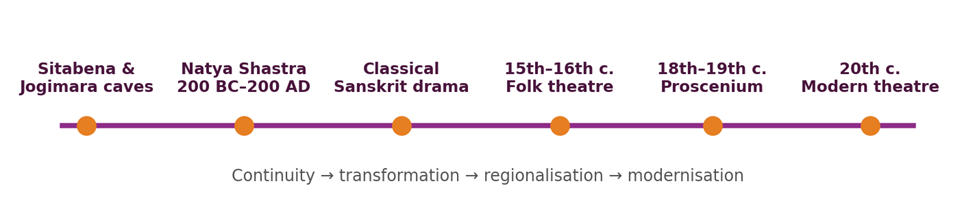
| PRELIMS CORE Sitabena & Jogimara caves → ancient amphitheatre tradition; Natya Shastra → first formal treatise on dramaturgy; Koodiyattam → oldest continuing theatre tradition in the source chapter; folk theatre → regional, rural and socially embedded. |
Three-layer mental model
| Layer | Core idea | UPSC use |
| Classical Sanskrit | Codified, literary, ritualised, rule-bound | Natya Shastra; playwrights; conventions; characters |
| Folk / regional | Local language, customs, faith, heroes, social themes | Region matching + distinctive features |
| Modern | Western proscenium + Indian traditions + social/political themes | Colonial influence; IPTA; institutions; personalities |
2. Introduction & Origins
- The ruins at Sitabena and Jogimara caves are presented in the source as representing the world’s oldest amphitheatres, highlighting the antiquity of theatrical culture in India.
- According to the Natya Shastra tradition, Brahma created Natya Veda for the pastime of the gods by combining elements of the four Vedas.
- The Natya Shastra is placed by the source between 200 BC and 200 AD and is described as the first formal treatise on dramaturgy.
- It discusses ten types of plays, ranging from one-act to ten-act forms, and covers the major dimensions of classical Sanskrit theatre.
Indian theatre began as a narrative art combining music, dance and acting; recitation, dance and music were integral rather than separate add-ons
| ETYMOLOGY ‘Nataka’ is derived from the root ‘nata’, meaning a dancer. Other terms used for drama include Rupaka, Drishyakavya and Preksakavya. |
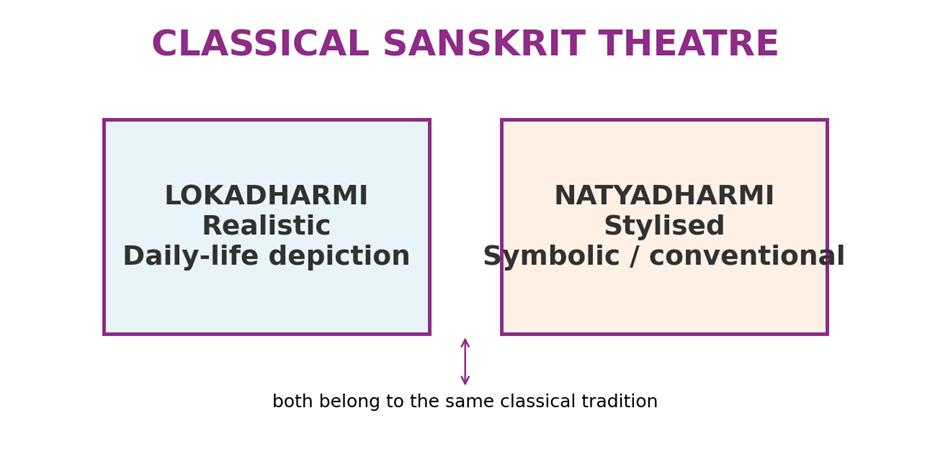
Lokadharmi vs Natyadharmi
| Feature | Lokadharmi | Natyadharmi |
| Nature | Realistic | Conventional / stylised |
| Representation | Daily life | Symbolic and overtly theatrical |
| Memory cue | ‘Loka’ = life as people experience it | ‘Natya’ = codified theatrical expression |
3. Classical Sanskrit Theatre: Major Playwrights
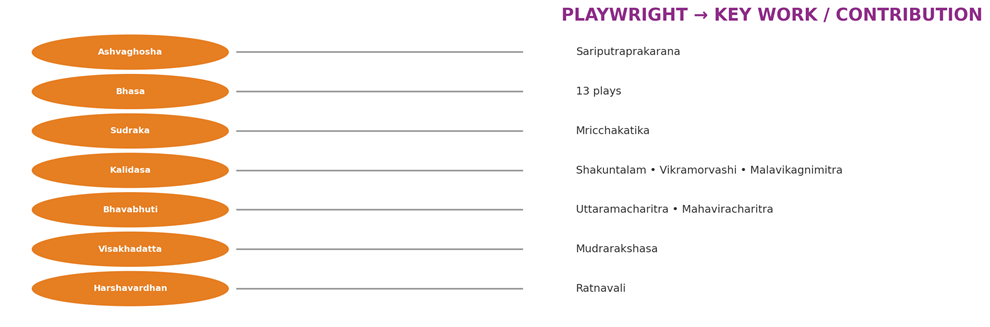
High-yield playwright–work pairs
| Playwright | Important work / point |
| Ashvaghosha | Sariputraprakarana — first example of classical Sanskrit drama in the source; nine-act play. |
| Bhasa | Thirteen plays; placed by the source in the 4th–5th century B.C. |
| Sudraka | Mricchakatika — introduces conflict; features an antagonist alongside hero and heroine. |
| Kalidasa | Malavikagnimitra, Vikramorvashi, Shakuntalam; conflict between desire and duty. |
| Bhavabhuti | Uttaramacharitra; Mahaviracharitra. |
| Visakhadatta | Mudrarakshasa. |
| Harshavardhan | Ratnavali. |
4. Types & Conventions of Sanskrit Plays
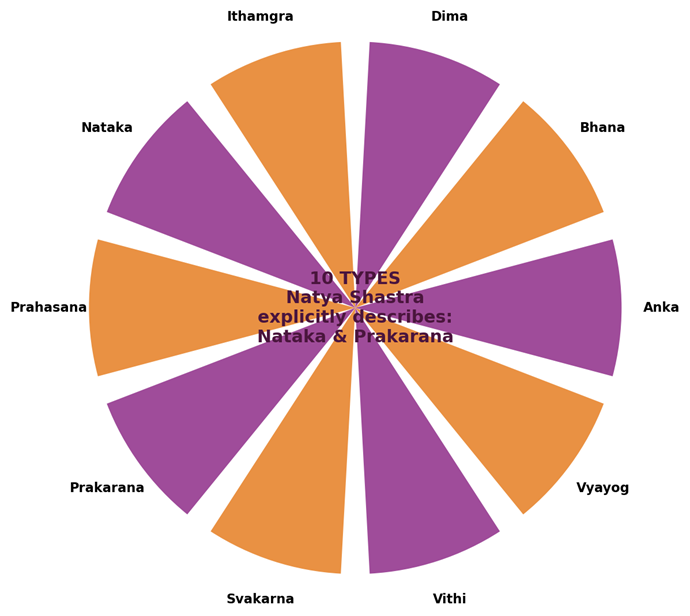
| Ten types | Important note |
| Anka • Bhana • Dima • Ithamgra • Nataka | Natya Shastra describes Nataka. |
| Prahasana • Prakarana • Svakarna • Vithi • Vyayog | Natya Shastra describes Prakarana. |
Rigid conventions
- Generally four to seven acts.
- Happy endings were the norm; tragedy was rare. The hero wins or does not die.
- The protagonist was male and achieved the object of his desire.
- Plots had a defined opening, progression, development, pause and conclusion.
5. Stagecraft & Performance Sequence
Ritualised progression
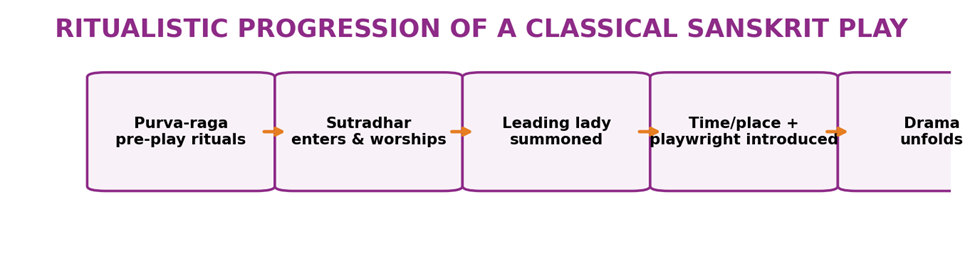
- Pre-play rituals (purva-raga) were largely performed behind the curtain.
- Sutradhar = stage manager and director; enters with assistants, dressed in white, worships the deity and seeks blessings.
- The leading lady is summoned; the Sutradhar announces time and place and introduces the playwright.
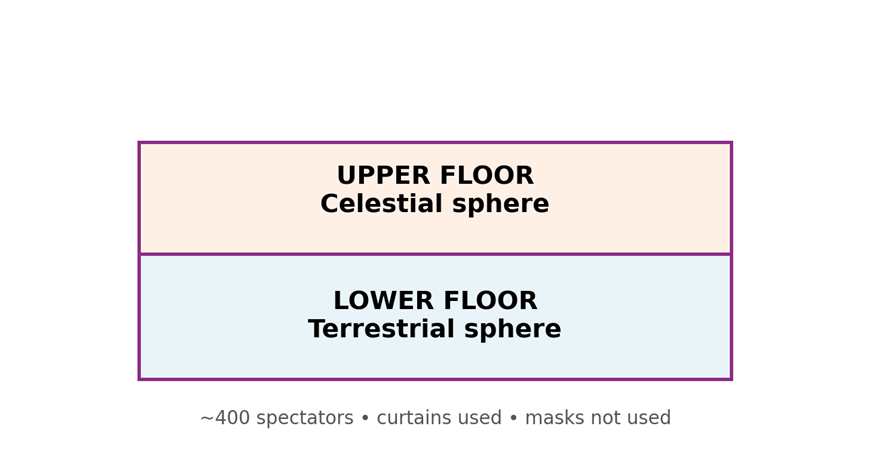
- According to Bharata in the source, the theatre could accommodate around 400 persons.
- Stages were two-storeyed: upper floor for the celestial sphere; lower floor for the terrestrial sphere.
- Curtains heightened dramatic impact; masks were not used.
6. Characters in Sanskrit Plays
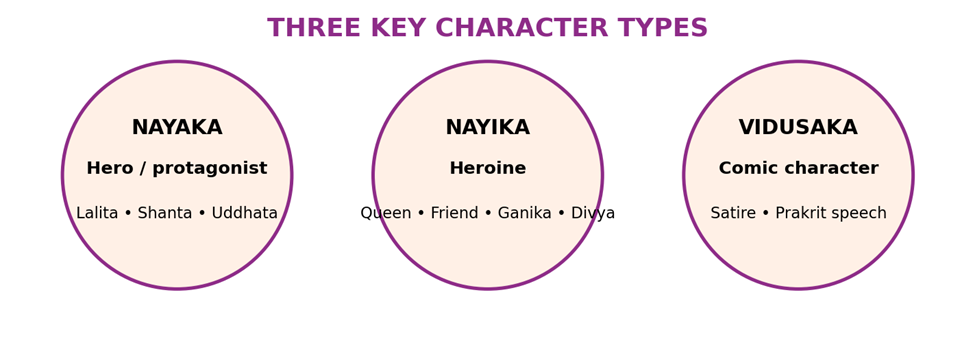
| Character | Key points | Examples / categories |
| Nayaka | Hero / protagonist; male | Lalita, Shanta, Uddhata; may be Pratinayaka such as Ravana/Duryodhana. |
| Nayika | Heroine; female | Queen, friend, courtesan (ganika), divine lady (Divya). |
| Vidusaka | Comic character; often hero’s friend; good-hearted; satire | Traditionally speaks Prakrit while other principal characters speak Sanskrit. |
| Mains value-add The Vidusaka shows that Sanskrit theatre was not merely elite ritual: humour and satire could question prevailing social norms while also supporting audience engagement. |
7. Decline of Sanskrit Theatre
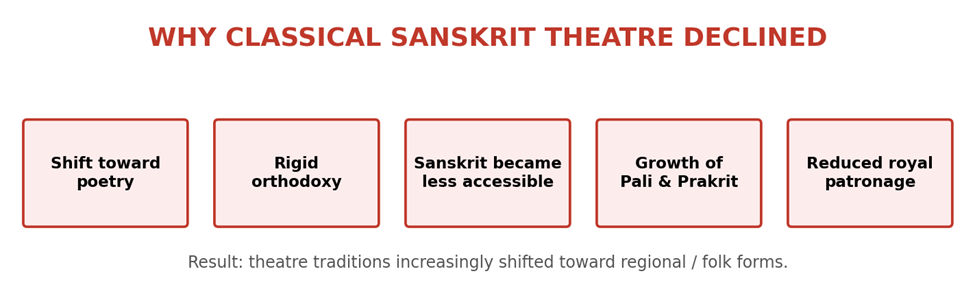
- Sanskrit dramatists increasingly moved toward poetry; lyrical writing gained popularity over dramatic writing.
- Rigid orthodoxy restricted creative space, encouraging movement toward other forms.
- Embellished Sanskrit lost popularity among the masses and became increasingly confined to religious contexts and Brahmin circles.
- Pali and Prakrit gained space as alternative languages.
- With Muslim rulers, Sanskrit theatre receded while dance and music received patronage.
| Continuity, not disappearance The decline of Sanskrit theatre did not mean the disappearance of theatre itself. Folk and regional theatre preserved performance traditions and adapted them to local beliefs, languages and audiences. |
8. Koodiyattam / Koothiyattam
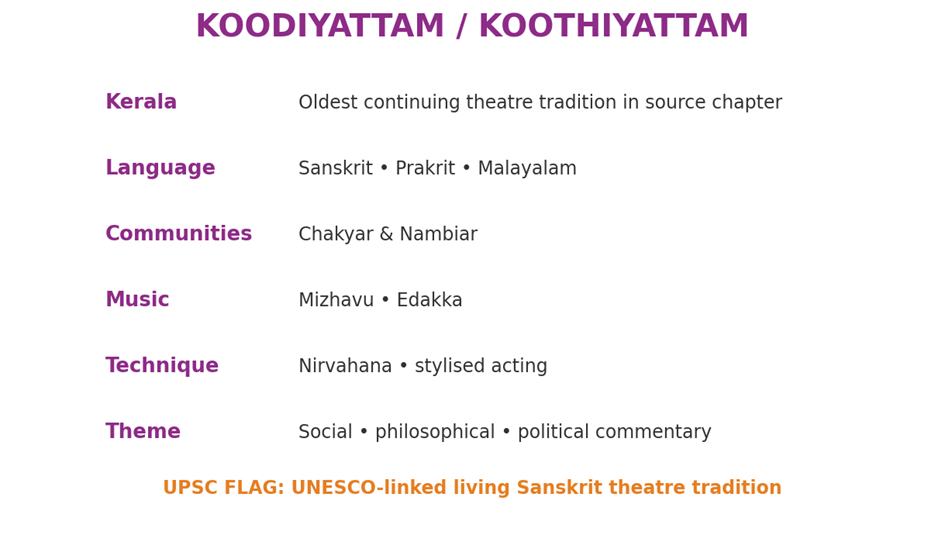
- Kerala; presented in the source as India’s oldest continuing form of theatre, surviving since the 10th century A.D.
- Follows Natya Shastra rules and was traditionally associated with Chakyar and Nambiar communities.
- Uses Sanskrit, Prakrit and Malayalam; Mizhavu and Edakka provide background music.
- All characters begin with Nirvahana, recollecting past events; the narrative then unfolds leisurely.
- Includes commentary on social, philosophical and political behaviour; Margi Madhu Chakyar is noted as a leading exponent.
9. Folk Theatre: Nature & Evolution
- Folk theatre reflects local lifestyle, social norms, beliefs and customs.
- Compared with urban-oriented Sanskrit theatre, folk theatre has rural roots and a rustic flavour.
- Many surviving forms emerged around the 15th–16th centuries with devotional themes.
- Love ballads, local heroes and secular themes were later incorporated.
- After Independence, folk theatre increasingly served as a vehicle for disseminating social wisdom rather than merely providing entertainment.
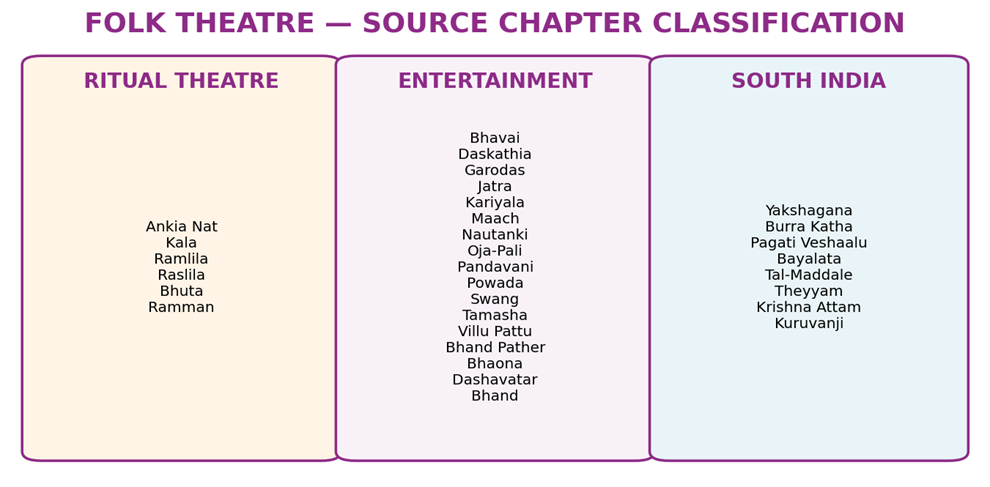
10. Ritual Theatre
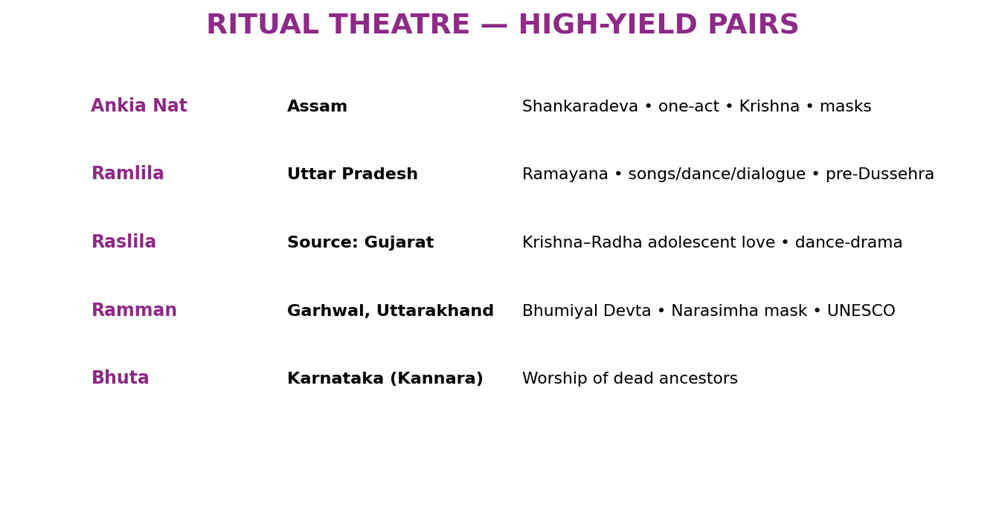
| Form | Region | Distinctive features |
| Ankia Nat | Assam | Traditional one-act; Shankaradeva + Mahadeva; opera style; Krishna; Sutradhar + Gayan-Bayan; khol/cymbals; masks. |
| Kala | Vaishnavite tradition | Vishnu life/incarnations; Dashavatar Kala, Gopal Kala, Gaulan Kala. |
| Ramlila | Uttar Pradesh | Ramayana via songs, dances and dialogue; mainly male actors, including Sita. |
| Raslila | Source: Gujarat | Dance-drama of adolescent love stories of Krishna and Radha. |
| Bhuta | Kannara district, Karnataka | Worship of dead ancestors; ‘Bhuta’ = spirit. |
| Ramman | Garhwal, Uttarakhand | Bhumiyal Devta; Bhandari caste; sacred Narasimha mask; songs/dance; Rama stories; UNESCO list. |
| UNESCO pair to remember Ramman — ritual theatre of Garhwal. Koodiyattam — Sanskrit theatre of Kerala. Keep the two distinct in Prelims. |
11. Theatre of Entertainment — Eastern & Western India
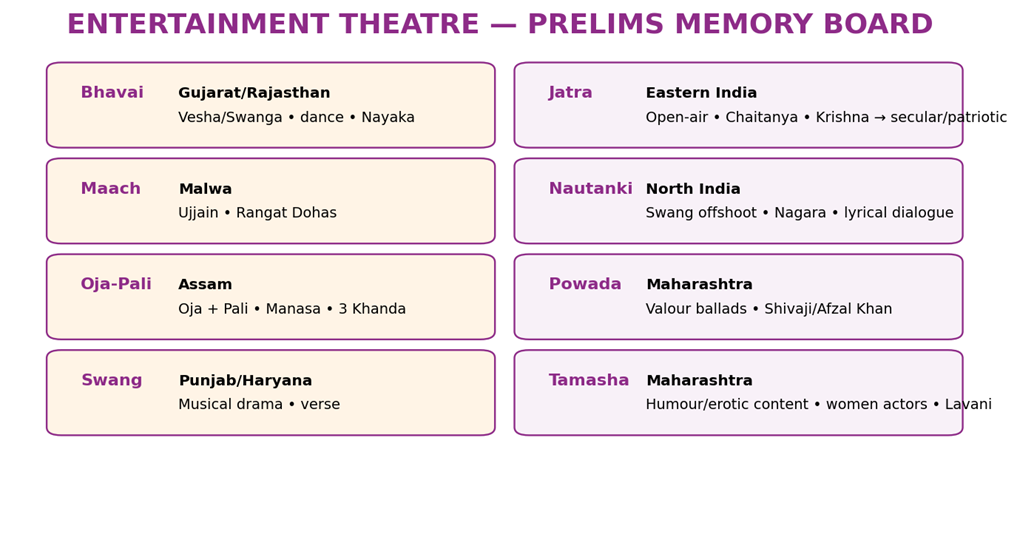
| Form | Region | Key identifier |
| Daskathia | Odisha | Gayaka + Palia; wooden kathia; Chhaiti Ghoda is a close variant. |
| Garodas | Gujarat | Garoda community; painted pictures; romance and valour. |
| Jatra | Eastern India | Open-air; Chaitanya; Krishna teachings → Puranic → secular/historical/patriotic; Sahi Jatra in Odisha. |
| Kariyala | Himachal Pradesh foothills | Open-air; fairs/festivals; all-night small plays/skits. |
| Maach | Malwa, Madhya Pradesh | Ujjain; 17th c.; mythological then romantic; Rangat Dohas. |
| Nautanki | North India | Swang offshoot; historical/social/folk tales; lyrical dialogue; Nagara; Kanpur & Lucknow schools. |
| Oja-Pali | Assam | Manasa; Oja narrator + Pali chorus; Baniya/Bhatiyali/Deva Khanda. |
| Powada | Maharashtra | Operatic valour ballads; Shivaji; Gondhalis and Shahirs. |
12. Theatre of Entertainment — North, West & Deccan
| Form | Region | Distinctive point |
| Bhavai | Gujarat & Rajasthan | Kutchh/Kathiawar; dance-heavy; Vesha/Swanga; romantic themes; Bhungala/Jhanjha/tabla; Sutradhar = Nayaka. |
| Swang | Punjab & Haryana | Musical drama in verse; ektara, harmonium, sarangi, dholak, khartal. |
| Tamasha | Maharashtra | Humour and erotic content; female actors may play male roles; Lavani. |
| Villu Pattu | Deccan | ‘Bow-song’; Ramayana narrated using bow-shaped instruments. |
| Bhand Pather | J&K | Social satire or mythical stories; secular outlook; music, dance, drama. |
| Bhaona | Assam, especially Majuli | Ankia Naat presentation; Vaishnavite; Sutradhar; moral/religious messages. |
| Dashavatar | Konkan, Sindhudurg & North Goa | Farmers’ theatre; ten Vishnu incarnations; Purva-ranga + Uttara-ranga. |
| Naqal / Bhand | Punjab & adjoining areas | Mimicry; Behroopiya/Naqalchi; comedy/wit/humour for social-political messages; two artists. |
| Memory chain Maharashtra = Tamasha + Powada + Dashavatar (Konkan link). Punjab/Haryana = Swang; Punjab region also has Naqal/Bhand. Assam = Oja-Pali + Bhaona + Ankia Nat. |
13. Theatre of South India
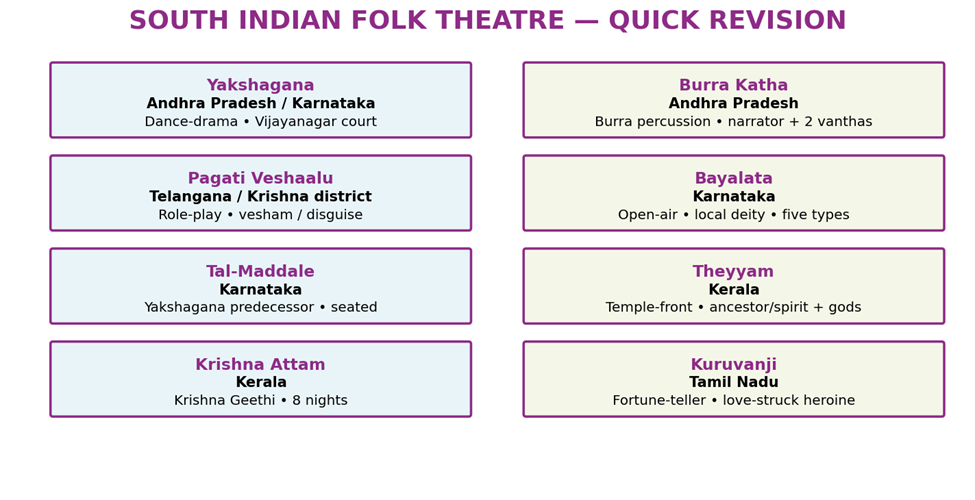
- When Sanskrit classical theatre declined in North India around the 8th century A.D., the source notes that it gained popularity in southern parts of India.
- A key distinction in the source: South Indian theatrical traditions emphasise dance, whereas Northern traditions emphasise music.
| Form | Region / origin | High-yield detail |
| Yakshagana | Andhra Pradesh & Karnataka | Source links origin to Vijayanagar royal courts and Jakkula Varu; evolved to dance-drama. Plays: Garudachalam, Krishna-Hiramani, Sugriva Vijayam. |
| Burra Katha | Andhra Pradesh | Named after Burra percussion; narrator + two vanthas/co-artists. |
| Pagati Veshaalu | Telangana & Krishna district | Role-playing; central character = vesham/disguise. |
| Bayalata | Karnataka | Open-air; local deity; Dasarat, Sannata, Doddata, Parijata, Yakshagana. |
| Tal-Maddale | Karnataka | Predecessor of Yakshagana; seated; no costume, dance or acting; Bhagavata + Arthadharis. |
| Theyyam | Kerala | Open theatre before temples; ancestors and gods; Vaishnavism, Shaktism, Shaivism; elaborate headgear/costumes. |
| Krishna Attam | Kerala | Mid-17th c.; Krishna Geethi; eight nights. |
| Kuruvanji | Tamil Nadu | ~300 years; Tamil poetry/songs; Thirukutarajappa Kaviyar; love-struck heroine + fortune-teller; Bharatanatyam. |
14. Visual Memory: Representative Folk Forms
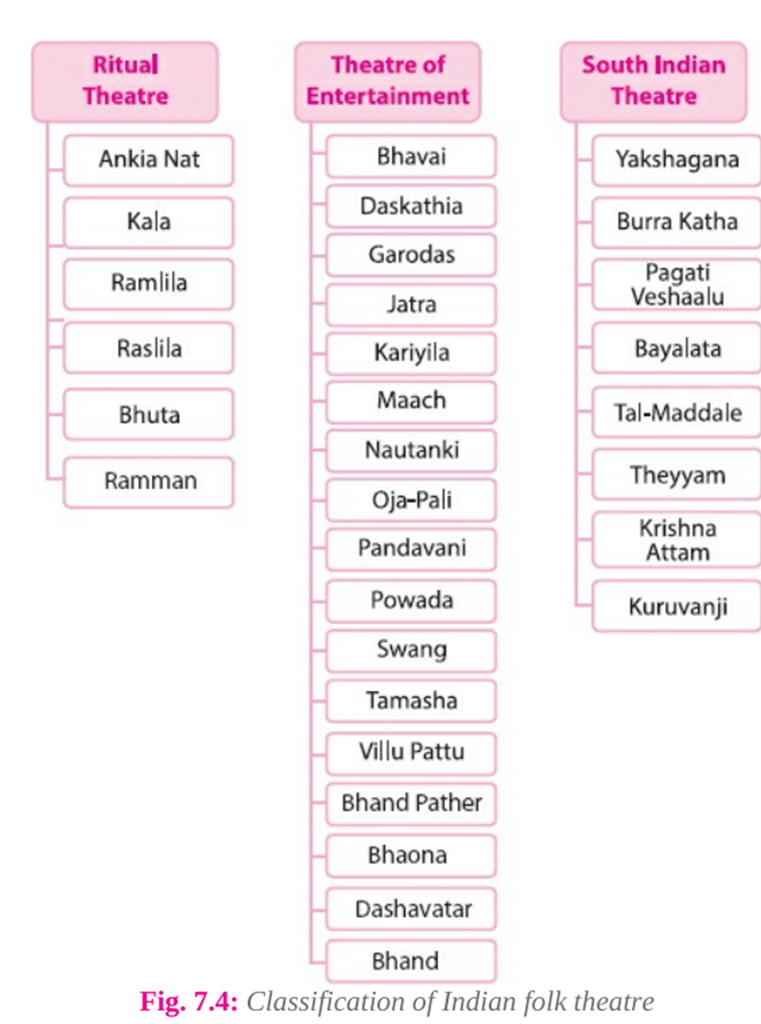
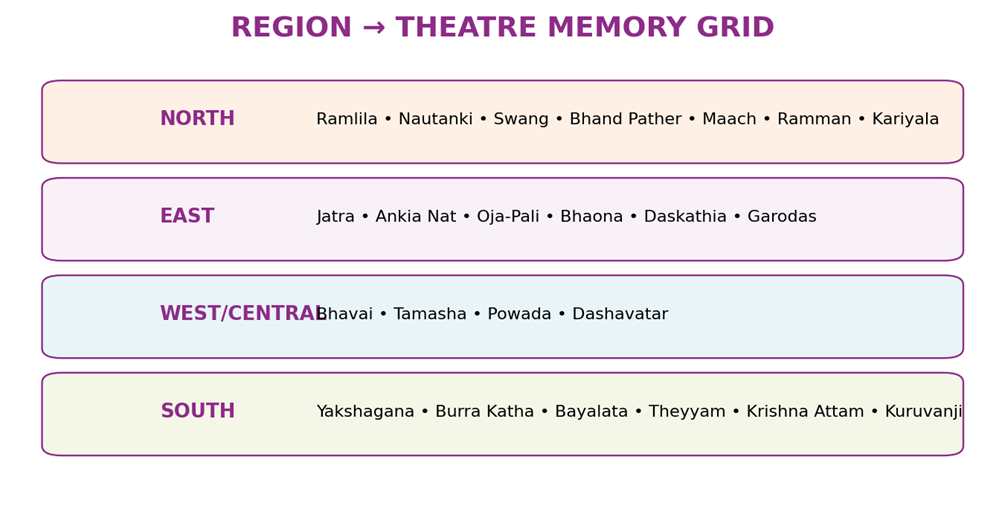
| Five distinctive one-liners Daskathia → Gayaka + Palia + kathia. Maach → Rangat Dohas. Nautanki → Nagara + lyrical dialogue. Tamasha → Lavani + female performers. Tal-Maddale → seated, no costume/dance/acting. |
15. Modern Indian Theatre: Colonial Foundations
- Modern/post-medieval Indian theatre took shape during the colonial era.
- Translations of ancient Sanskrit texts and Western classics stimulated theatre; Lessing and Shakespeare were adapted.
- Urban growth in Calcutta and Madras created demand for new entertainment forms.
- Western proscenium theatre emerged in the 18th–19th centuries; 19th-century Calcutta saw Belgachia Natyashala and Shobhabazar Natyashala.
- Indian practitioners combined Western features with Indian styles.
- Commercialisation increased; audiences began paying for performances.
- Themes included dowry, caste system, religious hypocrisy and political affairs.
- The British Government enacted the Dramatic Performances Act, 1876 to counter growing political awareness.
| Modern theatre = synthesis Indian traditions + Western proscenium + urbanisation + commercialisation + social/political commentary. |
16. Parsi Theatre, Regional Theatre & Key Personalities
- Parsi theatre was prominent in Western India from the 1850s to the 1920s.
- Plays were written in Gujarati and Marathi; colourful backdrops and music were essential.
- Themes included romance, humour and melodrama.
- From the 1930s, cinema drew many Parsi producers into filmmaking.
- Regional theatres of Bengal, Maharashtra and elsewhere gained prominence.
Rabindranath Tagore
- First play: Valmiki Pratibha, written at age twenty.
- Important works: Roktokoribi (Red Oleanders), Chitrangada and Post-Office.
- Themes: nationalism, spirituality and socio-political conditions.
- Other Bengal personalities: Prasanna Kumar Thakur, Girishchandra Ghosh and Deenabandhu Mitra (Nildarpan).
Prithvi Theatre
- Established in 1942 by Prithviraj Kapoor.
- Travelling theatre with about 150 artists; source states more than 2,000 plays.
- Permanent Mumbai theatre opened in 1978 and continues to exist.
17. IPTA, Institutions & Modern Theatre Personalities
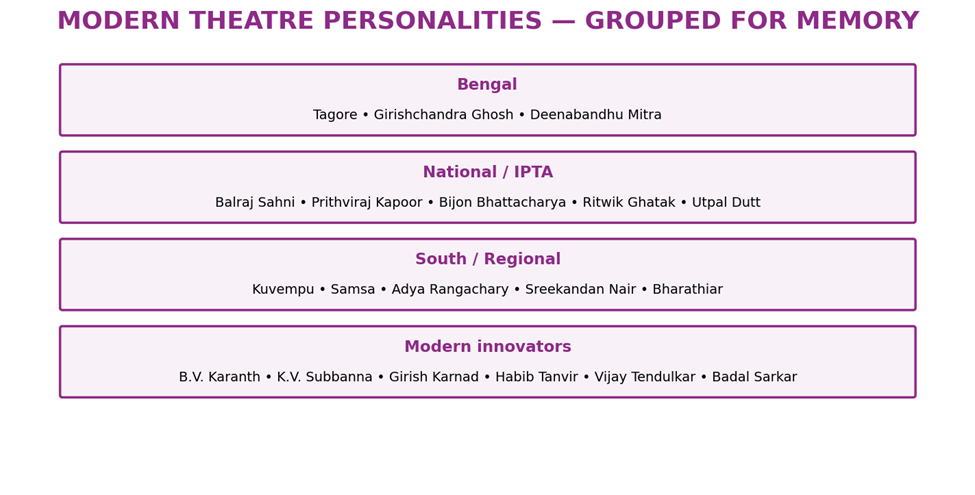
Indian People’s Theatre Association (IPTA)
- Formed in 1943 as a cultural wing of the Communist Party; source says it was disbanded in 1947.
- Played an important role in theatre development and addressed social themes such as the Bengal Famines.
- Associated personalities: Balraj Sahni, Prithviraj Kapoor, Bijon Bhattacharya, Ritwik Ghatak and Utpal Dutt.
- Source notes IPTA continues in Chhattisgarh, Punjab and West Bengal.
Institutional development
- Kalakshetra Manipur — Heisnam Kanhailal, 1969, to keep traditional theatre alive.
- Chorus Repertory Theatre — Ratan Thiyam, 1976.
- Sangeet Natak Akademi — 1952; promotion of performing arts including theatre.
- National School of Drama — under Ibrahim Alkazi; contributed to producing major theatre personalities.
- NINASAM — K.V. Subbanna; Ramon Magsaysay Award winner.
18. Modern Theatre Personalities — UPSC Ready
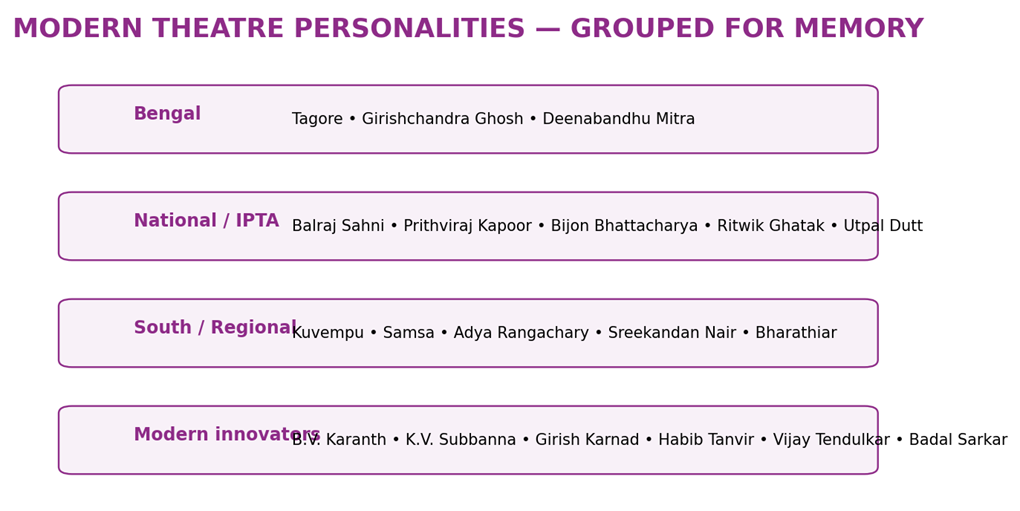
| Name | Association in source | Why remember |
| Samsa (Sami Venkatadri Iyer) | Karnataka | Kannada dramatist/playwright |
| Adya Rangachary | Karnataka | Kannada dramatist/playwright |
| Kuvempu | Karnataka | Actor-playwright |
| Subrahmanya Bharathiar | Tamil Nadu | Theatre personality |
| Veeresalingam Pantulu | Andhra Pradesh | Regional personality |
| Sreekandan Nair | Kerala | Theatre personality |
| Bharatendu Harishchandra | Hindi theatre | Modern theatre personality |
| Jaishankar Prasad | Hindi theatre | Modern theatre personality |
| B.V. Karanth | Andhra/Karnataka/MP | Regional theatre contribution |
| Girish Karnad | Modern Indian theatre | Major playwright/personality |
| Habib Tanvir | Modern Indian theatre | Major theatre innovator |
| Vijay Tendulkar | Modern Indian theatre | Major playwright |
| Badal Sarkar | Modern Indian theatre | Major theatre personality |
| Vijaya Mehta | Modern Indian theatre | Major theatre personality |
| Dharmavir Bharati | Modern Indian theatre | Major theatre personality |
| Mohan Rakesh | Modern Indian theatre | Major theatre personality |
| Chandrashekhar Kambar | Modern Indian theatre | Major theatre personality |
| P. Lankesh | Modern Indian theatre | Major theatre personality |
| Indira Parthasarathy | Modern Indian theatre | Major theatre personality |
19. Prelims Rapid Revision — Match the Following
| Theatre form | Region / association | Distinctive clue |
| Ankia Nat | Assam | Shankaradeva; one-act; Krishna; masks |
| Ramman | Garhwal, Uttarakhand | Bhumiyal Devta; Narasimha mask; UNESCO |
| Bhavai | Gujarat/Rajasthan | Vesha/Swanga; Nayaka; Bhungala |
| Jatra | Eastern India | Chaitanya; open-air; later secular/patriotic |
| Maach | Malwa | Rangat Dohas |
| Nautanki | North India | Swang offshoot; Nagara; Kanpur/Lucknow |
| Oja-Pali | Assam | Oja + Pali; Manasa |
| Powada | Maharashtra | Valour ballads; Shahirs/Gondhalis |
| Swang | Punjab/Haryana | Musical drama; verse |
| Tamasha | Maharashtra | Lavani; women performers |
| Bhand Pather | J&K | Social satire + myth; music/dance/drama |
| Bhaona | Assam/Majuli | Ankia Naat; Vaishnavite |
| Dashavatar | Konkan/North Goa | Ten Vishnu incarnations; Purva/Uttara-ranga |
| Yakshagana | Andhra Pradesh/Karnataka in source | Dance-drama; Vijayanagar court |
| Burra Katha | Andhra Pradesh | Burra percussion; narrator + two vanthas |
| Bayalata | Karnataka | Open-air; five types |
| Tal-Maddale | Karnataka | Predecessor of Yakshagana; seated |
| Theyyam | Kerala | Temple-front open theatre; elaborate headgear |
| Krishna Attam | Kerala | Eight nights; Krishna Geethi |
| Kuruvanji | Tamil Nadu | Fortune-teller; love-struck heroine |
20. Mains Answer Framework + Last-Minute Sheet
How to structure a 10/15-marker
- Introduction: define Indian theatre as a composite performing tradition linking narrative, music, dance and acting.
- Historical core: mention early amphitheatre evidence and the Natya Shastra.
- Classical section: explain Lokadharmi/Natyadharmi, playwrights, conventions, Sutradhar and characters.
- Transition: explain decline of Sanskrit theatre and persistence through regional/folk traditions.
- Folk section: classify into ritual, entertainment and South Indian traditions; give 4–6 region-form examples.
- Modern section: colonial proscenium, Parsi theatre, social themes, IPTA and institutions such as Sangeet Natak Akademi/NSD.
- Conclusion: theatre demonstrates cultural continuity, regional diversity and the ability of performance to transmit religious, social and political ideas.
30-second revision
| Remember | Keywords |
| Origin | Sitabena • Jogimara • Natya Veda • Natya Shastra |
| Classical | Lokadharmi • Natyadharmi • Nataka • Prakarana |
| Playwrights | Ashvaghosha • Bhasa • Sudraka • Kalidasa • Bhavabhuti • Visakhadatta • Harsha |
| Stage | Purva-raga • Sutradhar • two-storey • ~400 • curtains • no masks |
| Characters | Nayaka • Nayika • Vidusaka |
| Decline | Poetry • orthodoxy • Sanskrit accessibility • Pali/Prakrit • patronage shift |
| Living Sanskrit theatre | Koodiyattam |
| Folk | Ritual • Entertainment • South India |
| Modern | Proscenium • Parsi • Dramatic Performances Act 1876 • IPTA • Prithvi Theatre |
| Institutions | Sangeet Natak Akademi • NSD • Kalakshetra Manipur • Chorus Repertory • NINASAM |
| Final UPSC takeaway CLASSICAL THEORY → REGIONAL ADAPTATION → DEVOTIONAL & SECULAR FOLK FORMS → COLONIAL PROSCENIUM → SOCIAL/POLITICAL THEATRE → MODERN INSTITUTIONS. |