
The Collegium System – Origins, Evolution, and the Case for Reform – UPSC CIVIL SERVICES — POLITY & GOVERNANCE
Introduction
The appointment of judges to India’s constitutional courts is one of the few processes in a functioning democracy where the institution being staffed also selects its own members. This is the Collegium system — a mechanism with no textual basis in the Constitution of India, born instead out of three judgments of the Supreme Court delivered between 1981 and 1998. Nearly three decades since it took its present form, the Collegium remains central to debates on judicial independence, accountability, and transparency, and is a recurring theme in the UPSC syllabus under Polity and Governance (judiciary, appointment of judges, and separation of powers).
Constitutional Provisions: The Starting Point
The Constitution itself says nothing about a “Collegium.” Article 124(2) provides that judges of the Supreme Court are appointed by the President “after consultation with such of the Judges of the Supreme Court and of the High Courts… as the President may deem necessary,” and mandates that the Chief Justice of India (CJI) be consulted in appointments other than that of the CJI himself. Article 217 lays down a parallel process for High Court judges, requiring consultation with the Governor of the State, the CJI, and the Chief Justice of the High Court concerned. Article 222 deals with the transfer of judges between High Courts.
| Key Idea The word actually used in the constitutional text is “consultation,” not “concurrence.” The entire history of the Collegium system is, in essence, the story of the judiciary reinterpreting “consultation” to mean something closer to a binding “concurrence,” progressively shifting the balance of power from the Executive to the CJI and a body of senior judges. |
The Three Judges Cases: Origins of the Collegium
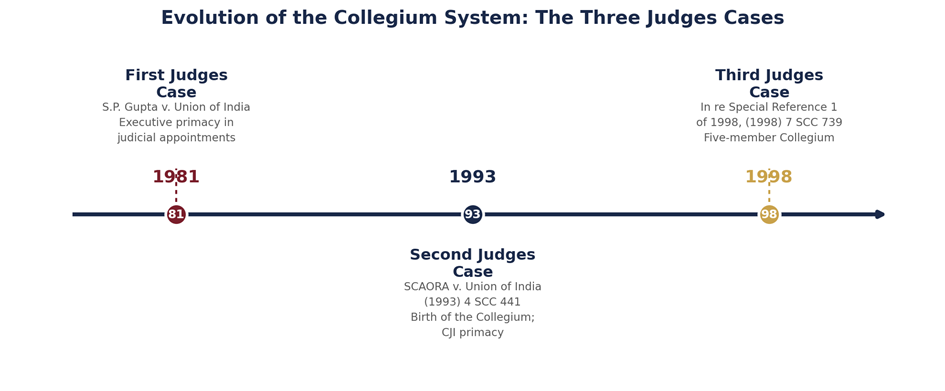
First Judges Case — S.P. Gupta v. Union of India (1981)
Also known as the “Judges’ Transfer Case,” this seven-judge bench ruling held that “consultation” under Articles 124 and 217 did not mean “concurrence,” and that the President (in effect, the Executive, acting through the Council of Ministers) was not bound by the advice of the constitutional functionaries consulted, including the CJI. This gave primacy to the Executive in matters of judicial appointment and transfer, and preserved the government’s dominant role for over a decade.
Second Judges Case — Supreme Court Advocates-on-Record Association v. Union of India (1993) 4 SCC 441
A nine-judge bench reversed the position taken in 1981. It held that “consultation” effectively meant “concurrence,” and that the CJI’s recommendation on judicial appointments would have primacy, subject to the CJI forming his opinion collectively — in consultation with his two senior-most colleagues on the Supreme Court, rather than as an individual. This judgment is the actual birth of the “Collegium” as an institution, even though the term itself gained currency only later. The rationale was rooted in the doctrine of judicial independence as a facet of the basic structure of the Constitution: the Court reasoned that unchecked executive discretion in appointments posed a risk to the separation of powers and to the judiciary’s independence from the political executive.
Third Judges Case — In re Special Reference 1 of 1998, (1998) 7 SCC 739
President K.R. Narayanan, exercising the advisory jurisdiction power under Article 143, referred nine questions to the Supreme Court seeking clarification on the “consultation” process laid down in 1993. A nine-judge bench responded with an advisory opinion (not a “case” in the conventional adversarial sense) that expanded the Collegium from the CJI-plus-two format to its present composition: the CJI and the four senior-most judges of the Supreme Court for appointments to the Supreme Court itself. For High Court appointments, the Collegium comprises the CJI and two senior-most Supreme Court judges, along with inputs from the senior judges of the High Court concerned and the state government. This 1998 opinion gave the Collegium system its current institutional shape.
How the Collegium Works Today
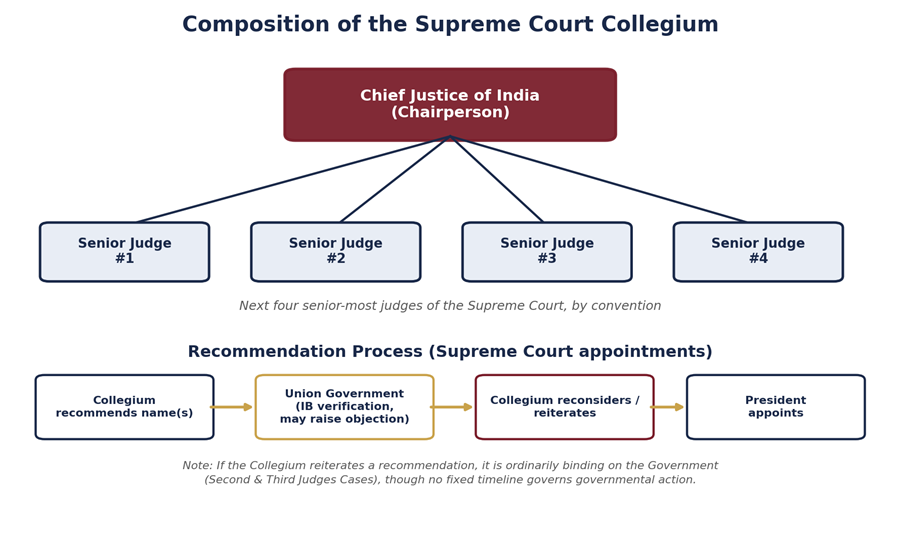
- Supreme Court appointments: The CJI and the four senior-most judges of the Supreme Court recommend names to the Union Government, which conducts an Intelligence Bureau (IB) verification and can raise objections or seek reconsideration, but if the Collegium reiterates its recommendation, it is ordinarily binding on the government (a principle reaffirmed in the Third Judges Case).
- High Court appointments: The Chief Justice of the High Court, in consultation with two senior colleagues, initiates proposals, which pass through the state government, the Supreme Court Collegium, and finally the Union Government before being sent to the President.
- Memorandum of Procedure (MoP): A set of guidelines, evolved after the Second and Third Judges Cases, that lays down the procedural steps for appointments and transfers. Attempts to finalise a revised MoP incorporating greater transparency and eligibility criteria have remained inconclusive for years, which is itself a recurring criticism.
The NJAC Interlude (2014–2015)
In an attempt to replace the Collegium with a broader-based body, Parliament passed the Constitution (Ninety-Ninth Amendment) Act, 2014 and the National Judicial Appointments Commission (NJAC) Act, 2014. The NJAC was to comprise the CJI, two senior Supreme Court judges, the Union Law Minister, and two eminent persons selected by a committee including the Prime Minister and the Leader of the Opposition. In Supreme Court Advocates-on-Record Association v. Union of India (2015), a five-judge Constitution Bench struck down both the Constitutional Amendment and the NJAC Act as unconstitutional, holding them violative of the basic structure doctrine on the ground that they compromised judicial independence by giving the political executive a substantive role in appointments. This restored the Collegium system, which continues to operate to this day.
Advantages and Disadvantages
Advantages of the Collegium System
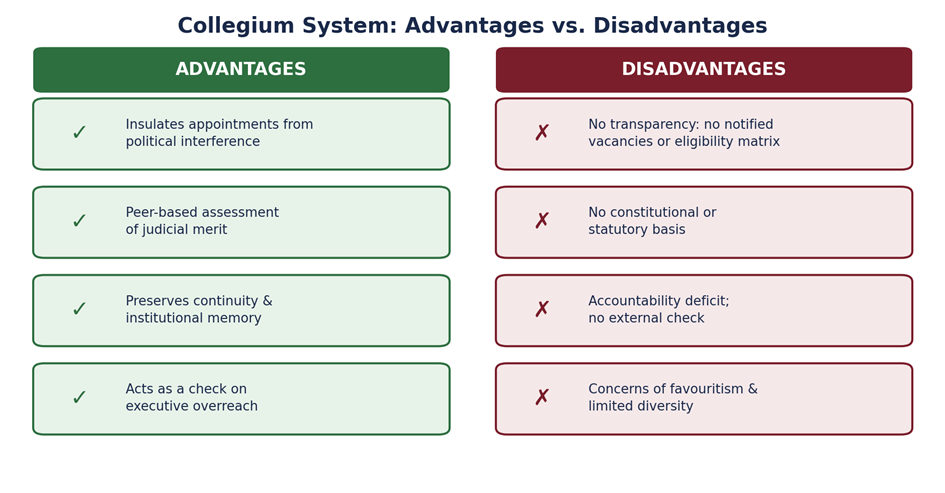
- Insulation from political interference: By keeping the Executive’s role largely consultative rather than determinative, the system seeks to prevent the ruling government of the day from packing courts with ideologically convenient appointees, thereby protecting judicial independence — a core element of the basic structure.
- Peer-based assessment of merit: Sitting judges are arguably best placed to assess the legal acumen, integrity, and judicial temperament of candidates from the bar or subordinate judiciary, drawing on first-hand knowledge of their conduct in court.
- Continuity and institutional memory: Because the same institution nurtures and elevates judges, the system aims to preserve consistency in judicial standards and institutional culture across generations of judges.
- A check against executive overreach: The doctrine emerged in an era (post-Emergency) marked by memories of “committed judiciary” rhetoric and mass transfers of judges seen as inconvenient to the government. The Collegium was in part a judicial response to that history.
Disadvantages and Criticisms
- Absence of transparency: There is no public notification of vacancies, no published eligibility matrix, and no disclosed methodology for evaluating candidates. Recommendations and rejections are rarely accompanied by reasons, making the process opaque to litigants, the bar, and the public alike.
- No constitutional or statutory basis: The Collegium is entirely a judicial creation. Critics argue that a body wielding such significant power over a coordinate constitutional institution ought to derive its authority and procedure from a clearly codified constitutional or statutory source rather than evolving interpretation.
- Accountability deficit: Unlike appointments to most other high constitutional offices, there is no external check on the Collegium’s decisions. The “judges appointing judges” structure has been described as unique among major constitutional democracies, most of which involve the executive, legislature, or independent commissions in some form.
- Allegations of favouritism and lack of diversity: Concerns have periodically been raised — including by former judges — about “uncle-judge syndrome,” dominance of a few families and law schools, and inadequate representation of women, marginalised communities, and lawyers from smaller Bar associations or subordinate judiciary.
- Delays and government-Collegium friction: The absence of fixed timelines for the government to act on Collegium recommendations has led to prolonged vacancies in the Supreme Court and High Courts, and to a pattern of the government sitting on reiterated names — a practice that strains the “binding” nature the Third Judges Case sought to establish, since the Constitution does not prescribe any timeframe for governmental action.
- No firm, published seniority or eligibility criteria: While seniority is a significant factor for Supreme Court elevation, it is not the sole or a rigidly codified criterion, leading to perceptions of inconsistency in how candidates are shortlisted.
- The pending MoP: Repeated rounds of negotiation between the Collegium and the government over a revised Memorandum of Procedure — meant to introduce eligibility criteria, a permanent secretariat, and grounds for rejection — have not concluded, leaving the process to run on informal convention.
Way Forward: Reform Without Compromising Independence
Most serious reform proposals do not seek a return to executive primacy (which the 2015 NJAC judgment rejected as a threat to basic structure) but rather ask for internal reform of the Collegium itself:
- Finalising and publishing the Memorandum of Procedure, including clear eligibility criteria and reasons for supersession or rejection.
- A permanent secretariat to process recommendations, handle documentation, and maintain records, reducing ad hoc delays.
- Timelines for governmental action on Collegium recommendations, to prevent indefinite deferral once a name is reiterated.
- Publication of resolutions and reasons, a practice the Supreme Court itself began intermittently after 2017 by placing some Collegium resolutions on its website, though this has been inconsistent and often omits reasoning.
- Diversity audits, to ensure fairer representation of women, Scheduled Castes/Scheduled Tribes/Other Backward Classes, minorities, and the district judiciary in higher judicial appointments.
Conclusion
The Collegium system represents a distinctive Indian constitutional innovation — an attempt to safeguard judicial independence by removing appointments almost entirely from executive control. Its origins in the Three Judges Cases reflect a judiciary responding to a specific historical anxiety about executive interference. Yet the very features that insulate it from political control — self-selection, absence of codified criteria, and lack of a formal accountability mechanism — have also made it, in the words of many constitutional commentators, one of the least transparent methods of judicial appointment among major democracies. For UPSC aspirants, the Collegium is best understood not as a settled institution but as a site of continuing tension between two constitutional values that are both legitimate but frequently in conflict: judicial independence and institutional accountability. The way forward likely lies not in abandoning judicial primacy (which the courts have tied to the basic structure) but in making the exercise of that primacy more transparent, criteria-based, and answerable to constitutional expectations of fairness.
Quick Reference Table
| Case | Year | Citation | Key Holding |
| First Judges Case (S.P. Gupta v. Union of India) | 1981 | AIR 1982 SC 149 | Executive has primacy; “consultation” ≠ “concurrence” |
| Second Judges Case (SCAORA v. Union of India) | 1993 | (1993) 4 SCC 441 | “Consultation” = “concurrence”; birth of the Collegium (CJI + 2 senior judges) |
| Third Judges Case (In re Special Reference 1 of 1998) | 1998 | (1998) 7 SCC 739 | Expanded Collegium to CJI + 4 senior-most judges (5-member body) |
| NJAC Case (SCAORA v. Union of India) | 2015 | (2016) 5 SCC 1 | Struck down the 99th Amendment and NJAC Act; restored the Collegium |