
INDIAN HANDICRAFTS – UPSC CIVIL SERVICES ILLUSTRATED REVISION ARTICLE
| CORE IDEA Indian handicrafts are handmade decorative or functional goods reflecting regional skill. They are especially important to tribal and rural communities as livelihoods and as traditions to be preserved. |
1. Indian Handicrafts — The Big Picture
Handicrafts are products crafted by hand, traditionally without machines. Different Indian regions have developed distinctive crafts combining utility, decoration, local materials, inherited techniques and artistic expression.
- Livelihood: important income sources, especially for tribal and rural communities.
- Cultural preservation: protects regional identities and inherited techniques.
- UPSC lens: learn every craft as Region + Material + Technique + Signature feature.
| PRELIMS MEMORY HOOK CRAFT = Region + Material + Technique + Signature feature. This is more efficient than memorising isolated names. |
2. Glassware
The source traces glassmaking references to the Mahabharata; the earliest material evidence cited is glass beads from the Painted Grey Ware culture of the Ganges Valley, around 1000 BCE. Satapatha Brahmana uses kanch or kaca for glass.
- Brahmapuri and Kolhapur (Maharashtra): glass industry around 2 BCE–2 CE; specialised lenticular beads.
- Vyasayogacharita contains references interpreted in the material as evidence of early optical lenses/spectacles.
- Other evidence: Maski; Ahar; Hastinapur; Ahichchatra; Eran; Ujjain.
- Mughal patronage: Sheesh Mahal decoration; glass hukkas, ittardans/perfume boxes and engraved glasses.
- Modern centres: Hyderabad—Churikajodas glass bangles; Firozabad—chandeliers/decorative pieces; Saharanpur—panchkora glass toys; Patna—Tikuli decorative glass beads, described as nearly lost to industrialisation but still worn by Santhal tribes.
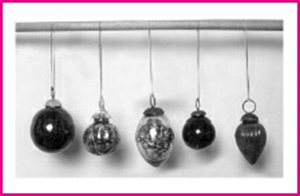
Fig. 3.1 — Glass beads.
3. Handicrafts on Cloth
Major textile techniques include weaving, printing, tie-and-dye and resist-dyeing. Regional forms make Indian cloth handicrafts exceptionally diverse.
| Technique / craft | Region(s) | What to remember |
| Bandhani / Bandhej | Rajasthan, Gujarat; also AP & TN | Tie-and-dye / resist dyeing; tied portions resist colour. |
| Laharia | Jaipur, Jodhpur | Tie-and-dye producing ripple/wave-like patterns. |
| Ikat | Telangana, Odisha, Gujarat, AP | Resist dyeing applied repeatedly to yarn before weaving. |
| Kalamkari | Andhra Pradesh | Hand painting on fabric using deep vegetable dyes. |
| Batik | Madhya Pradesh, West Bengal | Molten wax applied before cold dyeing; multicoloured textiles. |
| Tanchoi | Surat, Gujarat | Said to derive from Chinese inspiration; resembles a miniature painting. |
| Jamdani | West Bengal | Fine muslin with opaque patterns on a transparent background. |
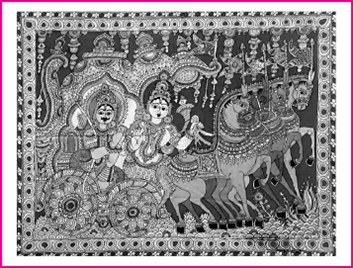
Fig. 3.2 — Handicrafts on cloth.
4. Traditional Regional Sarees — High-Yield Table
| Saree / textile | Main region | Distinctive feature |
| Pochampalli | Andhra Pradesh | Silk/cotton; intricate motifs; geometric Ikat; source notes Air India crew usage. |
| Patola | Patan, Gujarat | Rich handloom sarees. |
| Baluchari | Murshidabad, West Bengal | Ancient stories on border/pallu; silk threads. |
| Jamdani | West Bengal | Finest muslin; opaque patterns on transparent background. |
| Tanchoi Brocades | Varanasi | Banarasi type; single/double warp; 2–5 weft colours on silk. |
| Chanderi | Madhya Pradesh | Silk, zari and cotton; very light, see-through fabric. |
| Ilkal | Karnataka | Kasuti embroidery; chariot and elephant motifs. |
| Tant | West Bengal | Crisp cotton, printed saree. |
| Nauvari / Kasta | Maharashtra | Single nine-yard sari. |
| Bomkai | Odisha | Silk/cotton; Ikat, embroidery and intricate thread work. |
| Konrad | Tamil Nadu | Stripes/checks, wide border, animal/natural motifs; temple saree. |
| Kosa | Chhattisgarh | Silk saree. |
| Paithani | Maharashtra | Silk; gold-coloured thread; parrot motif. |
| Kalamkari | Andhra Pradesh | Pen used for painting designs. |
| Kasavu | Kerala | Thick golden border. |
| Dabu | Chittorgarh, Rajasthan | Ancient mud-resist hand block printing on cotton. |
5. Ivory Crafting
Ivory carving is traced to the Vedic period, where danta probably referred to the elephant tusk. Harappan evidence indicates ivory objects such as dice were exported to Turkmenistan, Afghanistan and parts of the Persian Gulf.
- Sanchi inscription (2nd century BCE): guild of ivory workers from Vidisa; associated with Sanchi Stupa sculpture.
- Taxila ivory comb: evidence of continued use in the early historic period.
- Mughal uses: combs, dagger handles and ornaments.
- Centres: Delhi, Jaipur and parts of West Bengal; objects included caskets, palanquins and Ambari Hathi.
- Kerala—painting on ivory; Jodhpur—ivory bangles; Jaipur—ivory jali work.
| EXAM CAUTION The chapter is historical in scope. Current legal/conservation status of ivory should be checked separately for contemporary questions. |
6. Terracotta Crafts
Terracotta literally means ‘baked earth’. Semi-fired clay becomes hard and relatively waterproof, making it suitable for sculpture, architecture, pottery and bricks.
- Bankura Horse and Panchmura Horse of West Bengal are highlighted specimens.
- Bankura district terracotta temples are important examples.
- Pala-period Buddhist viharas are major specimens of terracotta art.
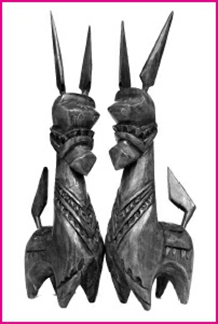
Fig. 3.3 — Terracotta craft.
7. Silver Jewellery & Bidri
- Filigree is a major silver-jewellery technique.
- Odisha: painri and paijam silver anklets; knitted silver ornament called gunchi.
- Bidri, Karnataka: silver inlay against a dark background, creating strong contrast.
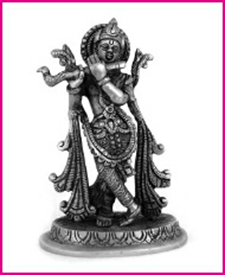
Fig. 3.5 — Metal craft illustration.
8. Clay & Pottery Work
Pottery is called the ‘Lyric of handicrafts’ in the source. The earliest evidence cited is Mehrgarh, where clay pottery was highly developed around 6000 BCE.
| Historical pottery | Period / place | Key point |
| Painted Grey Ware | Vedic period, 1500–600 BCE | Typically grey; associated with the Vedic period. |
| Red & Black Pottery | 1500–300 BCE; West Bengal | Red-and-black tradition. |
| Northern Black Polished Ware | 700–400 BCE and 400–100 BCE | Two phases; partly overlaps the Mauryan period. |
| Roulette Pottery | 200–100 BCE; Arikamedu | Important southern evidence. |
From the Gupta period (300–600 CE), embellishment, painting, stamping and moulding became prominent. Indo-Islamic traditions introduced glazed pottery.
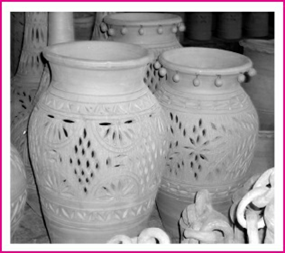
Fig. 3.4 — Pottery.
Regional Pottery — Quick Revision
| Pottery | Region | Signature |
| Khurja Pottery | Uttar Pradesh | Colourful and sturdy; household items. |
| Black Pottery | Azamgarh, UP | Special dark tint. |
| Glazed Tiles | Chunar & Chinhat | Special glazing techniques. |
| Blue Pottery | Jaipur | Made of Multani Mitti. |
| Kagzi Pottery | Alwar | Delicate, thin and slightly brittle. |
| Pokhran Pottery | Pokhran | Household items. |
| Dalgate Pottery | Jammu & Kashmir | Special glaze. |
| Karigari Pottery | Tamil Nadu | Special centres in South Arcot. |
| Surai | West Bengal | Common jugware. |
| Black Pottery | Ukhrul, Manipur | Special black tint in glaze. |
| Gopichandan | Saurashtra | Clay art objects. |
9. Bronze Crafts
Metal casting has been used in Indian craftsmanship for more than 5,000 years. The bronze Dancing Girl of Mohenjo-daro is dated in the source to around 3500–3000 BCE.
- Copper and tin are identified as the earliest non-ferrous metals; together they form bronze.
- Matsya Purana gives early literary evidence on bronze casting methods; Rasa Ratnakar discusses metal purity and zinc distillation.
- Uttar Pradesh: Etawah, Sitapur, Varanasi and Moradabad are major centres.
- Products: flower pots, divine images and ritual objects such as tamrapatra, kanchantal and panchpatra.
- Tamil Nadu produces statues reflecting Pallava, Chola, Pandya and Nayaka traditions.
10. Metal Crafts & Techniques
| Technique / craft | Region / centre | Core idea |
| Marori | Rajasthan | Metal etched; gaps filled with resin. |
| Embossing / Repoussé | Various | Raised design in relief. |
| Engraving | Various | Scratching/cutting lines into metal. |
| Badla | Marwar, Rajasthan | Semi-circular/rounded zinc pots. |
| Baarik Kaam / Nakasshi | Moradabad | Delicate engraved metal work. |
| Tarkashi | Rajasthan | Fine copper/brass wires in chiselled grooves. |
| Koftagiri / Damascening | Jaipur & Alwar | Light metal inlaid on dark metal. |
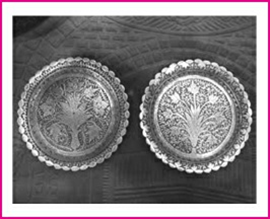
Fig. 3.6 — Marori work of Rajasthan.
| Centre / region | Craft / feature |
| Kerala | Rare Jain imagery and icons are mentioned in the source table. |
| Karnataka | Gaja Tandava — Shiva in Tandava posture. |
| Odisha & West Bengal | Dokra casting; brass ornaments. |
| Jaipur & parts of UP | Pahaldar lamps — copper/brass lamps. |
| Warangal, Telangana | Pembarthi — sheet-metal brass work for chariots and temples. |
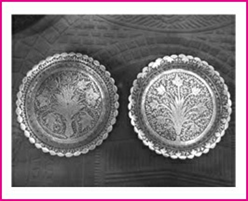
Fig. 3.7 — Metal-work illustration.
11. Leather Products
Leather tanning is traced to about 3000 BCE. Early skins mentioned are tiger and deer; camel became especially important. Ancient rishis are described as using animal skins as mats.
- Leather is difficult to preserve archaeologically because it is perishable.
- Modern uses: footwear, bags and wallets.
- Rajasthan: camel-leather bags; Jaipur and Jodhpur—Mojadis.
- Kanpur: major leather/tanning centre; Maharashtra—Kolhapuri chappals.
- Chennai and Kolkata: leather bags and footwear.
- Punjabi juttis: applique decoration.
- Bikaner: Manoti Art—decoration using camel skin.
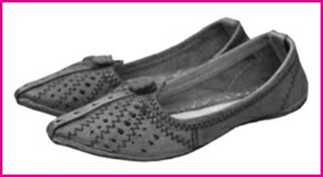
Fig. 3.8 — Jutti.
12. Wooden Work
Wood supports furniture, architectural elements and decorative carving. The chapter emphasises regional wood types and climate-linked craftsmanship.
- Kashmir: walnut and deodar; tradition flourished from the 13th century; wooden houses and houseboats; latticework—acche-dar, khatamband, azlipinjra.
- Gujarat: latticework on windows and doors.
- Himachal Pradesh: Brahmour and Chatrahi; temple woodcarving—naghbel, kutheriphool, jali, dori.
| Region | Wood / material | Typical craft |
| Karnataka | Sandalwood | Carved wooden items. |
| Andhra Pradesh | Raktachandan / red sandalwood | Carved dolls and figurines. |
| Kerala | Teakwood | Tharavad houses; deep brown colour and intricate woodwork. |
| Nagaland / North-East | Kumisyng | Local wood; huge log drums. |
| Rajasthan | Rohilda | Sindoor boxes and turned bowls. |
| Ratnagiri, Maharashtra | Hale & Pangora | Lacquered imitation fruits. |
13. Various Types of Toys
Toy making is both an art and a flourishing business. The earliest toy-cart evidence cited is Harappan.
- Harappan sites: Alamgirpur, Ambkheri, Kalibangan, Lothal; copper, bronze and terracotta toy-cart models.
- Early historic sites: Atranjikhera, Nagarjunakonda, Sambhar, Sonapur, Ujjain, Brahmpuri.
- Materials: clay, paper, papier-mâché, painted wood and lacquered wood.
- Andhra Pradesh: Tirupati red-wood dolls.
- Rajasthan: colourful cloth dolls and stuffed toys.
- Assam: pith / Indian cork dolls.
- Mysore and Chennapatna: lacquered-wood toys.
- Kondapalli, Andhra Pradesh: ponki softwood; Ambari Hathi.
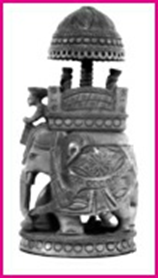
Fig. 3.9 — Toy-craft illustration.
14. Stoneware / Stone Craft
India’s geography and long masonry tradition produced highly skilled stone carving. Materials include soft-brittle sandstone, red stone and hard granite.
- Mauryan monuments demonstrate advanced carving and sculpture.
- Major examples: Ajanta, Ellora, Khajuraho, Sanchi, Bharhut and Masrur’s monolithic rock-cut temple in Kangra.
- Mughal period: greater use of marble and Pietra Dura — coloured-stone inlay on marble.
- Taj Mahal and Itmad-ud-Daulah’s tomb are highlighted white-marble monuments.
- Rajasthan: Makrana marble / Sang-e-Marmar.
- Jhansi, Uttar Pradesh: dark-brown stone called Sang-e Rathak.
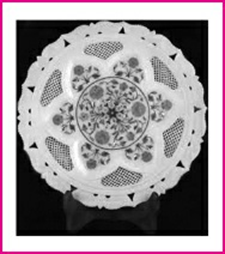
Fig. 3.10 — Stonework.
15. Embroidery Crafts
Embroidery creates raised textile designs using gold, silver, silk or cotton threads and needles. The chapter covers stitching, appliqué, metallic-thread work and mirror work.
| Craft | Region | Distinctive feature |
| Pipli / Appliqué | Pipli, Odisha | Patchwork of colourful fabric; used for lamps and other decorative pieces. |
| Phulkari | Punjab, Haryana, Delhi | Darning creates colourful flower-like patterns. |
| Bagh | Punjab | Like Phulkari but covers the whole surface. |
| Gota | Rajasthan | Gold thread/zari; appliqué-like patterns. |
| Zari | Khandela & Jaipur | Gold/silver thread work. |
| Karchobi | Rajasthan | Raised zari-like metallic thread on cotton padding. |
| Chikankari | Lucknow | White-thread floral/patterned embroidery. |
| Kashida / Kashidakari | Kashmir | Fine embroidery, especially on cashmere shawls; floral motifs. |
| Banaras Brocade | Varanasi | Silver/gold zari on silk; floral motifs; 2–8 weeks in source. |
| Himroo | Aurangabad, Maharashtra | Historic royal dress/shawl material. |
| Maheshwari | Madhya Pradesh | Cotton-silk mix; golden zari; reversible borders. |
| Chamba Rumal | Himachal Pradesh | Pahari-painting influence; Krishna themes; marriage gifts. |
| Shisha | Kutch, Gujarat | Tiny mirrors fixed with herringbone and satin stitch. |
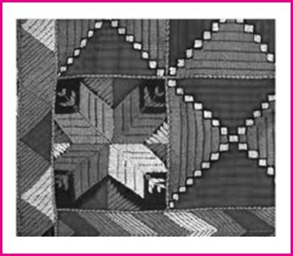
Fig. 3.11 — Appliqué patterns.
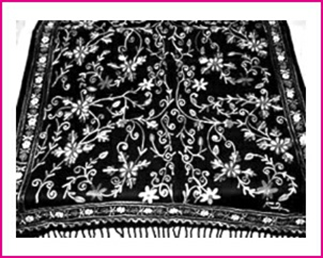
Fig. 3.12 — Kashida embroidery.
Additional traditions: Kantha in West Bengal/Odisha uses layers of old cloth or saris stitched and embroidered; Manipur uses dark muga-silk embroidery on phanek borders for auspicious occasions; Kasuti of Karnataka uses geometric cross-stitch motifs and is traditionally hand-made.
| KASUTI MEMORY HOOK Kasuti = Karnataka + counted threads + geometric motifs + no knots + both sides look alike. |
16. Embroidery — Complete Revision List
| Embroidery | Region | One-line identifier |
| Chikankari | Lucknow, UP | Guide pattern printed first; embroidery follows; finished piece washed. |
| Kantha | West Bengal & Odisha | Thread often drawn from border threads of used cloth; varied motifs. |
| Phulkari | Punjab | Bright floral motifs; stitches worked from reverse. |
| Bagh | Punjab | Phulkari-like but embroidery covers whole surface. |
| Zardozi | Uttar Pradesh | Gold/silver/copper wire + polished metallic finish + silk threads. |
| Kashidakari | J&K | Chain stitches; flora; generally no human/animal figures. |
| Aari | J&K & Gujarat | Concentric chain stitch using a long hooked needle; floral motifs. |
| Mirror work | Rajasthan & Gujarat | Small mirrors stitched into colourful embroidery. |
| Dharaniya | Gujarat | Embroidered wall hangings. |
| Heer | Gujarat | Bold geometric patterns in silk. |
| Gota | Rajasthan | Gold-zari ribbon pieces applied and sewn down. |
| Akshida | Bihar | Similar to Bagh. |
| Kasuti | Karnataka | Single thread; counted threads; no knots; both sides alike. |
| Rabari | Gujarat | Animal decorations by Rabari tribe. |
| Pichwai | Rajasthan & Gujarat | Colourful hangings behind religious idols. |
| Shamilami | Manipur | Mixes weaving and embroidery. |
| Phool Patti ka Kaam | Aligarh, UP | Flower-petal and leaf motifs. |
| Toda | Toda tribes, Tamil Nadu | Similar to Kantha. |
| Banni | Gujarat | Lohana community; silk floss, geometric motifs and glass work. |
| Banjara | Lambada Andhra & Banjara MP | Appliqué + mirrors + beadwork. |
| Mukesh | Uttar Pradesh | Twisted thin metallic threads create all-over patterns. |
| Karchobi | Rajasthan | Raised zari embroidery over cotton padding. |
| Pipli | Pipli village, Odisha | Bright patterned fabric pieces sewn onto plain background. |
17. Floor Designs
Floor designs have universal appeal and are commonly created during religious or family auspicious occasions. They usually begin at a central dot and expand through repeated geometric patterns.
- Common motifs: circles, squares, triangles, straight lines and curves.
- Natural, non-staining and easily erasable materials are used because designs are temporary.
- White is produced with dry chalk/lime (chuna), powdered marble, or rice powder mixed with lime.
| Design | Region | Key features |
| Chowkpurna | Punjab & Uttar Pradesh | Squares, circles, triangles; chowk linked to Lakshmi’s chowki; auspicious occasions. |
| Aipan | Himachal Pradesh | Squares, circles and triangles. |
| Mandana | Rajasthan & Madhya Pradesh | Decoration; squares/hexagons/triangles/circles; ground cleaned with cow dung; sometimes crimson from reti/red earth. |
| Santhias | Gujarat | Entrance decoration for important occasions. |
| Rangoli | Maharashtra | Elegant shapes; lotus and swastik motifs. |
| Kolam | South India | Links dots; rice/stone powder on wet ground; red geru outline. |
| Hase / Muggulu / Golam | Karnataka / AP / Kerala | Regional names of Kolam. |
| Mandapa Kolam | South India | Large wet-rice-paste Kolam for marriages. |
| Graha Kolam | South India | Daily sanctification of household worship space. |
| Jhonti | Odisha | Stylised; conch, fish, serpent, flower motifs. |
| Aripana | West Bengal & Assam | Chalk outline; coloured powder/rice paste; alta red, turmeric yellow; flower before each design. |
18. Kolam, Jhonti & Aripana — Special Notes
- Kolam lines are drawn with powdered rice or white crushed-stone powder on wet ground and outlined with red geru.
- Kolam is called Hase in Karnataka, Muggulu in Andhra Pradesh and Golam in Kerala.
- Cosmological bodies such as the Sun and Moon may be drawn.
- Mandapa Kolams are large marriage-hall designs made with wet rice paste; Graha Kolam sanctifies household worship space each morning.
- Jhonti of Odisha and Aripana of West Bengal/Assam are highly stylised; common motifs include conch shells, fish, serpents and flowers.
- Aripana uses chalk powder outlines and coloured powder/rice paste; alta/sindoor gives red and turmeric gives yellow. A flower is traditionally placed before each Aripana.
19. UPSC One-Page Revision Formula
| Area | Instant recall |
| Glassware | PGW beads c.1000 BCE; Brahmapuri/Kolhapur lenticular beads; Mughal Sheesh Mahal; Hyderabad Churikajodas; Firozabad; Saharanpur panchkora; Patna Tikuli. |
| Cloth | Bandhani/Bandhej = tie-dye; Laharia = waves; Ikat = resist on yarn; Kalamkari = pen + vegetable dyes; Batik = wax; Tanchoi = Chinese-inspired; Jamdani = muslin + opaque patterns. |
| Sarees | Pochampalli–AP; Patola–Patan; Baluchari–Murshidabad; Jamdani–WB; Tanchoi–Varanasi; Chanderi–MP; Ilkal–Karnataka; Tant–WB; Nauvari–Maharashtra; Bomkai–Odisha; Konrad–TN; Kosa–Chhattisgarh; Paithani–Maharashtra; Kasavu–Kerala; Dabu–Rajasthan. |
| Ivory | Vedic danta; Harappan exports; Sanchi guild of Vidisa; Mughal combs/handles/ornaments; Delhi–Jaipur–WB centres. |
| Terracotta | Baked earth; Bankura/Panchmura; Bankura temples; Pala Buddhist viharas. |
| Silver/Bidri | Filigree; Odisha painri/paijam/gunchi; Bidri = silver inlay on dark base. |
| Pottery | Mehrgarh c.6000 BCE; PGW; Red & Black; NBPW; Roulette–Arikamedu; Gupta decoration; Indo-Islamic glazing. |
| Bronze/metal | Dancing Girl; copper+tin=bronze; Matsya Purana; UP centres; Marori; Repoussé; Nakasshi; Tarkashi; Koftagiri. |
| Leather | Tanning c.3000 BCE; Rajasthan camel leather; Mojadi; Kanpur; Kolhapuri chappal; Punjabi jutti; Bikaner Manoti. |
| Wood | Kashmir walnut/deodar; latticework; Gujarat doors/windows; Himachal temple carving; Karnataka sandalwood; AP red sandalwood; Kerala teak; Nagaland log drums. |
| Toys | Harappan carts; Tirupati dolls; Rajasthan cloth toys; Assam pith; Mysore/Chennapatna lacquered wood; Kondapalli Ambari Hathi. |
| Stone | Ajanta/Ellora; Khajuraho; Sanchi/Bharhut; Masrur; Mughal marble + Pietra Dura; Makrana; Jhansi dark-brown stone. |
| Embroidery | Pipli, Phulkari, Bagh, Zardozi, Kashidakari, Aari, Mirror work, Gota, Kasuti, Rabari, Pichwai, Banni, Banjara, Mukesh, Karchobi, etc. |
| Floor art | Chowkpurna/Aipan; Mandana; Santhias; Rangoli; Kolam + Hase/Muggulu/Golam; Mandapa/Graha Kolam; Jhonti; Aripana. |
20. UPSC Prelims — Source-Based Takeaway
| 2015 PYQ The chapter reproduces a 2015 Prelims question asking what Kalamkari painting refers to. The correct association is the hand-painted cotton textile tradition of South India. |
| MAINS LENS Use handicrafts to discuss cultural diversity, continuity of traditional knowledge, regional specialisation, livelihoods of rural/tribal communities, material culture, and preservation. Strong answers connect a craft to region, technique and historical context. |