
Kinematics
Table of Contents
Kinematics is defined as the study of motion without considering its causes. The word “kinematics” comes from a Greek term meaning motion and is related to other English words such as “cinema” (movies) and “kinesiology” (the study of human motion). In one-dimensional kinematics we will study only the motion of a ball, for example, without worrying about what forces cause or change its motion. Such considerations come in other chapters. In this chapter, we examine the simplest type of motion—namely, motion along a straight line, or one-dimensional motion.
Position
In order to describe the motion of an object, you must first be able to describe its position—where it is at any particular time. More precisely, you need to specify its position relative to a convenient reference frame. Earth is often used as a reference frame, and we often describe the position of an object as it relates to stationary objects in that reference frame. For example, a rocket launch would be described in terms of the positionof the rocket with respect to the Earth as a whole, while a professor’s positioncould be described in terms of where she is in relation to the nearby white board. In other cases, we use reference frames that are not stationary but are in motionrelative to the Earth. To describe the position of a person in an airplane, for example, we use the airplane, not the Earth, as the reference frame.
Displacement
If an object moves relative to a reference frame (for example, if a professor moves to the right relative to a white board or a passenger moves toward the rear of an airplane), then the object’s position changes. This change in position is known as displacement. The word “displacement” implies that an object has moved, or has been displaced.
Definition:
DISPLACEMENT
Displacement is the change in position of an object:
Δx=xf−x0,
where Δx is displacement , xf is the final position and x 0 is the initial position
In this text the upper case Greek letter Δ always means “change in” whatever quantity follows it; thus, Δx means change in position
We can find displacement by subtracting initial position X0 from the final position Xf
Note that the SI unit for displacement is the meter (m), but sometimes kilometres, miles, feet, and other units of length are used. Keep in mind that when units other than the meter are used in a problem, you may need to convert them into meters to complete the calculation.
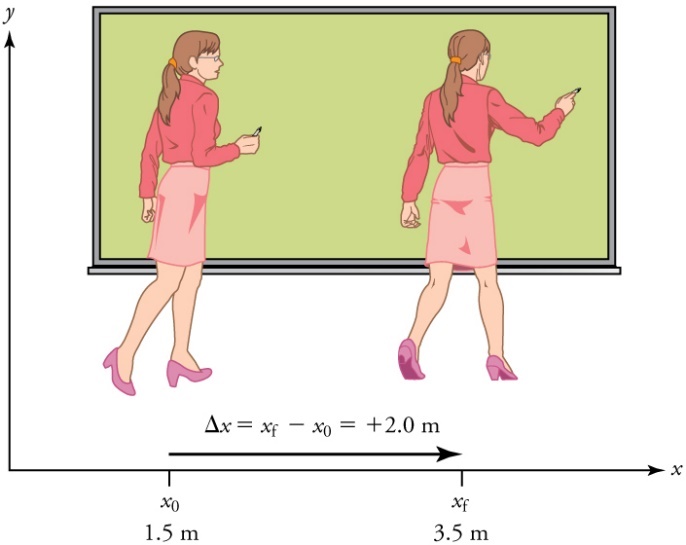
A professor paces left and right while lecturing. Her position relative to Earth is given by x. The +2.0 m displacement of the professor relative to Earth is represented by an arrow pointing to the right.
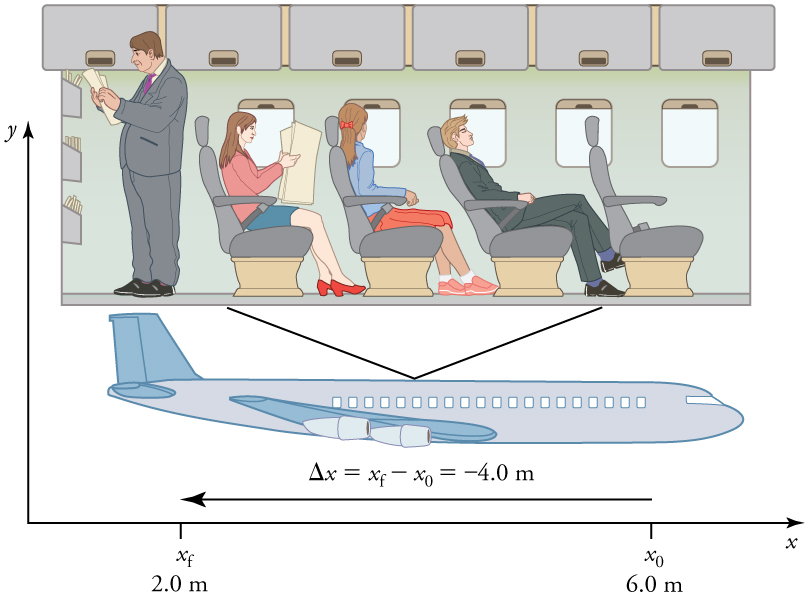
A passenger moves from his seat to the back of the plane. His location relative to the airplane is given by x. The −4.0 m displacement of the passenger relative to the plane is represented by an arrow toward the rear of the plane. Notice that the arrow representing his displacement is twice as long as the arrow representing the displacement of the professor (he moves twice as far)
Note that displacement has a direction as well as a magnitude. The professor’s displacement is 2.0 m to the right, and the airline passenger’s displacement is 4.0 m toward the rear. In one-dimensional motion, direction can be specified with a plus or minus sign. When you begin a problem, you should select which direction is positive (usually that will be to the right or up, but you are free to select positive as being any direction).
The professor’s initial position is X0 =1.5 m and her final position is Xf =3.5 m . Thus her displacement is
Δx=Xf−X0=3.5 m−1.5 m=+2.0 m.
In this coordinate system, motion to the right is positive, whereas motion to the left is negative.
Similarly, the airplane passenger’s initial position is X0=6.0 m and his final position is Xf=2.0m and hence his displacement is
Δx=Xf−X0=2.0 m−6.0 m=−4.0 m.
His displacement is negative because his motion is toward the rear of the plane, or in the negative x direction in our coordinate system.
Distance
Although displacement is described in terms of direction, distance is not.
Distance is defined to be the magnitude or size of displacement between two positions. Note that the distance between two positions is not the same as the
distance travelled between them.
Distance travelled is the total length of the path traveled between two positions.
Distancehas no direction and, thus, no sign. For example, the distance
the professor walks is 2.0 m. The distance the airplane passenger walks is 4.0 m.
MISCONCEPTION ALERT:
DISTANCE TRAVELED VS. MAGNITUDE OF DISPLACEMENT
It is important to note that the distance traveled, however, can be greater than the magnitude of the displacement (by magnitude, we mean just the size of the displacement without regard to its direction; that is, just a number with a unit). For example, the professor could pace back and forth many times, perhaps walking a distance of 150 m during a lecture, yet still end up only 2.0 m to the right of her starting point. In this case her displacement would be +2.0 m, the magnitude of her displacement would be 2.0 m, but the distance she travelled would be 150 m.
In kinematics we nearly always deal with displacement and magnitude of displacement, and almost never with distance travelled. One way to think about this is to assume you marked the start of the motion and the end of the motion. The
Displacement is simply the difference in the position of the two marks and is independent of the path taken in traveling between the two marks. The
distance travelled, however, is the total length of the path taken between the two marks.
Exercise
A cyclist rides 3 km west and then turns around and rides 2 km east. (a) What is her displacement? (b) What distance does she ride? (c) What is the magnitude of her displacement?
Answer
The rider’s displacement is .
a) Δx=Xf−X0 = 2 – 3 = -1 (The displacement is negative because we take east to be positive and west to be negative.)
(b) The distance traveled is 3 km + 2 km = 5 km.
(c) The magnitude of the displacement is 1 km
Vectors, Scalars, and Coordinate Systems
What is the difference between distance and displacement?
Whereas displacement is defined by both direction and magnitude, distance is defined only by magnitude. Displacement is an example of a vector quantity. Distance is an example of a scalar quantity.
A vector is any quantity with both magnitude and direction. Other examples of vectors include a velocity of 90 km/h east and a force of 500 newtons straight down. The direction of a vector in one-dimensional motion is given simply by a plus (+) or minus (−) sign. Vectors are represented graphically by arrows. An arrow used to represent a vector has a length proportional to the vector’s magnitude (e.g., the larger the magnitude, the longer the length of the vector) and points in the same direction as the vector. Some physical quantities, like distance, either have no direction or none is specified.
A scalar is any quantity that has a magnitude, but no direction. For example, a 20ºC temperature, the 250 kilocalories (250 Calories) of energy in a candy bar, a 90 km/h speed limit, a person’s 1.8 m height, and a distance of 2.0 m are all scalars—quantities with no specified direction. Note, however, that a scalar can be negative, such as a −20ºC temperature. In this case, the minus sign indicates a point on a scale rather than a direction. Scalars are never represented by arrows.
Coordinate Systems for One-Dimensional Motion
In order to describe the direction of a vector quantity, you must designate a coordinate system within the reference frame. For one dimensional motion, this is a simple coordinate system consisting of a one-dimensional coordinate line. In general, when describing horizontal motion, motion to the right is usually considered positive, and motion to the left is considered negative. With vertical motion, motion up is usually positive and motion down is negative. In some cases, however, as with the jet in Figure , it can be more convenient to switch the positive and negative directions. For example, if you are analyzing the motion of falling objects, it can be useful to define downwards as the positive direction. If people in a race are running to the left, it is useful to define left as the positive direction. It does not matter as long as the system is clear and consistent. Once you assign a positive direction and start solving a problem, you cannot change it. Figure :

It is usually convenient to consider motion upward or to the right as positive (+) and motion downward or to the left as negative (−).
Time, Velocity, and Speed :
There is more to motion than distance and displacement. Questions such as, “How long does a foot race take?” and “What was the runner’s speed?” cannot be answered without an understanding of other concepts. In this section we add definitions of time, velocity, and speed to expand our description of motion.
Time
The most fundamental physical quantities are defined by how they are measured. This is the case with time. Every measurement of time involves measuring a change in some physical quantity. It may be a number on a digital clock, a heartbeat, or the position of the Sun in the sky. In physics, the definition of time is simple—time is change, or the interval over which change occurs. It is impossible to know that time has passed unless something changes. The amount of time or change is calibrated by comparison with a standard. The SI unit for time is the second, abbreviated s. We might, for example, observe that a certain pendulum makes one full swing every 0.75 s. We could then use the pendulum to measure time by counting its swings or, of course, by connecting the pendulum to a clock mechanism that registers time on a dial. This allows us to not only measure the amount of time, but also to determine a sequence of events.
How does time relate to motion? We are usually interested in elapsed time for a particular motion, such as how long it takes an airplane passenger to get from his seat to the back of the plane. To find elapsed time, we note the time at the beginning and end of the motion and subtract the two. For example, a lecture may start at 11:00 A.M. and end at 11:50 A.M., so that the elapsed time would be 50 min.
Elapsed time Δt is the difference between the ending time and beginning time,
Δt = tf – t0 , where
Where Δt is the change in time or elapsed time, is the time at the end of the motion, and t0 is the time at the beginning of the motion.
Velocity
Your notion of velocity is probably the same as its scientific definition. You know that if you have a large displacement in a small amount of time you have a large velocity, and that velocity has units of distance divided by time, such as miles per hour or kilometres per hour.
Average velocity is displacement (change in position) divided by the time of travel,
ṽ = Δx / Δt = (Xf −X0) / (tf −t0)
where ṽ is the average (indicated by the bar over the v) velocity, Δx is the change in position (or displacement), and Xf and X0 are the final and beginning positions at times tf and t0 respectively
Notice that this definition indicates that velocity is a vector because displacement is a vector. It has both magnitude and direction. The SI unit for velocity is meters per second or m/s, but many other units, such as km/h, mi/h (also written as mph), and cm/s, are in common use.
Suppose, for example, an airplane passenger took 5 seconds to move −4 m (the negative sign indicates that displacement is toward the back of the plane). His average velocity would be
ṽ = Δx / Δt = (-4m)/5s = -0.8 m/s
The average velocity of an object does not tell us anything about what happens to it between the starting point and ending point, however. For example, we cannot tell from average velocity whether the airplane passenger stops momentarily or backs up before he goes to the back of the plane. To get more details, we must consider smaller segments of the trip over smaller time intervals.
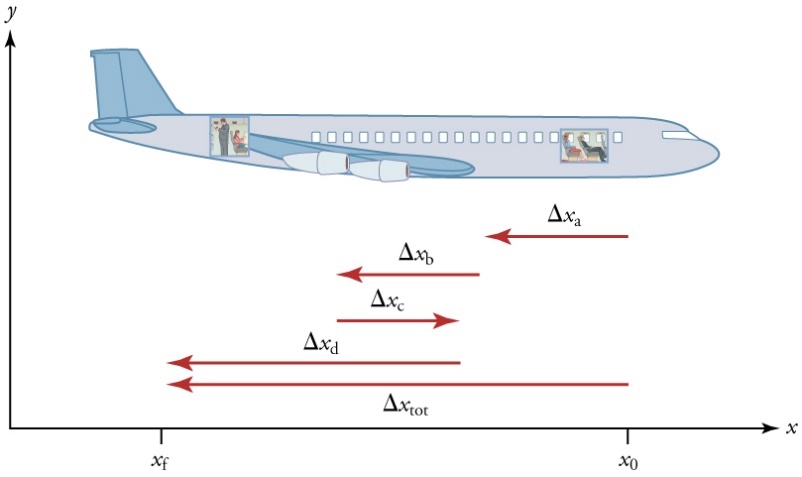
The smaller the time intervals considered in a motion, the more detailed the information. When we carry this process to its logical conclusion, we are left with an infinitesimally small interval. Over such an interval, the average velocity becomes the instantaneous velocity or the velocity at a specific instant. A car’s speedometer, for example, shows the magnitude (but not the direction) of the instantaneous velocityof the car. (Police give tickets based on instantaneous velocity, but when calculating how long it will take to get from one place to another on a road trip, you need to use average velocity.)
Instantaneous velocity v is the average velocity at a specific instant in time (or over an infinitesimally small timeinterval).
Speed
In everyday language, most people use the terms “speed” and “velocity” interchangeably. In physics, however, they do not have the same meaning and they are distinct concepts. One major difference is that speed has no direction. Thus speed is a scalar . Just as we need to distinguish between instantaneous velocity and average velocity, we also need to distinguish between instantaneous speed and average speed
Instantaneous speed is the magnitude of instantaneous velocity . For example, suppose the airplane passenger at one instant had an instantaneous velocity of −3.0 m/s (the minus meaning toward the rear of the plane). At that same time his instantaneous speed was 3.0 m/s. Or suppose that at one time during a shopping trip your instantaneous velocity is 40 km/h due north. Your instantaneous speed at that instant would be 40 km/h—the same magnitude but without a direction.
Average speed , however, is very different from average velocity. Average speed is the distance travelled divided by elapsed time .
We have noted that distance travelled can be greater than displacement. So average speedcan be greater than average velocity , which is displacement divided by time . For example, if you drive to a store and return home in half an hour, and your car’s odometer shows the total distance travelled was 6 km, then your average speed was 12 km/h. Your average velocity , however, was zero, because your displacement for the round trip is zero. (Displacement is change in position and, thus, is zero for a round trip.) Thus average speed is not simply the magnitude of average velocity
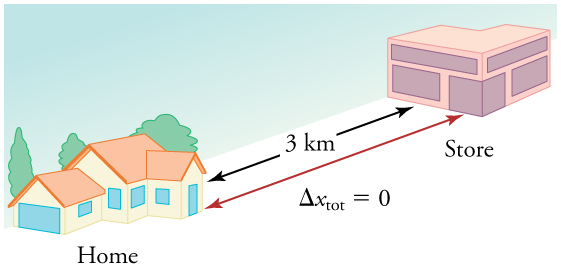
Another way of visualizing the motion of an object is to use a graph. A plot of position or of velocity as a function of time can be very useful. For example, for this trip to the store, the position , velocity, and speed-vs.-time graphs are displayed (Note that these graphs depict a very simplified model of the trip. We are assuming that speed is constant during the trip, which is unrealistic given that we’ll probably stop at the store. But for simplicity’s sake, we will model it with no stops or changes in speed. We are also assuming that the route between the store and the house is a perfectly straight line.)
.
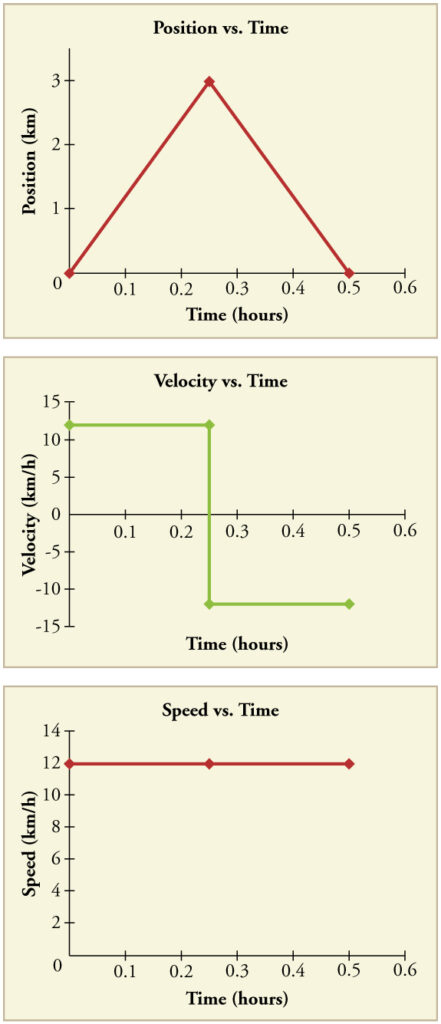
Position vs. time , velocity vs. time, and speed vs. time on a trip. Note that the velocity for the return trip is negative.
Acceleration :
In everyday conversation, to accelerate means to speed up. The accelerator in a car can in fact cause it to speed up. The greater the acceleration, the greater the change in velocity over a given time . The formal definition of
Acceleration is consistent with these notions, but more inclusive.
AVERAGE ACCELERATION
Average Acceleration is the rate at which velocity changes,
ặ=Δv / Δt=(Vf−V0) / (Tf−T0)
where ặ is average acceleration ,V is velocity, and T is time
Because acceleration is velocity in m/s divided by time in s, the SI units for acceleration are m/s 2 (meters per second squared)
Recall that velocity is a vector —it has both magnitude and direction. This means that a change in velocity can be a change in magnitude (or speed), but it can also be a change in direction. For example, if a car turns a corner at constant speed, it is accelerating because its direction is changing. The quicker you turn, the greater the acceleration. So there is an Acceleration when velocity changes either in magnitude (an increase or decrease in speed) or in direction, or both.
ACCELERATION AS A VECTOR
Acceleration is a vector in the same direction as the change in velocity, Δv. Since velocity is a vector , it can change either in magnitude or in direction. Acceleration is therefore a change in either speed or direction, or both. Keep in mind that although acceleration is in the direction of the change in velocity, it is not always in the direction of motion
. If acceleration is in a direction opposite to the direction of motion , the object slows down.
Problem :
A racehorse coming out of the gate accelerates from rest to a velocity of 15.0 m/s due west in 1.80 s. What is its average acceleration ?
First we draw a sketch and assign a coordinate system to the problem. This is a simple problem, but it always helps to visualize it. Notice that we assign east as positive and west as negative. Thus, in this case, we have negative velocity.
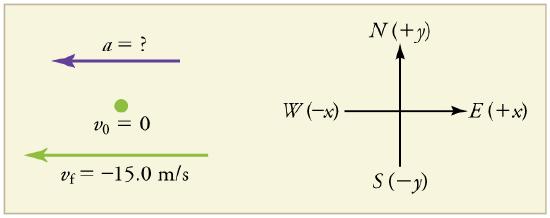
We can solve this problem by identifying Δv and Δt from the given information and then calculating the average acceleration directly from the equation
ặ=Δv / Δt=(Vf−V0) / (Tf−T0)
We know that
V0=0, Vf =−15.0 m/s (the negative sign indicates direction toward the west), Δt=1.80 s
Since the horse is going from zero to −15.0 m/s, its change in velocity equals its final velocity: Δv=vf=−15.0 m/s
Substituting the values , we get
ặ = (−15.0 m/s) / 1.80 s= −8.33 m/s2
Falling Objects
Falling objects form an interesting class of motion problems. For example, we can estimate the depth of a vertical mine shaft by dropping a rock into it and listening for the rock to hit the bottom. By applying the kinematics developed so far to falling objects, we can examine some interesting situations and learn much about gravity in the process.
Gravity
The most remarkable and unexpected fact about falling objects is that, if air resistance and friction are negligible, then in a given location all objects fall toward the center of Earth with the same constant acceleration, independent of their mass. This experimentally determined fact is unexpected, because we are so accustomed to the effects of air resistance and friction that we expect light objects to fall slower than heavy ones.
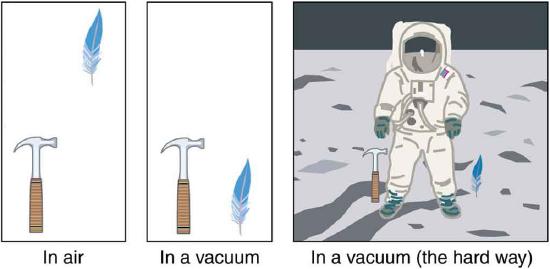
In the real world, air resistance can cause a lighter object to fall slower than a heavier object of the same size. A tennis ball will reach the ground after a hard baseball dropped at the same time . (It might be difficult to observe the difference if the height is not large.) Air resistance opposes the motion of an object through the air, while friction between objects—such as between clothes and a laundry chute or between a stone and a pool into which it is dropped—also opposes motion between them. For the ideal situations of these first few chapters, an object falling without air resistance or friction is defined to be in free-fall . The forceof gravity causes objects to fall toward the center of Earth. The acceleration of free-falling objects is therefore called the acceleration due to gravity . The acceleration due to gravity is constant, which means we can apply the kinematics equations to any falling object where air resistance and friction are negligible. This opens a broad class of interesting situations to us. The acceleration due to gravity is so important that its magnitude is given its own symbol, g. It is constant at any given location on Earth and has the average value
g=9.80 m/s2
The direction of the acceleration due to gravity is downward (towards the center of Earth). In fact, its direction defines what we call vertical. Note that whether the acceleration a in the kinematic equations has the Value +g or −g depends on how we define our coordinate system . If we define the upward direction as positive, then a=−g=−9.80 m/s2 , and if we define the downward direction as positive, then a=g=9.80 m/s2
KINEMATIC EQUATIONS FOR OBJECTS IN FREE FALL :
V=V0−gt
y=y0+v0 t−1/2(gt2)
v2=(v0)2−2g(y−y0)
Example problem :
A person standing on the edge of a high cliff throws a rock straight up with an initial velocity of 13.0 m/s. The rock misses the edge of the cliff as it falls back to earth. Calculate the position and velocity of the rock 1.00 s, 2.00 s, and 3.00 s after it is thrown, neglecting the effects of air resistance .
Solution :
Draw a sketch
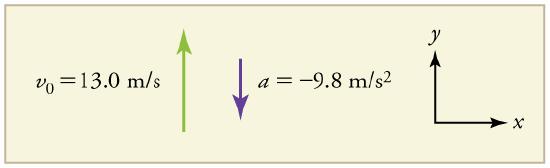
We are asked to determine the position y at various times. It is reasonable to take the initial position y0 to be zero. This problem involves one-dimensional Motion in the vertical direction. We use plus and minus signs to indicate direction, with up being positive and down negative. Since up is positive, and the rock is thrown upward, the initial velocity must be positive too. The acceleration due to gravity is downward, so a is negative. It is crucial that the initial velocity and the acceleration due to gravity have opposite signs. Opposite signs indicate that the acceleration due to gravity opposes the nitial motion and will slow and eventually reverse it.
Since we are asked for values of position and velocity at three times, we will refer to these as y1 and v1 ; y2 and v2; and y 3 and v3
Solution for Position y1 :
We know that y0=0; v0=13.0 m/s; a=−g=−9.80 m/s2 and t=1.00 s.
We need to Identify the best equation to use. We will use
y=y0+v0 t−1/2(gt2)
which is the value we want to find.
Substituting the known values and solve for y1
y1=0+(13.0 m/s)(1.00 s) – 1/ 2(−9.80 m/s2)(1.00 s)2 =8.10 m
Solution for Velocity V1 :
Given that
y0=0; v0=13.0 m/s; a=−g=−9.80 m/s2
We also know from the solution above that y1=8.10 m
The best equation to use is v=v0−gt
Where (−g )= gravitational acceleration
Substituting the values , we get
V1=v0 −gt=13.0 m/s−(9.80 m/s2)(1.00 s)=3.20 m/s
Solution for Remaining Times
The procedures for calculating the position and velocity att = 2.00 s and 3.00 s are the same as those above. The results are summarized in the Table below :
| Time , t | Position , y | Velocity, v |
| 1.00 s | 8.10 m | 3.20 m |
| 2.00 s | 6.40 m | −6.60 m |
| 3.00 s | −5.10m | −16.4 m |
Centripetal Acceleration :
We defined acceleration as a change in velocity, either in its magnitude or in its direction, or both. When an object moves along a circular path, the direction of its velocity changes constantly, so there is always an associated acceleration, even if the speed of the object is constant. You experience this acceleration yourself when you turn a corner in your car. What you notice is a sideways acceleration because you and the car are changing direction. The sharper the curve and the greater your speed, the more noticeable this acceleration will become. In this section we briefly examine the direction and magnitude of that acceleration.
The below image shows an object moving in a circular path at constant speed, called uniform circular motion . The direction of the instantaneous velocity is shown at two points along the path. Acceleration is in the direction of the change in velocity, which points directly toward the center of rotation (the center of the circular path). This pointing is shown with the vector diagram in the figure. We call the acceleration of an object moving in uniform circular motion (resulting from a net external force) the centripetal acceleration (ac ) – centripetal means “toward the center” or “center seeking.”
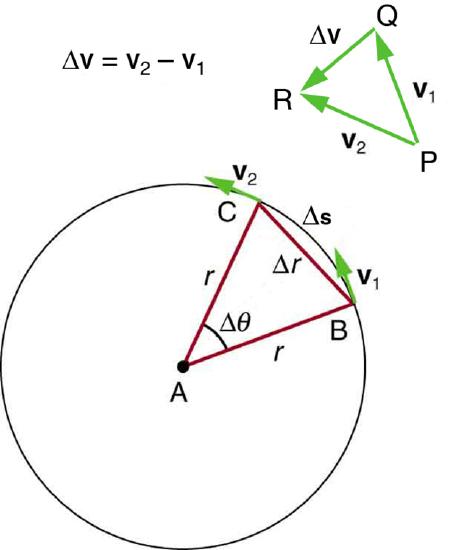
The directions of the velocity of an object at two different points are shown, and the change in velocity Δv is seen to point directly toward the center of curvature. (See small inset.) Because ac=Δv/Δt , the acceleration is also toward the center; ac is called centripetal acceleration. (For small time differences, Δθ is very small, and the arc length Δs is approximately equal to the chord length Δr)
The direction of centripetal acceleration is toward the center of curvature, but what is its magnitude? If we use the geometry shown in the above Figure along with some kinematics equations, we can obtain
ac=v2 / r
which is the acceleration of an object in a circle of radius r at a speed v.
We see in the above Equation that centripetal acceleration is greater at high speeds and in sharp curves (smaller radius), as you have noticed when driving a car. But it is a bit surprising that ac is proportional to speed squared, implying, for example, that it is four times as hard to take a curve at 100 km/h than at 50 km/h. A sharp corner has a small radius, so that ac is greater for tighter turns .
The unit of centripetal acceleration is m/s2
Take Quiz
1. Which of the following quantities is a scalar in kinematics?
a) Velocity
b) Speed
c) Acceleration
d) Displacement
ANSWER
b) Speed
2. What is the SI unit of acceleration?
a) m/s
b) m/s²
c) m/s³
d) m
ANSWER
b) m/s²
3. A car is moving in a straight line with a constant speed. What can you say about its acceleration?
a) It is zero
b) It is non-zero
c) It is increasing
d) It is decreasing
ANSWER
a) It is zero
4. When an object is in uniform circular motion, what can be said about its speed and velocity?
a) Speed is constant, velocity is constant
b) Speed is constant, velocity is changing
c) Speed is changing, velocity is constant
d) Both speed and velocity are changing
ANSWER
a) Speed is constant, velocity is changing
5. A car travels 200 meters in 10 seconds. What is its average speed?
a) 20 m/s
b) 10 m/s
c) 2 m/s
d) 5 m/s
ANSWER
d) 5 m/s
6. Which of the following equations represents the relationship between distance (d), initial velocity (u), acceleration (a), and time (t)?
a) d = ut
b) d = u + at
c) d = ut + (1/2)at²
d) v = u + at
ANSWER
c) d = ut + (1/2)at²
7. A ball is dropped from a height of 40 meters. How long does it take to reach the ground?
a) 2 seconds
b) 4 seconds
c) 6 seconds
d) 8 seconds
ANSWER
b) 4 seconds
8. If an object is in free fall near the surface of the Earth, what is the value of acceleration due to gravity (g)?
a) 9.8 m/s²
b) 10 m/s²
c) 9.81 m/s
d) 10.1 m/s²
ANSWER
a) 9.8 m/s²
9. A car accelerates from rest at a rate of 2 m/s² for 10 seconds. What is its final velocity?
a) 10 m/s
b) 20 m/s
c) 5 m/s
d) 2 m/s
ANSWER
b) 20 m/s
10. In which of the following motions is the speed constant, but the velocity changing?
a) Uniform circular motion
b) Free fall
c) Straight-line motion at constant speed
d) Linear motion with constant velocity
ANSWER
a) Uniform circular motion
11. An object is thrown vertically upward. What happens to its acceleration as it rises?
a) It increases
b) It decreases
c) It remains constant
d) It becomes zero
ANSWER
b) It decreases
12. A particle moves in a straight line with a uniform velocity of 8 m/s for 20 seconds. What is its displacement?
a) 160 m
b) 4 m
c) 20 m
d) 8 m
ANSWER
a) 160 m
13. A vehicle travels half the distance with speed V and the remaining distance with speed 2V . The average speed is : (NEET 2023 question)
a) V/3
b) 2V/3
c) 4V/3
d) 3V/4
ANSWER
c) 4V/3
14. Find the ratio of the distances travelled by a free falling body in the 1st , 2nd , 3rd and 4th second respectively (NEET 2022 question)
a) 1:4:9:16
b) 1:3:5:7
c) 1:1:1:1
d) 1:2:3:4
ANSWER
a) 1:4:9:16
15. A car starts from rest and accelerates at 5 m/s2. At t=4 s, a ball is dropped out of a window by a person sitting in the car. What is the velocity and acceleration of the ball at t=6 s ? (Take g=10 m/s2) (NEET 2021 question)
a) 20 m/s , 5 m/s2
b) 20 m/s , 0
c) m/s , 0
d) m/s , 10 m/s2
ANSWER
d) m/s , 10 m/s2