
INDIAN MUSIC – UPSC Civil Services Examination — Comprehensive Article
| How to use this article Designed for GS-I preparation: build conceptual clarity first, then revise the comparison tables, state-wise folk traditions, instruments, institutions and communities for Prelims; use the analytical themes and cultural linkages for Mains. |
1. Introduction and Historical Evolution
Indian music is presented in the chapter as a major expression of India’s cultural continuity and diversity. Its evolution can be traced from archaeological evidence and Vedic traditions to sophisticated systems of raga, tala and swara, and later to classical, folk, devotional, semi-classical and modern forms.
Early evidence and Vedic foundations
- Tradition associates Narada Muni with the introduction of music to earth and with the concept of Naada Brahma — the cosmic sound that pervades the universe.
- Archaeological evidence from the Indus Valley Civilization includes a seven-holed flute and the Ravanahatha.
- The Vedic period provides the earliest literary traces of Indian music. The Sama Veda is especially important: the seven notes of the raga Kharaharapriya are noted in descending order.
- Gandharva Veda, the science of music, is described as an Upaveda of the Sama Veda.
- The Aitareya Aranyaka mentions parts of the Veena; the Jaimini Brahmana refers collectively to dance and music; and the Kausitaki Brahmana brings dance, vocal and instrumental music together as an art.
- The chapter notes theories connecting Om with the origin of ragas and notes.
- Panini (c. 500 BCE) made an early proper reference to the art of making music, while Bharata’s Natyashastra (compiled c. 200 BCE–200 CE) provides the first major systematic treatment of musical theory.
Ancient and medieval musicology
- Later Vedic ritual music included Sangama, in which verses were chanted according to musical patterns.
- The epics were associated with narrative music called Jatigan.
- Bharata’s Natyashastra elaborated the octave and the 22 shrutis (microtonal divisions).
- Dathilam also endorsed the existence of 22 shrutis per octave. Sarangadeva later supported this view.
- Sarangadeva’s 13th-century Sangeet Ratnakara identified about 264 ragas, including North Indian and Dravidian repertoires, and contributed to the study and classification of microtones.
- Matanga’s Brihaddeshi (9th century) focused particularly on the definition of raga.
- Nanda’s Sangeeta Makaranda (11th century) enumerated 93 ragas and classified them into feminine and masculine forms.
- Ramamatya’s Swaramela-Kalanidhi (16th century) dealt primarily with ragas.
- Venkatamakhin’s Chaturdandi-prakasika (17th century) is another important work of musicology.
Guru–shishya and Gurukul tradition
The chapter emphasises the Gurukul/Ashram system as an important mechanism for transmitting musical knowledge. Students lived with the teacher, traditionally for a long period (described as 12 years), learning through direct experience and service. Kings and wealthy patrons supported such hermitages. Princes and commoners were treated alike in the idealised system.
| UPSC linkage The evolution of Indian music illustrates continuity with change: Vedic ritual and textual traditions remained foundational, while patronage, religious movements and cultural interactions created new forms and styles. |
Persian and Islamic influence
Persian and Islamic influences significantly changed the tenor of North Indian music. The devotional Dhruvapad tradition transformed into Dhrupad by the 15th century. By the 17th century, Khayal had emerged as a major Hindustani form. The period also saw the growth of numerous folk traditions.
2. Anatomy of Indian Classical Music
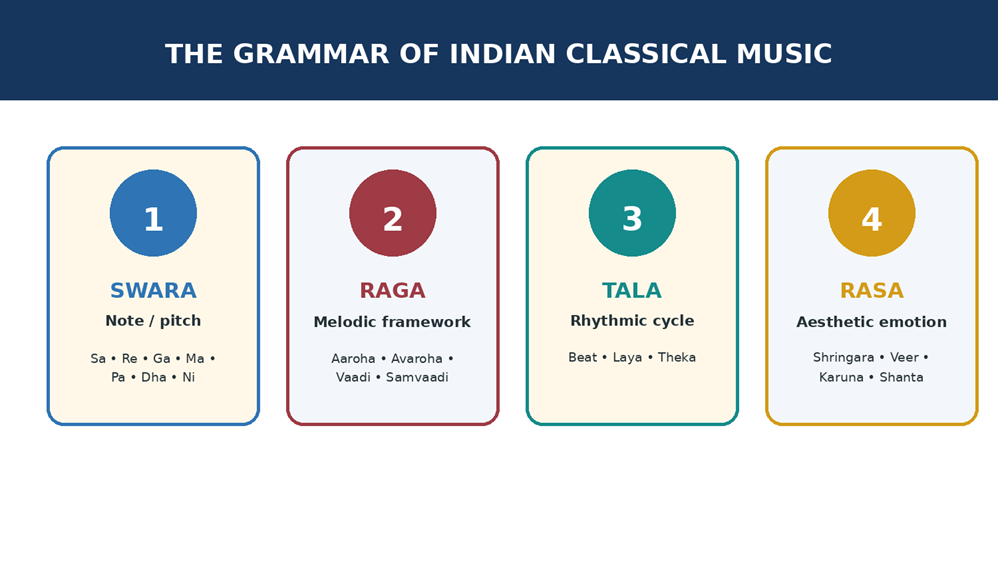
The chapter identifies three pillars of Indian classical music: Swara (pitch/note), Raga (melodic framework) and Tala (rhythmic cycle).
Swara and Shruti
Swara originally had associations with Vedic recitation. In music it denotes a note or scale degree. The seven basic swaras form the Saptak/Sargam:
| Sanskrit name | Abbreviation | Functional description |
| Sadaja | Sa | Tonic |
| Rishabha | Re/Re | Supertonic |
| Gandhara | Ga | Mediant |
| Madhyama | Ma | Sub-dominant |
| Panchama | Pa | Dominant |
| Dhaivata | Dha | Sub-mediant |
| Nishada | Ni | Subtonic |
A Shruti is a smaller gradation of pitch or microtone. The chapter describes 22 shrutis in the octave; of these, 12 are treated as audible in its discussion — seven Suddha swaras and five Vikrita swaras.
Raga
The word raga is derived from Sanskrit ‘Ranj’, meaning to delight, please or satisfy. A raga is not merely a scale or mode; it is a precise and aesthetic melodic framework with a characteristic ascending and descending movement and a distinctive emotional personality.
- Audav/Odava: pentatonic — 5 notes.
- Shadava: hexatonic — 6 notes.
- Sampurna: heptatonic — 7 notes.
- Shuddha Raag: adding notes absent from the original does not substantially alter its nature/form.
- Chhayalag Raag: adding notes not present in the original changes its nature/form.
- Sankeerna Raag: combination of two or more ragas.
- Vaadi: principal or most important note of the raga.
- Samvaadi: second most important note, related as a fourth or fifth to the principal note.
- Anuvaadi: other notes used in the composition besides vaadi and samvaadi.
- Vivadi: notes not present in the composition.
- Aaroha: ascending movement; Avaroha: descending movement.
- Laya may be Vilambit (slow), Madhya (medium) or Drut (fast).
Six major Hindustani ragas :
| Raga | Time | Season | Mood/association |
| Bhairav | Dawn | Any | Peace |
| Hindol | Morning | Spring | Sweetness of a young couple |
| Deepak | Night | Summer | Compassion |
| Megh | Late night | Rainy | Courage |
| Shree | Evening | Winter | Gladness |
| Malkaush | Midnight | Winter | Vir/bravery |
Tala and Laya
Tala is the rhythmic grouping/cycle of beats. The chapter notes cycles ranging from 3 to 108 beats. Tala has its own divisions and is conceptually independent of the accompanying music; the uniform tempo of a tala is laya.
- Important Hindustani talas mentioned: Dadra, Kaharba, Rupak, Ektal, Jhaptal, Teental and Ada Chautal.
- Teental is especially important and uses 16 beats.
- Carnatic tala has a more rigid structure and is built from Laghu, Dhrutam and Anu Dhrutam.
- The chapter gives 35 basic Carnatic talas, each capable of five subdivisions (‘ghaatis’), giving 175 combinations.
Rasa
Raga is intended not merely to produce sound but to evoke an emotional/aesthetic response called Rasa. The chapter describes the nine Naurasas:
| Rasa | Mood |
| Shringara | Love |
| Haasya | Humour/laughter |
| Karuna | Pathos |
| Roudra | Anger |
| Bhayanak | Horror/fear |
| Veer | Bravery |
| Adbhuta | Wonder |
| Bibhatsa | Disgust |
| Shant | Peace/calm |
Bhakti (devotion) gained wider acceptance after the 15th century and some musicologists consider it closely related to Shanta. Bharata also associated particular swaras with moods: Madhyam with humour, Pancham with erotic feeling, Shadja with heroism and Rishabh with wrath.
Thaat and Samay
Thaat is a system for classifying ragas into groups. In Hindustani music, V. N. Bhatkhande’s 10-Thaat system is central. A thaat contains seven notes selected from the 12-note system, arranged in ascending order, and is not itself sung or endowed with a rasa; the ragas derived from it are sung.
| The 10 Hindustani Thaats |
| Bilawal |
| Khamaj |
| Kafi |
| Asavari |
| Bhairavi |
| Bhairav |
| Kalyan |
| Marwa |
| Poorvi |
| Todi |
Samay is the time theory of raga performance. The 24-hour day is divided into Poorva Bhaag (12 AM–12 PM) and Uttar Bhaag (12 PM–12 AM). The chapter associates the Poorvang saptak with Sa–Ma and the Uttarang with Pa–Sa.
Other important raga components
- Alap: gradual, slow exposition of a raga, highlighting vaadi, samvaadi and other characteristic features; generally without words and often in aakar (‘aa’ sound).
- Sthayee/Mukhda: first/main part of a Hindustani composition.
- Antara: second part of the composition.
- Taan: fast, technically demanding patterns of notes demonstrating dexterity and rhythmic variation.
- Murki: a short, very fast taan-like cluster of about 3–4 notes.
- Alankara: patterned melodic ornamentation/sequences such as Sa-Re-Ga, Ga-Ma-Pa, etc.
Thaat vs Raga — Prelims table
| Feature | Thaat | Raga |
| Nature | Scale/framework | Aesthetic melodic form |
| Notes | 7 notes | At least 5 notes |
| Movement | Aaroha only | Aaroha + Avaroha |
| Sung? | No | Yes |
| Melodic/rasa quality | No inherent emotional quality | Must be melodious and evokes mood |
| Vaadi/Samvaadi | Absent | Present |
| Function | Classifies ragas | Performs/expresses melody |
3. Classification of Indian Music
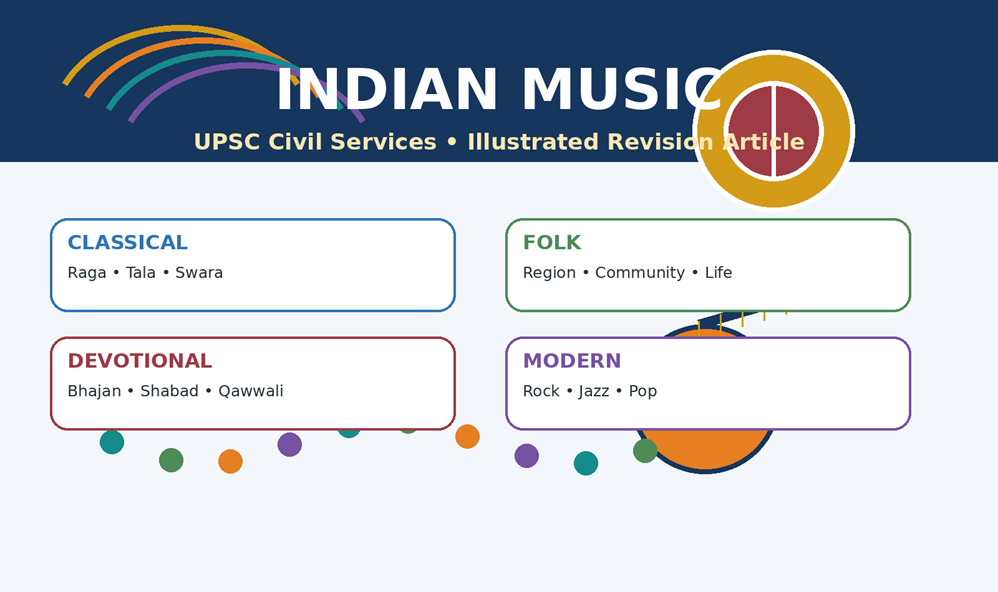
The chapter classifies Indian music broadly into classical music, semi-classical styles, folk music and modern music, while also highlighting fusion between classical and folk traditions and later interactions with global genres.
4. Hindustani Classical Music
Hindustani music is associated primarily with northern India. Though its historical roots and Carnatic music trace back to Bharata’s Natyashastra, the two branches diverged around the 14th century. Hindustani music places greater emphasis on musical structure and improvisational possibilities and uses the Shuddha Swara Saptaka/‘octave of natural notes’ in the chapter’s description.
Ten main singing styles listed in the chapter are Dhrupad, Dhamar, Hori, Khayal, Tappa, Chaturang, Ragasagar, Tarana, Sargam and Thumri.
Dhrupad
- One of the oldest and grandest Hindustani classical forms; associated with the Natyashastra and older forms such as Prabhanda and Dhruvapada.
- The term combines ‘dhruva’ (fixed/unmoving) and ‘pada’ (verse/word).
- Consolidated as a classical form by the 13th century; reached a zenith under Akbar, who patronised Baba Gopal Das, Swami Haridas and Tansen. Dhrupad was also associated with the court of Raja Man Singh Tomar of Gwalior.
- Declined in the 18th century.
- Performance begins with a wordless alap, gradually increasing in tempo; the composed Dhrupad section follows with Pakhawaj.
- Temple origins and use of Sanskrit syllables are emphasised.
- Compositions commonly have 4–5 stanzas and are often performed by two male vocalists with Tanpura and Pakhawaj.
Four Dhrupad gharana/vani traditions
| Tradition | Key features / associations |
| Dagari/Dagar Gharana | Dagar Vani; strong emphasis on alap; Dagar family traditionally performs in pairs; Muslim performers singing Hindu devotional texts; Gundecha Brothers cited. |
| Darbhanga Gharana | Khandar and Gauhar Vani; emphasis on alap and composed songs; layakari; Mallik family; Ram Chatur Mallik, Prem Kumar Mallik, Siyaram Tewari. |
| Bettiah Gharana | Nauhar and Khandar Vani; family-specific techniques; Mishra family; Indra Kishore Mishra; Haveli style associated with Bettiah and Darbhanga. |
| Talwandi Gharana | Khandar Vani; based in Pakistan, creating continuity challenges within Indian music. |
Gharana system
A gharana is a social and artistic organisation linking musicians through lineage/apprenticeship and adherence to a distinctive musical style. The term derives from ‘ghar’ (house/family). A gharana can represent the place where a musical ideology originated and shapes teaching, performance, musical thinking and appreciation.
Important Hindustani vocal gharanas listed include Agra, Gwalior, Indore, Jaipur, Kirana and Patiala.
Khayal
- ‘Khayal’ is derived from Persian and means idea/imagination.
- The chapter attributes its origin to Amir Khusrau and notes major patronage from Sultan Mohammad Sharqi in the 15th century.
- It allows substantial improvisation and uses short compositions (about 2–8 lines) called Bandish.
- A typical performance includes Bada Khyal (slow) and Chhota Khyal (fast).
- Taan is prominent; therefore alap occupies less space than in Dhrupad.
- Themes are frequently romantic, devotional or eulogistic; Krishna-related compositions are important.
Major Khayal gharanas
| Gharana | Distinctive features |
| Gwalior | One of the oldest and elaborate Khayal traditions; equal emphasis on melody and rhythm; complex singing with preference for comparatively simple ragas; Nathu Khan and Vishnu Palushkar cited. |
| Kirana | Named after Kirana in Uttar Pradesh; popularity associated with Abdul Karim Khan and Abdul Wahid Khan; precise tuning, expressive notes, slow-tempo ragas, melody and clarity of text; Bhimsen Joshi and Gangubai Hangal. |
| Agra | Associated with Khuda Baksh/Haji Sujan Khan in differing accounts; revived and lyrically developed by Faiyaz Khan; blend of Khayal and Dhrupad; emphasis on Bandish. |
| Patiala | Started by Bade Fateh Ali Khan and Ali Baksh Khan; patronised by Maharaja of Patiala; noted for ghazal, thumri and khayal, rhythm, alankara and intricate taans; Bade Ghulam Ali Khan associated. |
| Bhendibazaar | Founded by Chhajju Khan, Nazir Khan and Khadim Hussain Khan; long-breath singing; repertoire includes some Carnatic ragas. |
Tarana
Tarana gives rhythm a central role. A short melody is repeated and varied, with a contrasting higher melody introduced before returning to the main theme. Fast rhythmic syllables and complex rhythmic manipulation demand specialised training. The chapter cites Pandit Rattan Mohan Sharma of the Mewati Gharana as a leading Tarana singer and notes the title ‘Tarana ke Baadshah’ awarded to him in 2011.
5. Semi-Classical Styles of Hindustani Music
Semi-classical music retains the swara foundation but relaxes the strictness of classical raga/tala treatment. The chapter notes lighter raga versions, lighter talas, Madhya/Drut laya and greater emphasis on bhava and lyrics than on alap-jod-tan-jhala.
Thumri
- Based on mixed ragas; generally romantic or devotional.
- Strongly influenced by Bhakti traditions; Krishna-love themes are common.
- Lyrics may use Hindi, Awadhi or Braj Bhasha.
- Often sung in a female voice; characterised by sensuality and freedom to improvise.
- Purbi Thumri: slower; Punjabi Thumri: faster and livelier.
- Banaras and Lucknow are major centres; Begum Akhtar is highlighted.
- The term thumri can also cover lighter forms such as Dadra, Hori, Kajari, Saavan, Jhoola and Chaiti.
Tappa
- Fast, subtle and knotty melodic-rhythmic construction; quick turns of phrases.
- Originated in folk songs of camel riders of north-west India.
- Entered the semi-classical tradition through the Mughal court of Muhammad Shah.
- The Baithaki style developed under zamindari patronage in late 19th/early 20th-century salons and entertainment halls.
- The chapter notes that the form is declining and lists Mian Sodi, Pandit Laxman Rao of Gwalior and Shanno Khurana among its few exponents.
Ghazal
- A poetic form of rhyming couplets with a refrain and common metre; conventionally not more than 12 ashaar/couplets in the chapter’s description.
- Origin associated with Iran in the 10th century; spread into South Asia from the 12th century through Sufi mystics and Islamic Sultanate courts; reached a high point during the Mughal period.
- Traditionally deals with love, especially love, loss and separation; South Asian ghazal carries Islamic mystical influence and permits the beloved to be interpreted as human or divine.
- Traditional classical rendering was relatively difficult for wider audiences; later simplification of language and phrasing broadened its reach.
- Associated names include Rumi, Hafiz, Muhammad Iqbal, Mirza Ghalib and Kazi Nazrul Islam.
6. Carnatic Music
Carnatic music is the southern branch of Indian classical music. The chapter describes it as kriti-based, with greater emphasis on saahitya (lyric quality), while using the traditional octave and fixed tala structures.
Kriti and components of a Carnatic composition
- Kriti: a highly evolved composition set to a raga and fixed tala/rhythmic cycle.
- Pallavi: first/initial thematic line(s), often repeated; central to Ragam Thanam Pallavi, which provides major scope for improvisation.
- Anu Pallavi: usually two lines following the Pallavi; may recur near the end but need not follow every Charanam.
- Varnam: usually performed at the beginning of a recital; introduces the raga; divided into Purvanga and Uttaranga.
- Ragamalika: usually concluding section; permits extensive improvisation but returns to the original theme.
- Swara-Kalpana: improvised swara passages, often with the drummer in medium/fast pace.
- Thanam: melodic improvisation in free rhythm with mridangam.
- Ragam: corresponding pieces of melodic improvisation without mridangam.
| Important nuance Although the chapter’s comparison table describes Carnatic music as having less improvisational freedom than Hindustani music, Carnatic performance itself contains substantial structured improvisation — especially in Ragam Thanam Pallavi and Swara-Kalpana. |
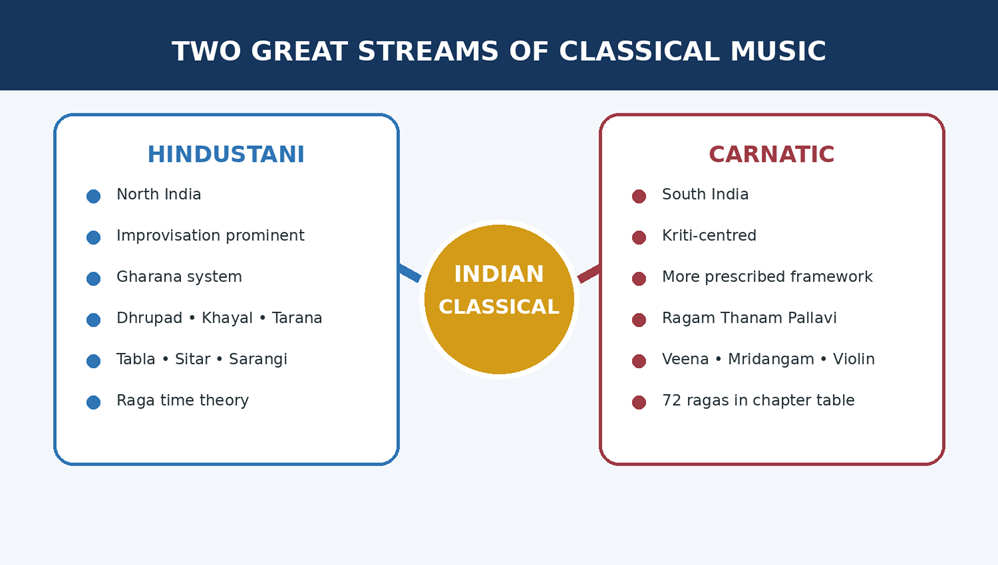
7. Hindustani vs Carnatic — High-Yield Comparison
| Dimension | Hindustani | Carnatic |
| Core region | North India | South India |
| Historical interaction | Greater Arab, Persian and Afghan influence | Described in the chapter as more indigenous |
| Improvisation | Greater scope for variation | More prescribed/structured overall, but with important improvisatory sections |
| Sub-styles | Multiple styles and gharanas | More unified prescribed tradition in the chapter’s comparison |
| Instrumental emphasis | Instruments highly important along with vocals | Greater emphasis on vocal/lyric quality |
| Raga figure in chapter | 6 major ragas | 72 ragas (as stated in the comparison table) |
| Time theory | Adheres to raga time | Does not adhere to the same time system |
| Major instruments | Tabla, Sarangi, Sitar, Santoor | Veena, Mridangam, Mandolin |
| Common instruments | Flute, Violin | Flute, Violin |
8. Folk Music of India — State/Region-wise Revision
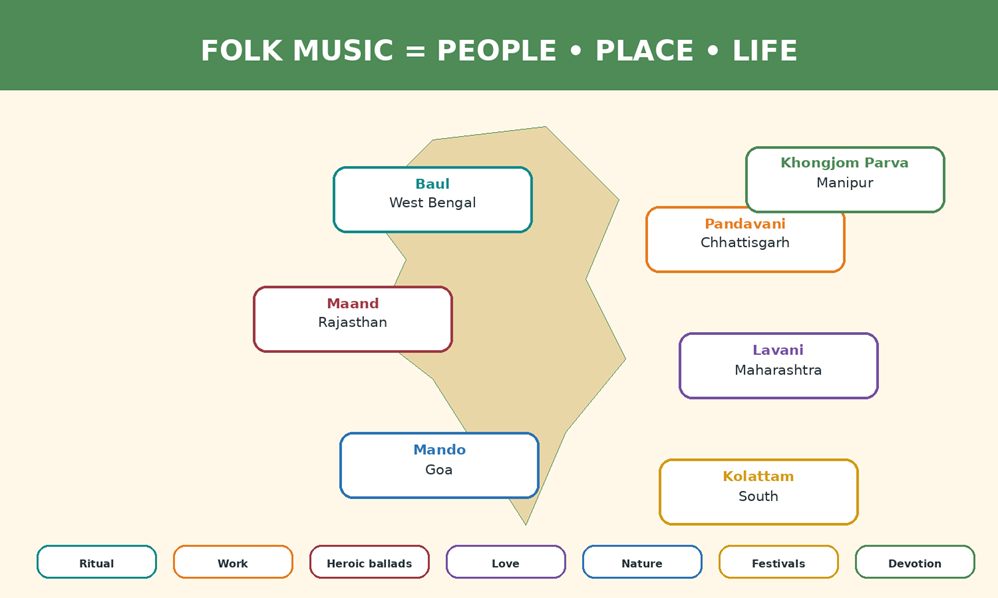
Folk music reflects India’s geographical and social diversity. Unlike classical music, which follows codified principles and a guru-shishya tradition, folk music is the music of the people and has no rigid universal rules. It is often rhythmic, theme-based and linked with dance, work, rituals, life-cycle events, local heroes, religion and nature.
| Tradition | Region | UPSC-ready features |
| Baul | West Bengal | Mystical/religious folk tradition; Bhakti and Sufi influences; Baul Gaan; Lalon Phakir and others. |
| Wanawan | Kashmir | Auspicious wedding music. |
| Pandavani | Chhattisgarh | Mahabharata/Bhima; singing + instrumental accompaniment; Tijanbai. |
| Alha | Madhya Pradesh | Heroic ballad; Mahabharata/Pandava-linked heroes; Braj, Awadhi, Bhojpuri. |
| Panihari | Rajasthan | Women, water scarcity, wells, household concerns, occasional romantic themes. |
| Ovi | Maharashtra & Goa | Women’s songs; household leisure/work; marriage, pregnancy, lullabies; four-line poems. |
| Pai Song | Madhya Pradesh | Rainy-season festivals; prayer for good monsoon and harvest; associated with Saira dance. |
| Lavani | Maharashtra | Song-dance form; powerful Dholki rhythm; highly dance-oriented. |
| Maand | Rajasthan | Courtly roots; neither full classical raga nor unrestricted folk; Rajput glory; ‘Kesariya Balam’. |
| Dandiya Raas | Gujarat/Western India | Holi/Krishna-Radha associations; major Navratri tradition; men and women dance with sticks. |
| Powada | Maharashtra | Heroic ballads, especially Shivaji and past deeds. |
| Khongjom Parva | Manipur | Musical narration of the 1891 Khongjom battle. |
| Bhavageete | Karnataka & Maharashtra | Emotional songs; nature, love, philosophy; close to ghazal in musical character. |
| Mando | Goa | Indian-Western blend; guitar, violin and ghumot. |
| Kolannalu/Kolattam | Andhra Pradesh, Karnataka, Tamil Nadu | Rhythmic dance form similar to Dandiya; music accompanies dance. |
Other major folk traditions
| Tradition | Region | Theme / feature |
| Sohar | Bihar | Childbirth |
| Tikir | Assam | Teaching of Islam |
| Ja-jin-ja | Arunachal Pradesh | Marriage |
| Nyioga | Arunachal Pradesh | End of marriage ceremony |
| Heliamleu | Nagaland | Dancing songs |
| Neuleu | Nagaland | Legends and myths |
| Hereileu | Nagaland | War songs |
| Hekaileu | Nagaland | Songs about oneself |
| Dollu Kunitha | Karnataka | Men of Kuruba community; named after Dollu percussion instrument |
| Naatupura Paatu | Tamil Nadu | Village and city folk music |
| Veeragase | Karnataka | Hindu mythology; also Dussehra procession |
| Pala & Daskathia | Odisha | Religious ballads |
| Manganiars | North-West India | Songs of Alexander, local kings and battles |
| Dhadi | Punjab | Ballads of bravery |
| Basant Geet | Garhwal/Uttarakhand | Basant Panchami |
| Villu Pattu | Tamil Nadu | Religious; victory of good over evil |
| Sukar ke Biah | Bihar | Love between Shukra and Brihaspati |
| Saikuti Zai | Mizoram | Praise of brave men/hunters |
| Lai Haroba Festival songs | Manipur | Religious; Umang-Lai/forest deity |
| Chhakri | Kashmir | Fairy tales and love stories |
| Bhuta songs | Kerala | Songs against evil/ghosts |
| Khubakeshei | Manipur | Accompanied entirely by clapping |
Fusion of Classical and Folk: Sugam Sangeet and Related Forms
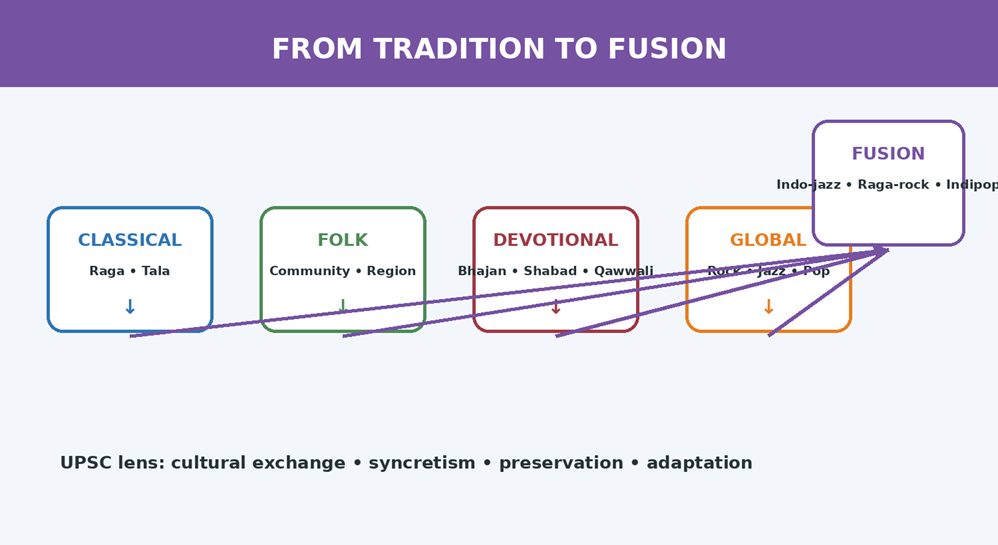
classical and folk traditions often intermingle, particularly through devotional music. Devotional themes provide a bridge because both royalty and common people have historically patronised deities.
Sugam Sangeet
Sugam Sangeet is presented as devotional music bringing classical and folk traditions together, with roots in earlier devotional forms such as Prabandha Sangeet and Dhruvapada.
Bhajan
- Popular devotional singing, especially in North India; closely linked to the Bhakti movement.
- Simple melodies, generally set in one or more ragas.
- Themes include the lives of gods and goddesses and episodes from the Ramayana and Mahabharata.
- Common instruments: chimta, dholak, dhaphli and manjira.
- Medieval exponents include Mirabai, Tulsidas, Surdas and Kabir; modern singers mentioned include Anup Jalota and Anuradha Paudwal.
Shabad
- Devotional music associated with Sikhism and sung in gurdwaras in praise of the Gurus.
- Guru Nanak and his disciple Mardana are associated in the chapter with its development and popularity.
- Three types are identified: raga-based Shabad, traditional shabds in the Adi Granth, and lighter forms.
- Singh Bandhus and Bhai Santa Singh are cited among known exponents.
Qawwali
- Devotional Sufi/Islamic music praising Allah, the Prophet Muhammad or Sufi saints.
- Generally composed in a single raga; lyrics may be in Urdu, Punjabi or Hindi, with Braj Bhasha and Awadhi also used.
- Performed at Sufi shrines; commonly uses tabla, dholak and harmonium.
- Tempo and intensity build progressively to induce a transcendental state.
- Amir Khusrau is sometimes credited with its origin, but the chapter explicitly notes that this attribution is disputed.
- Major names mentioned: Sabri Brothers, Nusrat Fateh Ali Khan and Aziz Warisi.
Other Sugam Sangeet forms :
| Form | Region | Key feature |
| Abhanga | Maharashtra | Praise of Vithoba; associated with Tukaram, Namdev and others. |
| Bhatiali | Bengal | Nature and daily life; traditionally sung by boatmen. |
| Tevaram | Tamil Nadu | Shaivite devotional tradition; Oduyars. |
| Kirtan | Bengal | Singing and dancing; inspiration from Gita Govinda. |
Rabindra Sangeet
- Music created/composed in the tradition of Rabindranath Tagore.
- Blends classical elements with Bengali folk strains.
- The chapter notes more than 2,000 songs being performed.
- Themes include worship, nature, love, celebration of life and patriotism/national commitment.
Gana Sangeet
Group/choral fusion music, often carrying patriotic messages or social criticism. It may address exploitation of women and children and other social concerns. The chapter gives Vande Mataram as a popular example of patriotic Gana Sangeet.
Haveli Sangeet
Originated mainly in Rajasthan and Gujarat as temple music and later moved beyond temple premises. It is associated with the Pushtimarg Sampradaya.
10. Modern Indian Music
Indian Rock
- Combines Indian musical elements with mainstream rock and is often India-centric in subject while retaining global rock conventions.
- Indian musicians began fusing rock with traditional Indian music from the mid-1960s; film music often overshadowed the independent rock scene.
- The chapter cites Usha Uthup among early rock singers from India.
- Cultural influence was two-way: Indian classical music influenced Western rock, with George Harrison’s Ravi Shankar-inspired raga rock and the Beatles’ engagement with Indian spiritual/cultural traditions cited as milestones.
Jazz and Indo-Jazz
- Jazz in India is traced to Bombay in the 1920s, when African-American jazz musicians performed for private audiences in elite hotels.
- Goan musicians helped carry the form into wider Indian musical and film circles.
- The chapter calls 1930–1950 the ‘Golden Age’ of jazz in India.
- Musicians such as Leon Abbey, Crickett Smith, Creighton Thompson, Ken Mac, Roy Butler and Teddy Weatherford are mentioned.
- Indian classical music and jazz both value improvisation; collaborations from the 1940s helped create Indo-jazz, combining jazz, classical and Indian influences.
- Ravi Shankar and John Coltrane are cited among pioneers/important figures in the interaction; Indian classical influence also extended to free jazz.
Indi-pop
- Combines Indian musical elements with pop; also called Indipop/Hindipop.
- The British-Indian fusion band Monsoon used the term ‘Indipop’ for an album in 1981.
- The genre expanded in the early 1990s through Alisha Chinai, Biddu and MTV India.
- Bollywood became a major source of Indian pop; remix culture attempted to renew old film songs with new beats but attracted criticism and the earlier Indi-pop phase declined.
- The chapter mentions Mohit Chauhan, Mika Singh, Raghav Sachar and Papon among contemporary pop musicians.
11. Musical Instruments — Four Traditional Categories :
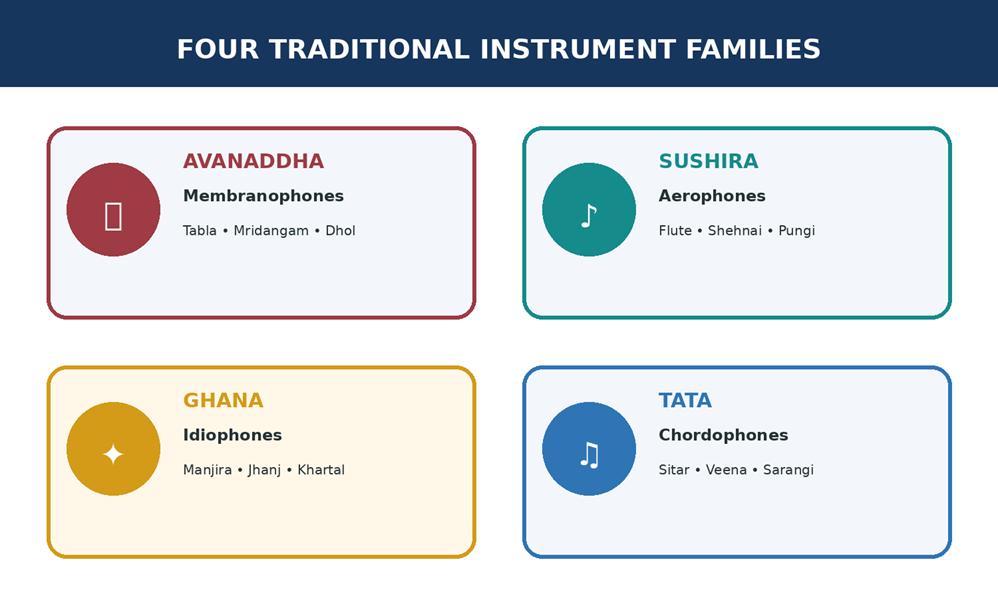
Traditional instruments are grouped into four broad categories based on how sound is produced
| Category | Scientific/modern equivalent | Principle | Examples / UPSC facts |
| Avanaddha / Awanad Vadya | Membranophones | Sound from stretched membrane/skin struck or beaten. | Tabla, drum, dhol, congo, mridangam; Bhumi Dundubhi described as an ancient example. Tabla accompanies Hindustani vocals; mridangam accompanies Carnatic music. |
| Sushira Vadya | Aerophones | Wind instruments; air column produces sound. | Bansuri, shehnai, pungi, etc. Shehnai is double-reeded with flaring tube; Bismillah Khan is associated with its zenith. Flute is traced to Vedic usage and was called Nadi/Tunava. |
| Ghana Vadya | Idiophones | Solid instruments; no tuning required in the conventional sense. | Manjira, Jaltarang, Kanch-tarang, Jhanj, Khartal. Manjira is a small brass cymbal and has Harappan archaeological associations; used to maintain rhythm/time. |
| Tata Vadya | Chordophones | Strings produce sound, modified by hand/bow/plectrum. | Sarangi, Esraj, violin; Sitar, Veena, Tamboora; Gotuvadyam and Swaramandal. Veena is associated with Saraswati. |
Tata Vadya sub-types
- Bowed: bow drawn across strings — Sarangi, Esraj, Violin.
- Plectral/plucked: strings plucked by fingers or plectrum — Sitar, Veena, Tamboora.
- Struck: strings struck with small hammer/sticks — Gotuvadyam, Swaramandal.
- The Bhangash family is associated with pioneering the Sarod in the 20th century.
- Sitar gharanas mentioned: Jaipur, Varanasi and Etawah (Imaad Khani).
12. Folk Musical Instruments — Prelims Map :
| Type | Instrument | Region/community/use |
| Chordophone | Tumbi | Punjab; Bhangra |
| Chordophone | Ektara / Tun Tuna | One-stringed; wandering monks |
| Chordophone | Dotara | Two-stringed; Bauls |
| Chordophone | Chikara | Rajasthan, Uttar Pradesh, Madhya Pradesh |
| Chordophone | Dilruba / Esraj | Punjab; also accompanies Rabindra Sangeet in eastern India |
| Chordophone | Onavillu | Kerala; bamboo |
| Chordophone | Sarinda | Santhals in eastern India; also Rajasthan and Assam; Sarangi-like |
| Aerophone | Pungi / Been | Snake charmers; dried bottle gourd + bamboo |
| Aerophone | Algoza | Double flute; North-West India, especially Punjab |
| Aerophone | Tangmuri | Khasi hill people, Meghalaya |
| Aerophone | Titti | Goat-skin bagpipe-like instrument; South India, especially Kerala and Andhra Pradesh |
| Aerophone | Mashak | Garhwal/Uttarakhand; also noted in Rajasthan/Uttar Pradesh in the chapter |
| Aerophone | Gogona | Bamboo; Bihu, Assam |
| Membranophone | Ghumot | Goa; Ganesh festival |
| Membranophone | Idakka | Kerala; damru-like |
| Membranophone | Udukai | Tamil Nadu; hourglass-shaped |
| Membranophone | Sambal | Konkan, Maharashtra; played with sticks |
| Membranophone | Tamak | Santhal tribe; two-headed drum |
| Membranophone | Diggi | Ghariya village, Uttar Pradesh; folk drum |
| Idiophone | Chimpta | Punjab; evolved from fire tongs |
| Idiophone | Gharha | Earthen pots; Punjab folk music |
| Idiophone | Andelu | Burra-Katha; pair of hollow metal rings |
13. Modern Developments and Institutions
Gandharva Mahavidyalaya
V. D. Palushkar established the institution in 1901 to teach and transmit Indian classical music and dance. It began in Lahore and shifted to Mumbai in 1915. The chapter describes its focus on Hindustani and Carnatic classical music and notes its devotional orientation and the associated Prayag Samiti in Allahabad.
Sangeet Natak Akademi
- Established in 1952 as India’s first national academy for the arts under the Government of India.
- Focuses on music, dance and drama and serves as a national platform for performing arts and intangible cultural heritage.
- Works with States and Union Territories to preserve and promote cultural traditions.
- Administers institutions including the National School of Drama, established in 1959 for focused work in dramatics.
Marris College of Music → Bhatkhande Music Institute
Vishnu Narayan Bhatkhande founded the institution in 1926 in Lucknow to integrate music theory with practical training in singing and instrumental performance. It was later renamed the Bhatkhande Music Institute.
SPIC MACAY
- Founded by Kiran Seth in 1977.
- Full form: Society for Promotion of Indian Classical Music and Culture Amongst Youth.
- Started as a voluntary youth movement to reconnect younger generations with Indian classical and cultural traditions.
- Promotes classical music, dance and culture through events, many of them free-entry, and has grown into a network with more than 200 chapters/branches worldwide according to the chapter.
14. Communities Related to Music
| Community/group | Region | Music/cultural association |
| Langha (Muslim tribal community) | Gujarat & Rajasthan | Entertain Muslim Rajputs; praise them through songs. |
| Manganiar / Merasi | Rajasthan | Use Kamaicha; perform classical-folk music. |
| Karta Bhajas | West Bengal | Four classes; chanting mantras leading to spiritual perfection in their belief. |
| Bauls | West Bengal | Mystic countryside singers; described as one class of Kartabhaja. |
| Jogi | Rajasthan | Music-linked community listed in the chapter. |
| Bhopa | Rajasthan | Music-linked community listed in the chapter. |
| Barot, Charan, Gadhvi | Gujarat | Traditional bardic/music communities. |
| Muria tribes | Madhya Pradesh | Sing Relo songs. |
| Kamar community | Chhattisgarh | Marriage songs. |
| Baghela | Madhya Pradesh | Semi-historical songs devoted to Hardaul deity. |
| Pulayar hill tribes | Tamil Nadu | Perform melodies called talams. |
| Idu Mishmis | Arunachal Pradesh | Ritual and fertility dances. |
| Moken tribe | Andaman & Nicobar Islands | Ancestor worship and ritual tribal dance. |
15. UPSC Prelims Quick Revision Sheet
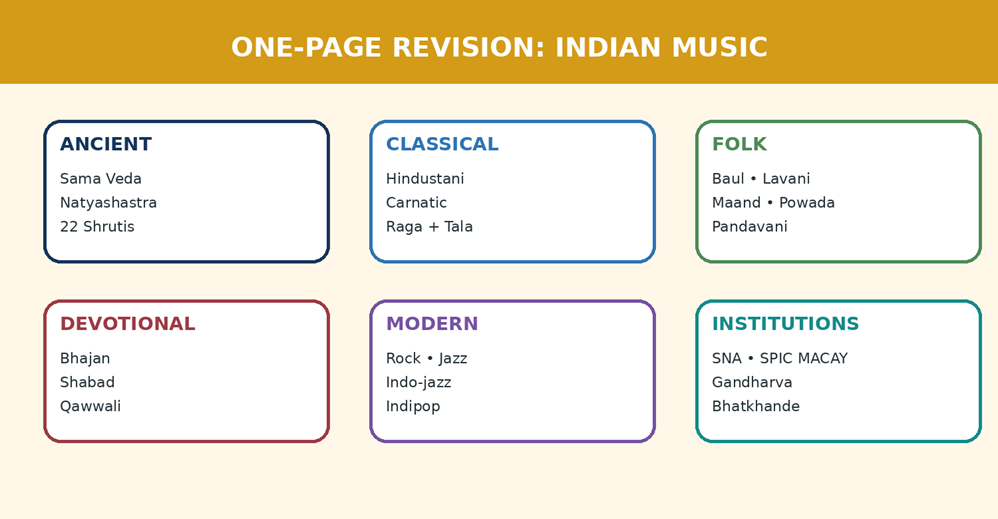
| Remember the 3 pillars SWARA = note/pitch | RAGA = melodic personality/framework | TALA = rhythmic cycle. RASA = emotional/aesthetic response. |
Ancient texts and what to associate
| Text/person | Association |
| Sama Veda | Vedic musical tradition; Gandharva Veda as Upaveda; seven notes referenced in the chapter. |
| Aitareya Aranyaka | Parts of Veena |
| Jaimini Brahmana | Dance + music |
| Kausitaki Brahmana | Dance + vocal + instrumental music |
| Panini | Early proper reference to art of making music |
| Bharata — Natyashastra | Major early systematic musical theory; octave and 22 shrutis |
| Dathilam | 22 shrutis |
| Matanga — Brihaddeshi | Definition of raga |
| Nanda — Sangeeta Makaranda | 93 ragas; masculine/feminine classification |
| Sarangadeva — Sangeet Ratnakara | About 264 ragas; microtones; North + Dravidian repertoires |
| Ramamatya — Swaramela-Kalanidhi | Raga-focused musicology |
| Venkatamakhin — Chaturdandi-prakasika | Important musicological work |
| V. N. Bhatkhande | 10-Thaat system; major North Indian musicologist |
Fast associations
- Dhrupad → Alap + Pakhawaj + temple/Sanskrit association + Akbar/Tansen + four vani/gharana traditions.
- Khayal → imagination + Bandish + Bada/Chhota Khyal + improvisation + taan.
- Thumri → mixed ragas + Bhakti/Krishna + Banaras/Lucknow + Begum Akhtar.
- Tappa → camel riders of North-West + Muhammad Shah’s court + fast knotty phrases.
- Ghazal → Persian origin tradition + Sufi influence in South Asia + rhyming couplets/refrain + love/loss.
- Carnatic → Kriti + Pallavi/Anu Pallavi/Varnam/Ragamalika + Ragam Thanam Pallavi + Mridangam.
- Baul → Bengal + mysticism + Bhakti/Sufi influences.
- Pandavani → Chhattisgarh + Mahabharata/Bhima + Tijanbai.
- Maand → Rajasthan + courtly roots + Kesariya Balam.
- Mando → Goa + Indian-Western blend + guitar/violin/ghumot.
- Kolattam → Andhra/Karnataka/Tamil Nadu + Dandiya-like rhythmic dance.
- Qawwali → Sufi shrine + devotional + tabla/dholak/harmonium.
- Rabindra Sangeet → Tagore + classical + Bengali folk + nature/love/patriotism.
- Shehnai → Bismillah Khan; flute → Vedic antiquity and Krishna imagery.
- Manjira → Ghana Vadya + rhythm/time + Harappan antiquity.
- SPIC MACAY → youth + classical culture + Kiran Seth + 1977.
16. UPSC Mains Analytical Framework
Theme 1: Continuity and change in Indian music
Indian music demonstrates continuity through enduring concepts such as swara, raga, tala, rasa, textual traditions and guru-shishya transmission. At the same time, it continuously absorbed new influences: Persian and Islamic elements shaped North Indian music; Bhakti and Sufi movements popularised devotional forms; folk traditions supplied themes and melodies; and modern interactions produced rock, jazz, pop and fusion.
Theme 2: Cultural syncretism
Indian music is a strong example of syncretism. Dhrupad traditions include Muslim performers singing Hindu devotional texts; Baul music combines Bhakti and Sufi influences; Qawwali developed in the South Asian Sufi milieu; Mando combines Indian and Western traditions; Indo-jazz and raga-rock show cross-cultural exchange. Such examples support arguments about India’s composite cultural heritage.
Theme 3: Classical–folk continuum
The classical and folk categories should not be treated as isolated. Maand occupies an intermediate position; Sugam Sangeet, Bhajan, Shabad and Qawwali connect formal musical structures with popular devotional practice; Rabindra Sangeet combines classical and Bengali folk elements. This continuum helps explain how culture is transmitted between elite, religious and community settings.
Theme 4: Institutions and cultural preservation
Institutional support is important for preventing decline in traditional music. Gandharva Mahavidyalaya, Sangeet Natak Akademi, Bhatkhande Music Institute and SPIC MACAY represent different models — formal education, national cultural policy, musicological training and youth-oriented cultural outreach.
Theme 5: Threats and preservation
- Some traditions in the chapter are explicitly described as declining or having very few active exponents, such as the Baithaki style of Tappa.
- Transmission through hereditary communities and guru-shishya traditions can weaken when younger generations shift away from traditional occupations.
- Commercial film/pop dominance can overshadow independent or traditional forms.
- Preservation requires documentation, institutional support, performance opportunities, education, community participation and youth engagement.
A ready-made Mains conclusion
| Conclusion Indian music is not a static inheritance but a living cultural system. Its strength lies in the coexistence of codified classical traditions, flexible folk practices, devotional syncretism and modern experimentation. Preserving this diversity requires transmitting both the musical grammar and the community contexts that give each tradition its meaning. |