
Indian Paintings – UPSC Civil Services Notes
1. Introduction & Principles of Painting
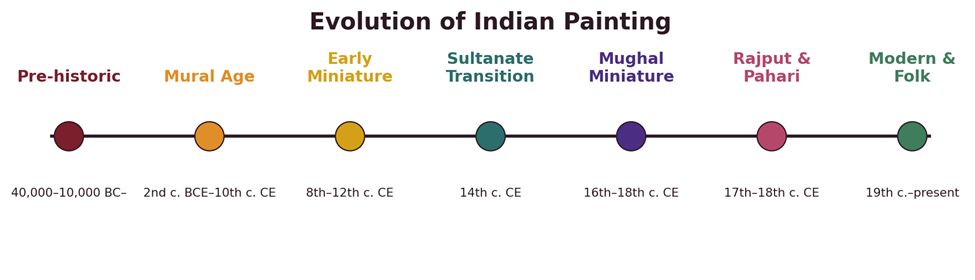
Indian painting has an unbroken tradition from prehistoric rock art through illustrated manuscripts, miniature schools, colonial hybrids, and modern/folk art. Broad arc: rock art → Indus painted pottery → Gupta-age murals (real “beginning” of the art) → miniature schools (Pala/Apabhramsa → Sultanate → Mughal/Rajput/Pahari/Deccan) → colonial Company & Bengal schools → modern & folk traditions.
Shadanga — The Six Limbs of Painting (mentioned by Vatsyayana in the Kamasutra, 3rd century CE):
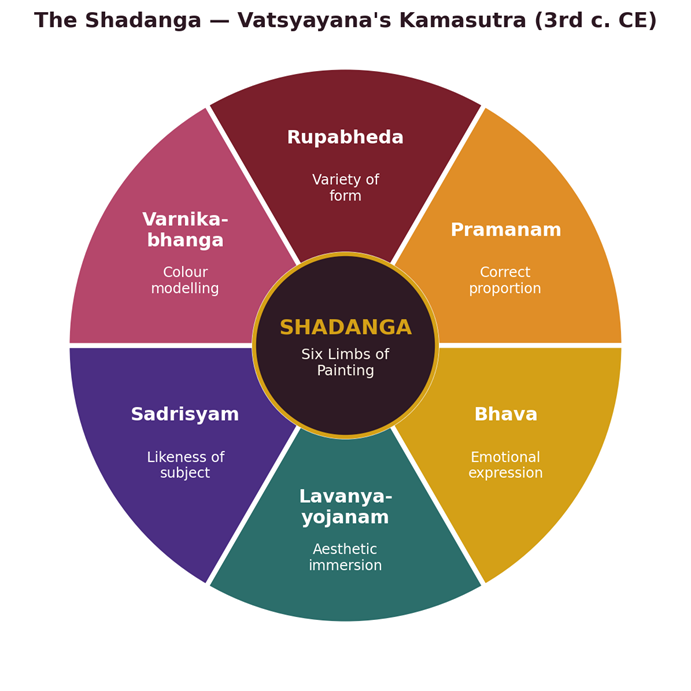
| Sanskrit Term | Meaning |
| Rupabheda | Variety of form |
| Sadrisyam | Portrayal of likeness of the subject |
| Bhava | Creation of luster and gleam with colours |
| Varnikabhanga | Mixing of colours to resemble the effects of modelling |
| Pramanam | Proportion of the object/subject |
| Lavanyayoganam | Immersion of emotions (“aesthetic bliss”) |
Other terms from Brahmanical/Buddhist literature: Lepya Chitra (myths/lore represented on textiles), Lekhya Chitra (line drawings/sketches), Dhuli Chitra, Pata Chitra. Vishakhadutta’s play Mudrarakshasa names painting styles (patas): Cauka Pitaka (isolated framed drawings), Dighala Pitaka (long scrolls), Yama Pitaka (isolated paintings).
2. Pre-Historic Paintings
Executed on rocks (rock engravings = Petroglyphs). First discovered at Bhimbetka caves (MP) in 1957–58 by V.S. Wakankar; called the “Zoo Rock Shelter” for its animal depictions (elephant, rhino, cattle, snake, deer, bison, barasingha).
Three major phases:
| Phase | Period | Features |
| Upper Paleolithic | 40,000–10,000 BCE | Quartzite rock walls; mineral pigments (ochre/geru + lime + water); colours — red, white, yellow, green; large animals (bison, elephant, rhino, tiger); red for hunters, green for dancers |
| Mesolithic | 10,000–4,000 BCE | Mainly red colour; smaller paintings; group hunting, grazing, riding scenes |
| Chalcolithic | — | More green/yellow; battle scenes; men riding horses/elephants with bows |
Later-period sites show Ashokan/Gupta Brahmi inscriptions (proving continued habitation): Jogimara Caves (Ramgarh hills, Surguja, Chhattisgarh, ~1000 BCE — love story in Brahmi script; attached to the Sitabenga rock-cut theatre), Narsinghgarh (MP — deer-skin tanning scenes, harp, geometric spirals), and Chhattisgarh sites — Kanker district (Udkuda, Garagodi, Khairkheda, Gotitola, Kulgaon), Koriya district (Ghodsar, Kohabaur), Durg district (Chitwa Dongri — a Chinese figure on a donkey, dragons), Bastar (Limdariha), Sarguja (Oogdi, Sitalekhni).
Bhimbetka Rock Paintings (detailed):
- South of Bhopal, Vindhyan ranges, MP; 500+ rock shelters; UNESCO World Heritage Site (2003).
- Oldest paintings ~30,000 years old; continuous occupation from 100,000 BCE to 1000 CE (paintings layered on top of one another).
- Spans Upper Paleolithic → Mesolithic → Chalcolithic → early historic → medieval (most belong to the Mesolithic age).
- Themes: everyday life (stick-like human figures), hunting/war scenes (bows, arrows, spears, shields, swords), geometric designs, dancing, music, animal fights, honey collection, children playing, women cooking, community dance.
- Colours: red ochre, purple, brown, white, yellow, green — from natural sources (e.g., Haematite → red).
3. Classification of Indian Paintings
A. Mural Paintings
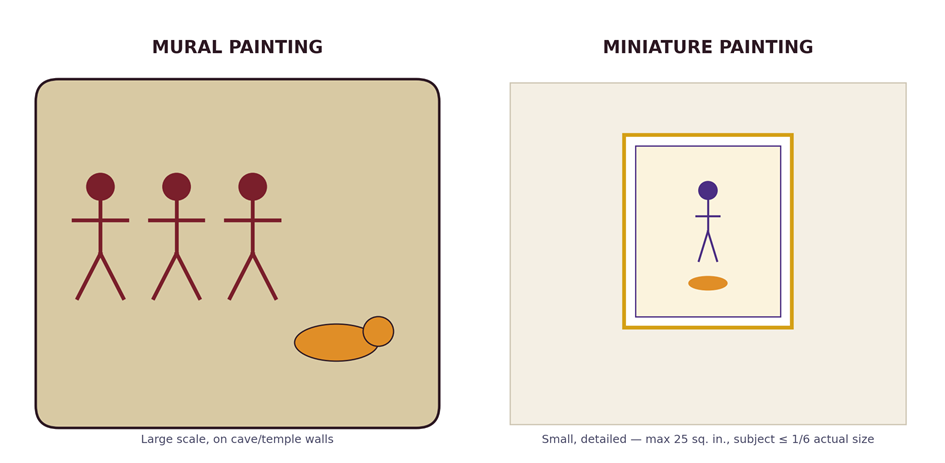
Paintings on walls/solid structures; existed in India 10th century BCE – 10th century CE; found at Ajanta, Armamalai, Ravan Chhaya, Bagh, Sittanavasal, Kailasanatha Temple (Ellora), etc. — mostly natural caves/rock-cut chambers; themes: Hindu, Buddhist, Jain (occasionally secular, e.g. Jogimara’s theatre-room decoration).
Ajanta Cave Paintings
- 29 rock-cut caves (horseshoe-shaped), carved from volcanic rock beginning 4th c. CE; took 4–5 centuries to complete.
- Caves 9 & 10 murals — Sunga period; rest — Gupta period; Caves 1 & 2 are the most recent.
- Technique: murals + true fresco (painted on wet plaster); tempera style (pigment-based).
- Themes: Jataka tales, life of Buddha, decorative flora/fauna; unique — each female figure has a distinct hairstyle; emotions shown via hand gestures; medium = vegetable & mineral dyes; outlines in red ochre, contours in brown/black/deep red.
- Key works: Padmapani mural; Bodhisattvas in tribhanga pose in Cave 1 — Vajrapani (Buddha’s power), Manjusri (wisdom), Padmapani/Avalokitesvara (compassion); The Dying Princess (Cave 16); Shibi Jataka (king offers his flesh to save a pigeon); Matri-Poshaka Jataka.
Jataka Stories (quick reference): tales of Buddha’s former births (human/animal) illustrating a virtue — The Ass in the Lion’s Skin, The Cock and the Cat, The Foolish Timid Rabbit, The Jackal and the Crow, The Lion and the Woodpecker, The Ox Who Envied the Pig, The Swan with Golden Feathers, King Shibi, The Turtle Who Couldn’t Stop Talking.
Ellora Cave Paintings — confined mostly to the Kailasa Temple, in two phases (during carving, and centuries later). Earlier phase: Vishnu-Lakshmi borne by Garuda. Later phase (Gujarati style): procession of Shaiva holy men. Covers all three religions. Key images: Lakshmi & Vishnu, Shiva with followers, graceful Apsaras.
Bagh Cave Paintings (MP) — extension of the Ajanta school; figures more tightly modeled, stronger outlines, more “earthly/human,” more secular. Cave 4 (“Rang Mahal”) has the best-preserved Buddhist/Jataka murals.
Armamalai Cave Paintings (Vellore, TN) — natural caves converted to a Jain temple (8th c.); depict the Ashtadikpalakas (guardian deities of 8 directions) and Jain themes.
Sittanavasal (Arivar Koil) Paintings (Pudukkottai, TN) — Jain rock-cut caves; resemble Bagh/Ajanta; painted on walls, ceiling, and pillars; central theme = Samavasarana (Jain preaching hall) with a lotus pond, ducks, swans, fish; attributed either to Pallava king Mahendravarman I or a 7th-c. Pandya renovation; medium = vegetable/mineral dyes on wet lime plaster; colours — yellow, green, orange, blue, black, white.
Ravan Chhaya Rock Shelter (Keonjhar, Odisha) — half-open-umbrella-shaped shelter, believed a royal hunting lodge; famous royal procession fresco (7th c.); also Chola-period remains (11th c.).
Lepakshi Paintings (Anantapur, AP) — Veerabhadra Temple walls, 16th c., Vijayanagara period; themes from Ramayana/Mahabharata/Vishnu avatars; notable for complete absence of primary colours (esp. blue); marks a decline in painting quality; black-outlined figures.
Jogimara Cave Paintings (Surguja, Chhattisgarh) — ~1000–300 BCE; Brahmi inscriptions telling a love story; dancing couples, elephants, fish; red outline with white/yellow/black; adjoins the Sitabenga rock-cut theatre.
Badami Cave Temple Murals (Karnataka) — 6th–7th c. CE; among the earliest surviving Hindu paintings; resemble Ajanta/Bagh tradition; big half-closed eyes, protruding lips; Chalukyan kings, Jain saints, Shiva-Parvati, Puranic scenes; Cave 3 — four-armed Brahma on his swan.
B. Miniature Paintings
| ★ QUICK FACT : Miniature comes from Latin minium (red lead paint) — not from “minimum”. A classic word-origin trap in Prelims. |
“Miniature” ← Latin minium (red lead paint used in Renaissance illuminated manuscripts) — not related to “minimum” (size is incidental, not definitional).
Technical conventions: painting not larger than 25 sq. inch; subject painted at ≤ 1/6th actual size (e.g., a 9-inch head painted no larger than 1.5 inches); figures usually shown in side profile, with bulging eyes, pointed nose, slim waist; Rajasthani figures — brown skin; Mughal figures — fairer skin; Krishna/divine beings shown blue; women — long black hair; men — turbaned, traditional dress.
Early Miniature (8th–12th century)
- Pala School of Art (750–1150 CE) — Buddhist manuscript illustrations on palm leaf/vellum (only banana/coconut-leaf material, per Buddhist non-violence norms); sinuous lines, subdued tones, solitary figures (rarely group scenes); simple compositions; patronised by Buddhist/Vajrayana rulers; painters — Dhimman and Vitapala.
- Apabhramsa School of Art (11th–15th c.) — origin: Gujarat & Mewar (Rajasthan); dominant western-Indian school; themes — Jain (later appropriated by Vaishnava school, adding Gita Govinda & secular love); early phase on palm leaf, later on paper; colours — red, yellow, ochre (later: bright + gold); features — fish-shaped bulging eyes, pointed nose, double chin, stiff figures, enlarged hips/breasts on female figures, animals drawn “like toys”; masterpieces — Kalpasutra and Kalakacharya Katha (15th c.).
Transition Period Miniature (from 14th c.)
Arrival of Muslim rule → cultural synthesis (not replacement) — traditional styles survived in western Indian courts; in Vijayanagara, a Deccan-influenced style emerged. Features: flat colour application, black outlines, three-quarter profile faces, stylised (non-naturalistic) landscapes.
Delhi Sultanate Miniature — fusion of Persian + Indian elements; finest example: Nimatnama (a cookery book) under Nasir Shah of Mandu; also the Lodi Khuladar style (between Delhi–Jaunpur). These Sultanate precedents fed into three major schools: Mughal, Rajput, Deccan.
Mughal Era Miniature Painting :
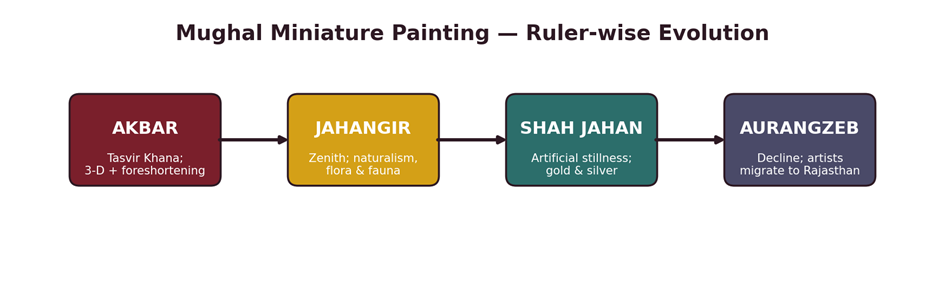
Shift from religious subjects to glorifying the ruler — hunting scenes, historical events, court life; Persian naturalism + imperial opulence; introduced foreshortening (objects drawn to look smaller/closer than actual).
| Ruler | Contribution |
| Babur | Too short a reign; patronised Persian artist Bihzad (Mughal family-tree illustrations) |
| Humayun | Great patron; in Persian exile (Shah Abbas’s court) recruited Abdus Samad & Mir Sayyid Ali, who later created the Tutinama (Tale of a Parrot) under Akbar |
| Akbar | Established Tasvir Khana (state atelier, salaried artists); “Indian influence” begins as native artists were absorbed; 3-D figures + foreshortening; encouraged calligraphy; shift from popular to court art; painters — Daswant, Basawan, Kesu; key manuscripts — Tutinama, Hamzanama, Anvar-i-Suhaili, Gulistan of Sadi |
| Jahangir | Zenith of Mughal painting; naturalist — flora/fauna focus; elaborate decorated margins; patron-artist himself; famous painter Ustad Mansoor (Zebra, turkey, cock studies); manuscript — Ayar-i-Danish |
| Shah Jahan | Artificial stillness over naturalism (European influence); pencil replaces charcoal; more gold/silver, brighter palette |
| Aurangzeb | Discouraged painting → sharp decline; artists migrated to Rajasthani provincial courts |
Regional (Rajput) Schools of Painting
Rajasthani (Rajput) Schools — patronised by Rajput courts; several theories of origin (Mughal-atelier migration, Deccan-Sultanate influx, indigenous pre-Mughal traditions, “Ganga-Jamuni” synthesis).
| Sub-school | Key Facts |
| Mewar | Longest Mughal resistance; capital shifted Ranthambhore→Chittorgarh→Udaipur; early phase dominated by Sahibdin (Rasikapriya, Ramayana, Bhagavata Purana); later phase — court-life & “tamasha” (ceremonial/city-view) paintings |
| Kishangarh | Legend of prince Sawant Singh & his beloved Bani Thani (painter: Nihal Chand; poet: Nagari Das); Bani Thani resembles Radha — distinctive profile, large lustrous eyes, thin lips, pointed chin |
| Bundi–Kota (“Hadoti”) | Krishna-bhakti kingdoms (rulers as “regents” of Krishna); detailed local vegetation; round faces, pointed noses; red-ribbon sky motif; notable patron — Rao Ram Singh II |
| Amber-Jaipur (“Dhundar”) | Wall paintings at Bairat; folk-styled finish despite Mughal dress; zenith under Sawai Pratap Singh (18th c.) — Bhagwata Purana, Ramayana, Ragamala illustrations |
| Marwar (Jodhpur, Bikaner, Jaisalmer) | Jodhpur/Bikaner ruled by Rathods, Jaisalmer by Bhatis; Mughal-pattern early, Rajput-dominant after 18th c.; peak under Man Singh (1803–1843) — Shiva Purana, Natacharitra, Durgacharitra, Panchtantra series |
Rajput vs Mughal Style — Key Differences :
| Basis | Rajput Style | Mughal Style |
| Type | Mural/fresco origin → later miniature | Based on Persian miniature style |
| Themes | Devotional/religious | Emperor & household; pomp, battles, hunts |
| Peculiarity | Hindu symbols — lotus, peacock, swan | Focus on the person, or on trees/camels/falcons |
| Time period | Mainly 17th–18th century | 16th–18th century |
Pahari Styles of Painting — sub-Himalayan princely states (~22 states, Jammu to Almora) under loose Mughal overlordship; two groups: Jammu/Dogra School (Northern series) and Basholi & Kangra School (Southern series); many figures per canvas, full of movement; leading painters — Nainsukh and Manaku.
- Basholi School (17th c., earliest phase): receding hairlines, big lotus-petal-shaped eyes; primary colours (red/yellow/green); Mughal cloth-painting technique + own style; first patron — Raja Kirpal Singh (Rasamanjari, Gita Govinda, Ramayana); leading painter — Devi Das (Radha-Krishna, royal portraits); colour-contrast borrowed from Malwa paintings.
- Kangra School — emerged after Mughal decline, when displaced artists found patronage under Raja Govardhan Singh (1774); began at Guler, peaked under Raja Sansar Chand; sensuous, intelligent style; themes — Gita Govinda, Bhagwata Purana, Satsai of Biharilal, Nal-Damyanti; famous “Baramasa” (Twelve Months) series; parent school to Kullu, Chamba, Mandi ateliers.
Ragamala Paintings — illustrate the Ragamala (“Garland of Ragas”); flourished 16th–17th c. across schools (Pahari, Rajasthani, Deccan, Mughal Ragamala); each raga personified via a colour/mood depicting a nayaka-nayika (hero-heroine) story, linked season/time-of-day, and a presiding deity (e.g., Bhairava/Bhairavi–Shiva, Sri–Devi). Six principal ragas: Bhairava, Deepak, Sri, Malkaush, Megha, Hindola.
Miniatures in South India
Developed independently in the early medieval period; distinguished by heavy gold use and a focus on divine figures over patron-rulers.
- Tanjore (Thanjavur) Paintings — Maratha patronage (18th c.); painted on glass/board (not cloth/vellum); brilliant colours + liberal gold leaf; gemstones/cut glass embellishment; mostly smiling Krishna imagery; zenith under Sarfoji Maharaj.
- Mysore Paintings — Mysore royal (and later British-era) patronage; Hindu gods/goddesses; one dominant figure per composition; gesso paste (zinc oxide + Arabic gum) base for sheen, countered with muted colours.
C. Modern Paintings
- Company Paintings — colonial hybrid (Rajput + Mughal + European elements); Indian-trained painters working for British patrons (e.g., Lord Impey, Marquess Wellesley); watercolour, linear perspective, shading; centres — Kolkata, Chennai, Delhi, Patna, Varanasi, Thanjavur; painters — Sewak Ram, Ishwari Prasad, Ghulam Ali Khan; prevalent till the 20th c.
- Bazaar Paintings — Bengal/Bihar; Greco-Roman (not Indian) influence on European encounter; everyday bazaar scenes with European backdrop; courtesans dancing before officials; multi-limbed/animal-headed deities (e.g., Ganesha) avoided as “unnatural” by European taste.
- Raja Ravi Varma — “originator” of modern Indian painting; Kerala; dubbed the “Raphael of the East“; fused South Indian style with Western technique/colour; works — Lady in the Moonlight, Mother India, Ravana Kidnapping Sita (from the Ramayana); biopic Rang Rasiya.
- Bengal School of Art (flourished ~1940s–60s per the text; founding energy from early 20th c.) — reaction against Western academic style; Abanindranath Tagore — founder-figure, Arabian Nights series, Bharat Mata, Swadeshi values; Nandalal Bose — Santiniketan; iconic white-on-black Gandhi sketch; illuminated the original Constitution of India; Rabindranath Tagore — dominant black lines, small-format works, poetic/spiritual sensibility; also Asit Kumar Haldar, Manishi Dey, Mukul Dey, Hemen Majumdar, Sunayani Devi.
- Cubist Style — Indian adaptation of European Cubism; objects broken/analysed/reassembled; leading figure — M.F. Husain (“Personification of Romance” series; recurring horse motif for fluid motion).
- Progressive Artists’ Group (1947) — founded by Francis Newton Souza; members — S.H. Raza, H.A. Gade, Ara, M.F. Husain; first exhibition 1948, patronised by Mulk Raj Anand; nurtured later talents — Balraj Khanna, V.S. Gaitonde, Biren De, Akbar Padamsee, Tyeb Mehta.
4. Folk Paintings (State-wise Reference Table)
| Tradition | Region | Key Features |
| Madhubani (Mithila) | Bihar (Madhubani, extending to Nepal Terai) | By village women; Hindu motifs (Krishna, Rama, Durga, Lakshmi, Shiva); symbolic figures (fish = luck/fertility); no shading → 2-D; double-line border, bold colour, ornate floral patterns; traditionally on mud/cow-dung-plastered walls with rice paste & vegetable colour, now paper/cloth/canvas; origin legend — King of Mithila ordered wall/floor painting to celebrate Sita-Rama’s wedding; revived via Jagdamba Devi (President’s award, 1970); other artists — Bua Devi, Bhati Dayal, Ganga Devi, Sita Devi; GI-tagged |
| Pattachitra | Odisha | Patta (canvas/cloth) + chitra (picture); classical + folk mix; natural colours (burnt coconut shell, Hingula, Ramaraja, lamp black); brush-drawn outlines (no pencil/charcoal), lacquer-glossed finish; themes — Jagannath/Vaishnava, Shakti/Shaiva cults; centre — Raghurajpur; palm-leaf version = Talapattachitra (layered leaves with peek-through “window” openings) |
| Patua Art | West Bengal | ~1,000 years old; scroll (“pat”) painters (patuas) narrate Mangal Kavyas; earlier cloth/religious, now paper/poster-paint & social-political commentary; patuas mainly from Midnapur; “chitrakars” from 24 Parganas & Birbhum |
| Kalighat Painting | Kolkata (19th c.) | By rural migrants near the Kalighat temple; watercolour on mill paper, calf/squirrel-hair brushes; plaque-like shaded figures; shifted from religious to social-satirical themes (first Indian art to voice subaltern sentiment) |
| Paitkar Painting | Jharkhand (tribal) | Ancient scroll painting; linked to goddess Ma Mansa; theme — afterlife/what happens after death; endangered art form |
| Kalamkari | Andhra Pradesh (Srikalahasti & Machilipatnam) | Kalam = pen (sharpened bamboo) dipped in fermented jaggery-water, then vegetable dyes; cotton-fabric base; Srikalahasti — freehand mythological wall-hangings; Machilipatnam — block/motif designs (cartwheel, lotus, animals) |
| Warli | Maharashtra–Gujarat border (Warli tribe) | Dates to 2500–3000 BCE tradition; resembles Bhimbetka murals; central chaukat/chauk motif; scenes of fishing, hunting, farming, dance; goddess Palaghata (fertility); basic geometry — circle (sun/moon), triangle (trees/mountains), square (sacred land); human/animal = two joined triangles + circle head; red-ochre mud base, white pigment (rice paste + gum) |
| Thangka | Sikkim, Himachal Pradesh, Ladakh, Arunachal Pradesh | Buddhist devotional scroll art on cotton canvas; natural/mineral dyes with symbolic colours (red = passion, gold = life/birth, white = serenity, black = anger, green = consciousness, yellow = compassion); silk-brocade framing; 3 types — Buddha’s life story, abstract doctrine (e.g. Wheel of Life), ritual/meditation offerings |
| Manjusha (Angika) | Bhagalpur, Bihar | Snake-motif (“snake painting”); painted on jute/paper boxes |
| Phad | Rajasthan | Scroll art (phad cloth, 15–30 ft long); deities Pabuji & Devnarayan; vegetable colours; large eyes, round faces; processional narrative scenes |
| Cheriyal Scroll | Telangana | Nakashi art; continuous comic-strip-style narrative by the Balladeer community; Hindu epics/Puranic stories; up to ~45 ft; GI-tagged (2007) |
| Pithora | Gujarat & Madhya Pradesh (tribal) | Ritual wall paintings for peace/prosperity on family occasions; horses a common motif |
| Saura | Odisha (Saura tribe) | Wall murals called italons/ikons; ritualistic; similar in spirit to Warli art |
5. UPSC Exam Tips for This Topic
- Prelims loves: matching pairs (painting tradition ↔ state ↔ GI status), cave-painting-site identification, “which colour is absent” facts (Lepakshi = no blue), and the Rajput-vs-Mughal / Ajanta-vs-Ellora style-comparison tables.
- Mains (GS I) may ask you to trace the evolution of Indian painting from prehistoric to modern, or to compare miniature schools (Mughal/Rajput/Pahari/Deccan).
- Build a mental timeline: Prehistoric rock art → Gupta-era murals (Ajanta/Ellora/Bagh) → Early miniatures (Pala/Apabhramsa) → Sultanate transition → Mughal → Rajput/Pahari/Deccan miniatures → Company/Bazaar/Bengal School → Modern (Cubist/Progressive Artists) → Folk traditions (still living).
- Memorise ruler-wise Mughal painting evolution (Babur→Aurangzeb) — a recurring PYQ pattern, just like the dynasty-wise architecture questions.
- Tag every folk-painting tradition to its state and note GI-tagged ones (Madhubani, Cheriyal) — a frequent one-liner MCQ format.
- Don’t confuse mural (large-scale, wall/cave) with miniature (small-scale, manuscript/album) — a classic Prelims trap.